







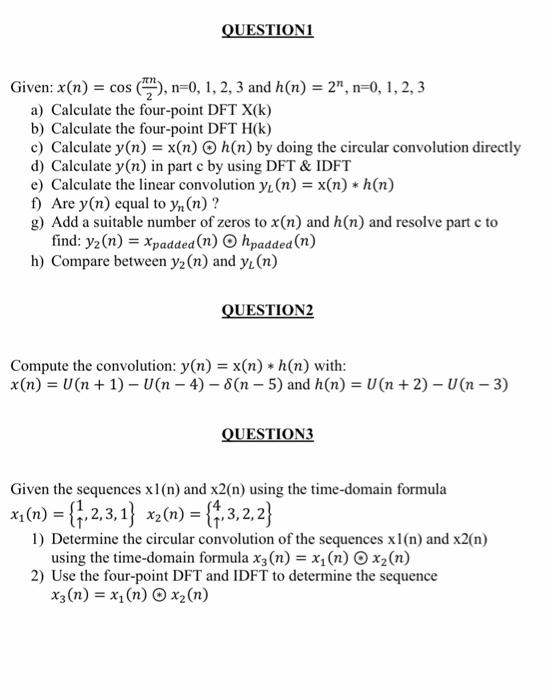
Question: Please solve the question and explain each step QUESTION1 Given: x(n) = cos), n=0, 1, 2, 3 and h(n) = 2, n=0, 1, 2, 3
 Please solve the question and explain each step
 QUESTION1 Given: x(n) = cos), n=0, 1, 2, 3 and h(n) = 2, n=0, 1, 2, 3 a) Calculate the four-point DFT X(k) b) Calculate the four-point DFT H(k) c) Calculate y(n) = x(n) h(n) by doing the circular convolution directly d) Calculate y(n) in part c by using DFT & IDFT e) Calculate the linear convolution y.(n) = x(n) *h(n) f) Are y(n) equal to yn(n)? g) Add a suitable number of zeros to x(n) and h(n) and resolve part c to find: yz(n) = Xpadded (n) O hpadded (n) h) Compare between yz(n) and y.(n) QUESTION2 Compute the convolution: y(n) = x(n) *h(n) with: x(n) = U(n + 1) U(n - 4) - 8(n-5) and h(n) = U(n + 2) - U(n 3) QUESTION3 Given the sequences xl(n) and x2(n) using the time-domain formula xi(n) = {1, 2, 3,1} x2(n) = {4,3,2,2} 1) Determine the circular convolution of the sequences xl(n) and x2(n) using the time-domain formula x3(n) = xy(n) Oxz(n) 2) Use the four-point DFT and IDFT to determine the sequence x3(n) = x1(n) x2(n)
Step by Step Solution
There are 3 Steps involved in it

Get step-by-step solutions from verified subject matter experts
 Study Help