Question: Strategic Management Frank Rothaermel,6eRelease: 6th Edition Please include a word count of your post (excluding citations and references), no matter whether it is an initial
Please include a word count of your post (excluding citations and references), no matter whether it is an initial post or a reply, at the end of your post. The initial post has to be at least 3 hundreds words.
Describe one way the company/organization where you work (or where you have worked) could benefit from content from Section 4.1 to Section 4.4 of the Textbook.
Also, describe one way the company/organization where you work (or where you have worked) could benefit from content from Section 4.5 of the Textbook.
For each way,clearly reference the specific contentfrom the Textbookthat supports your argument. Make sure you include the exactpage number and paragraph (from the beginning of that page) where the relevant information can be found. Note that althoughthe Textbookis digital, the page numbers are still visible on the right side. You will lose points if you do not provide page and paragraph informationfrom the Textbook.
WRITE A PARAGRAPH WITH 3 words. I USED TO WORK AT A RESTAURANT AS A SHIFT LEADER AND SERVER
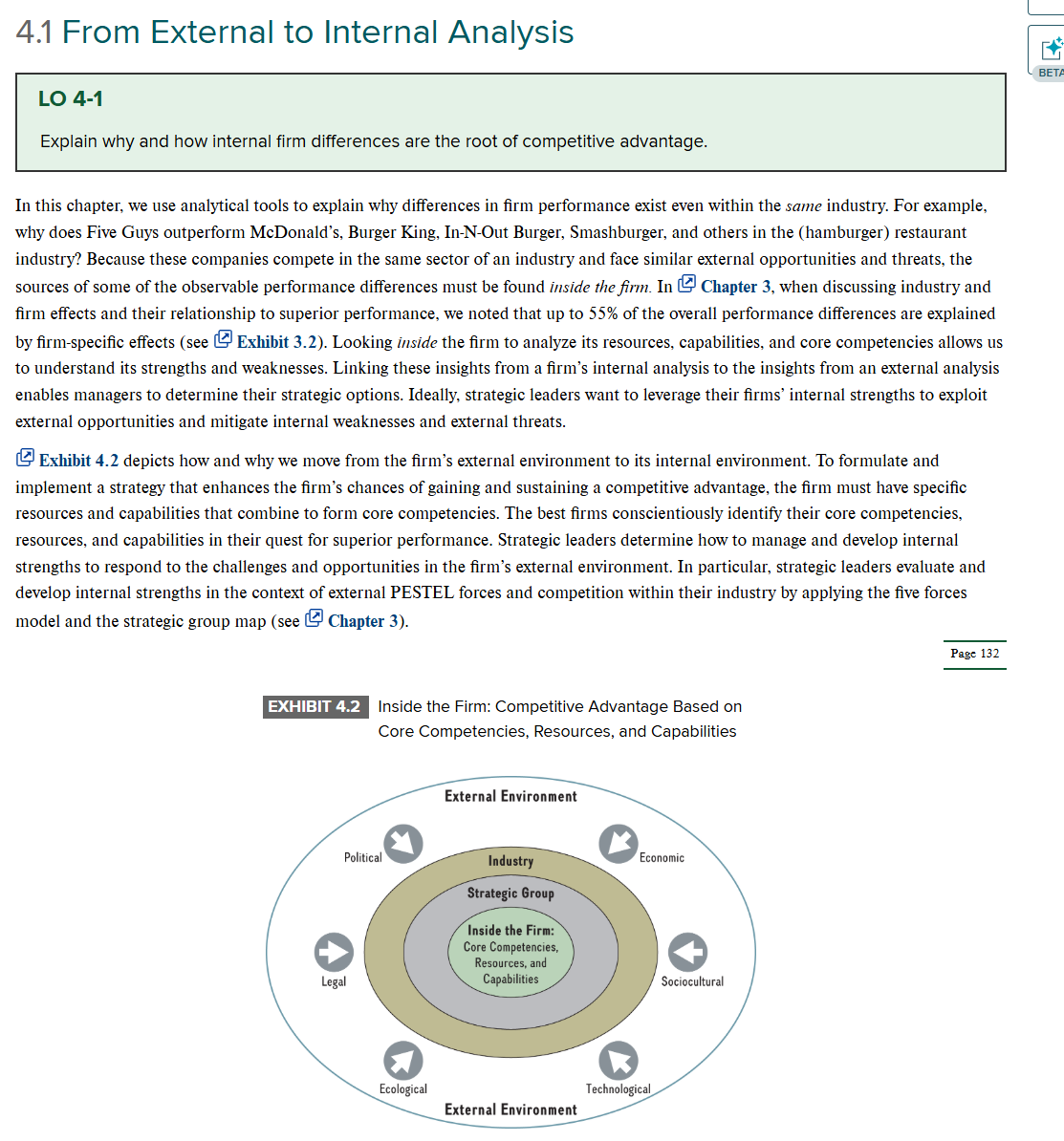
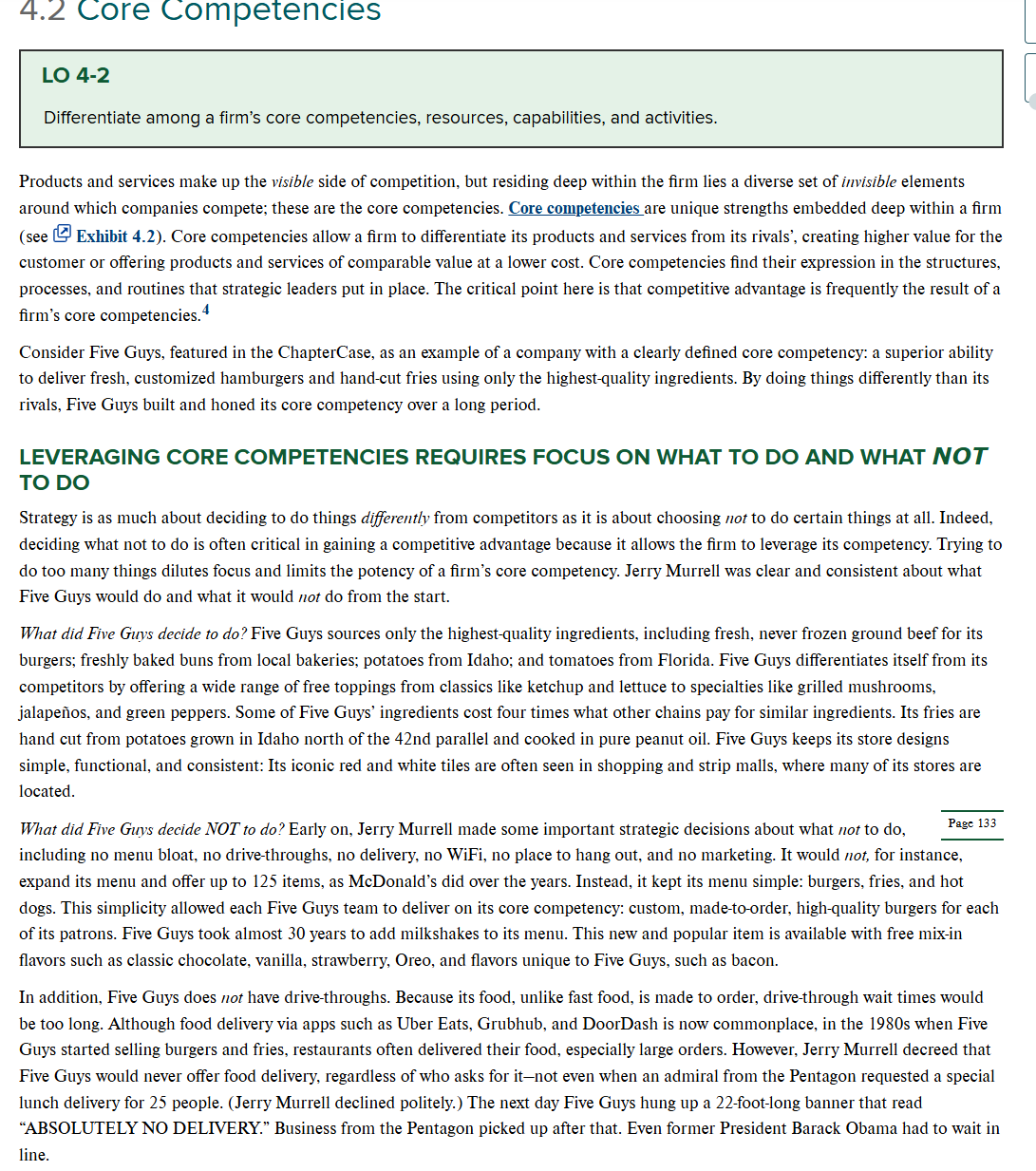
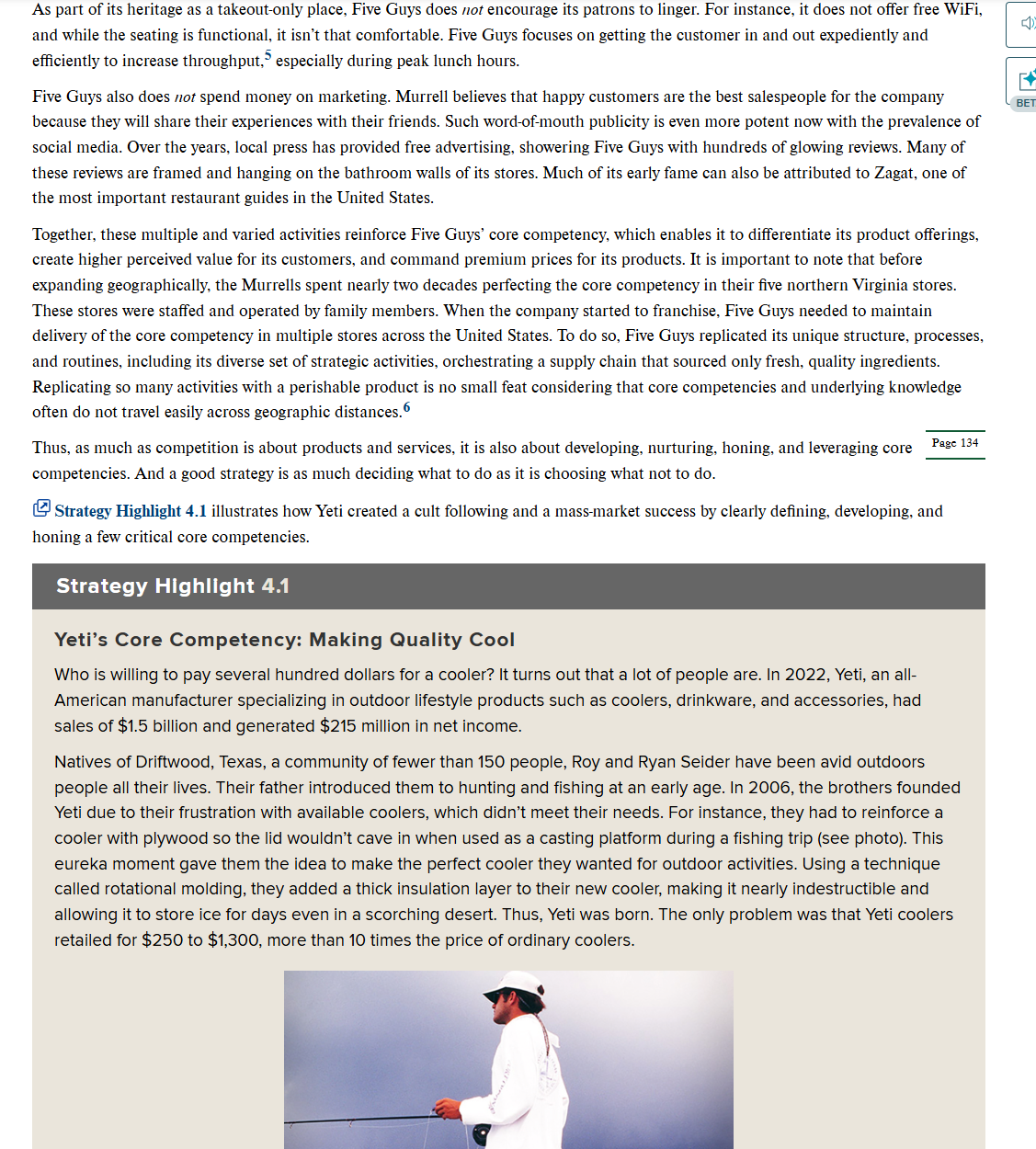
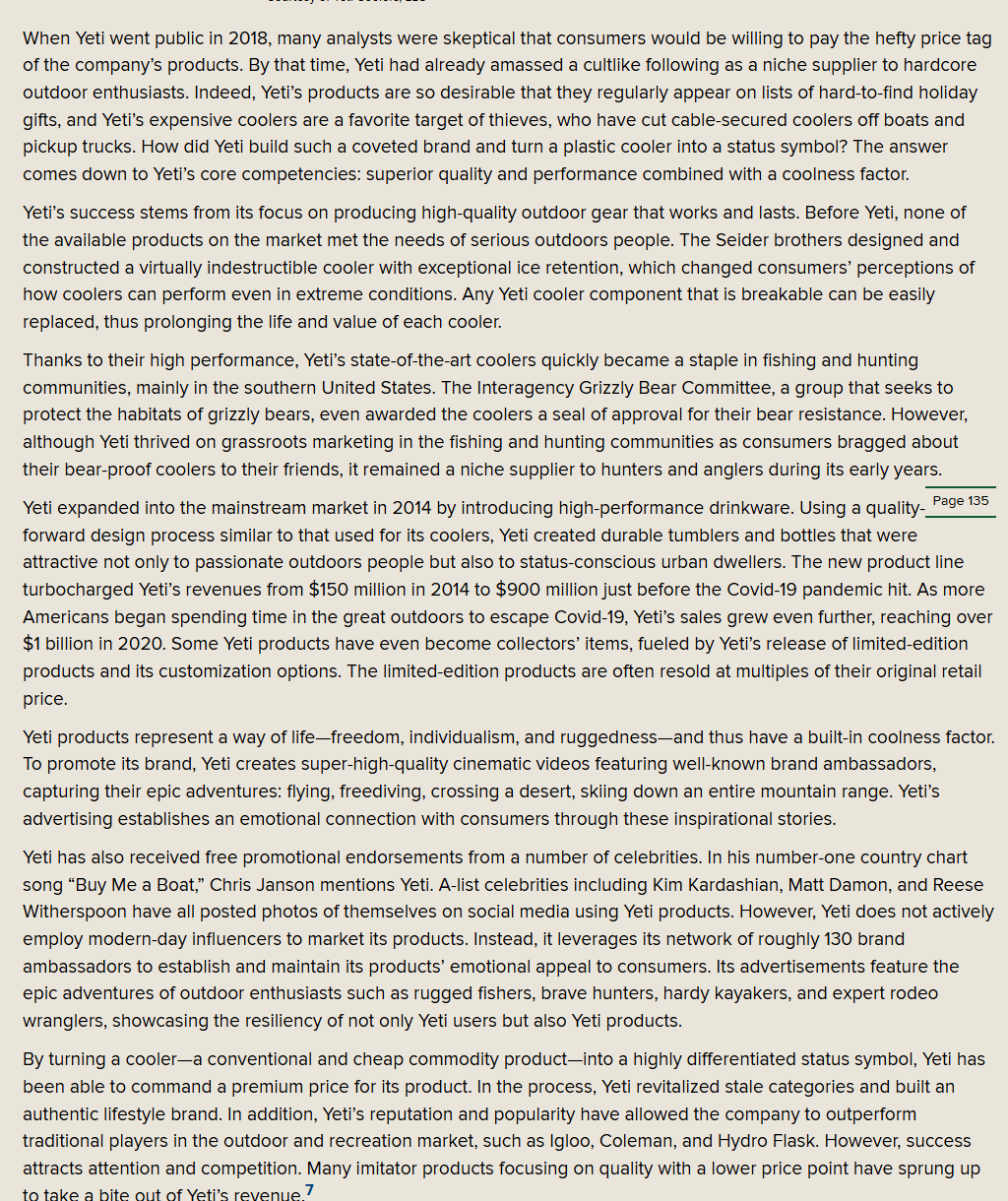
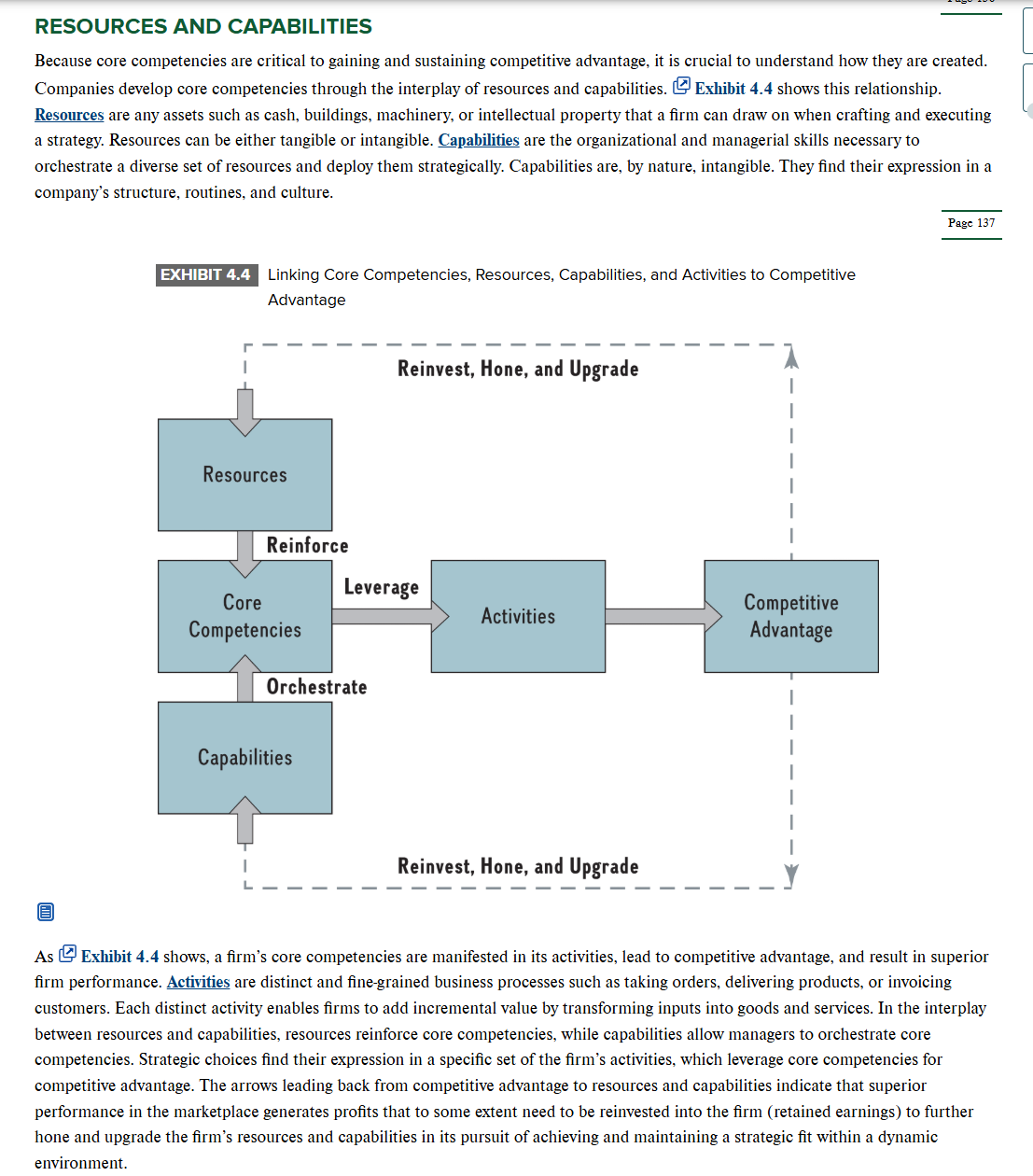
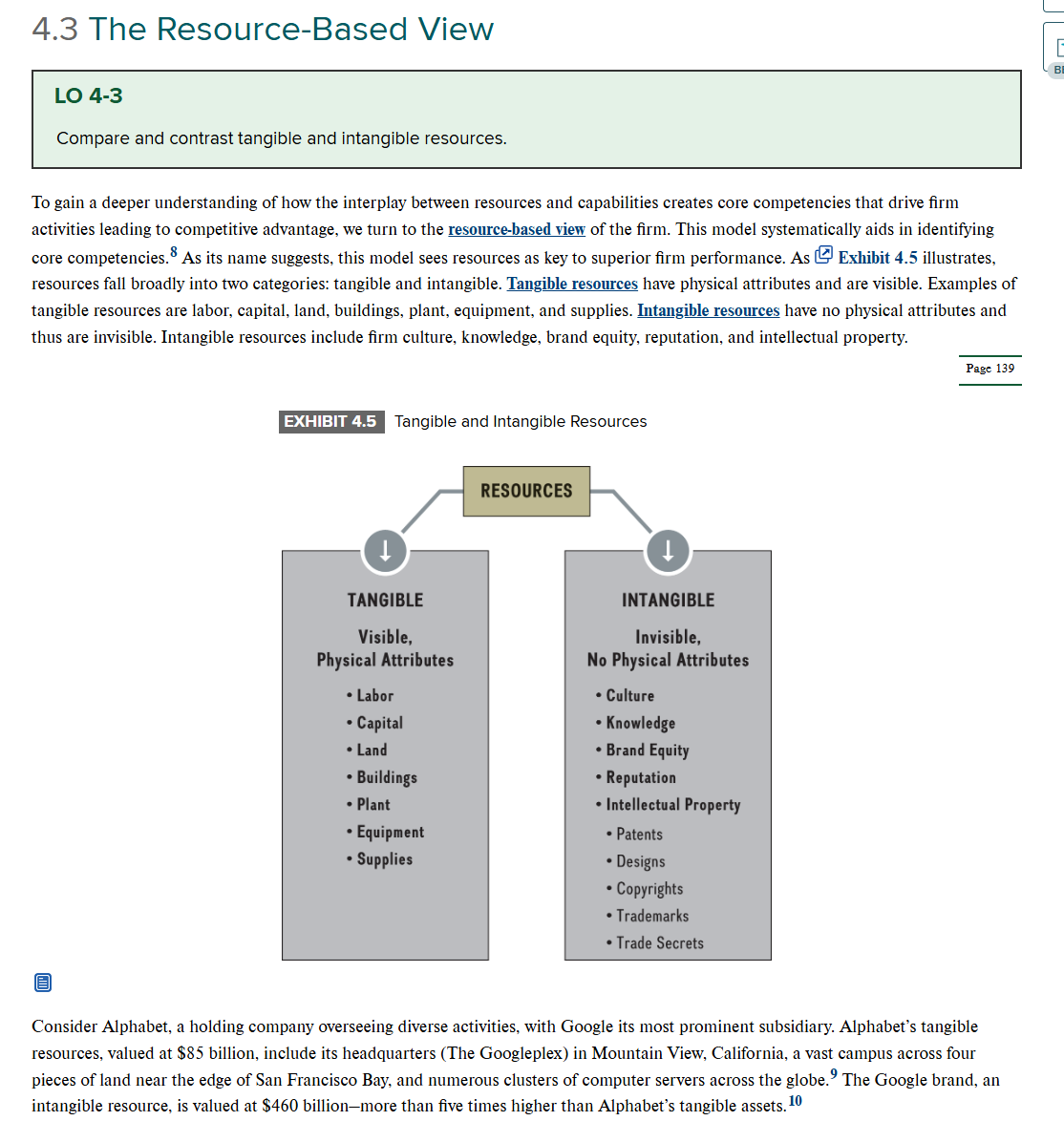
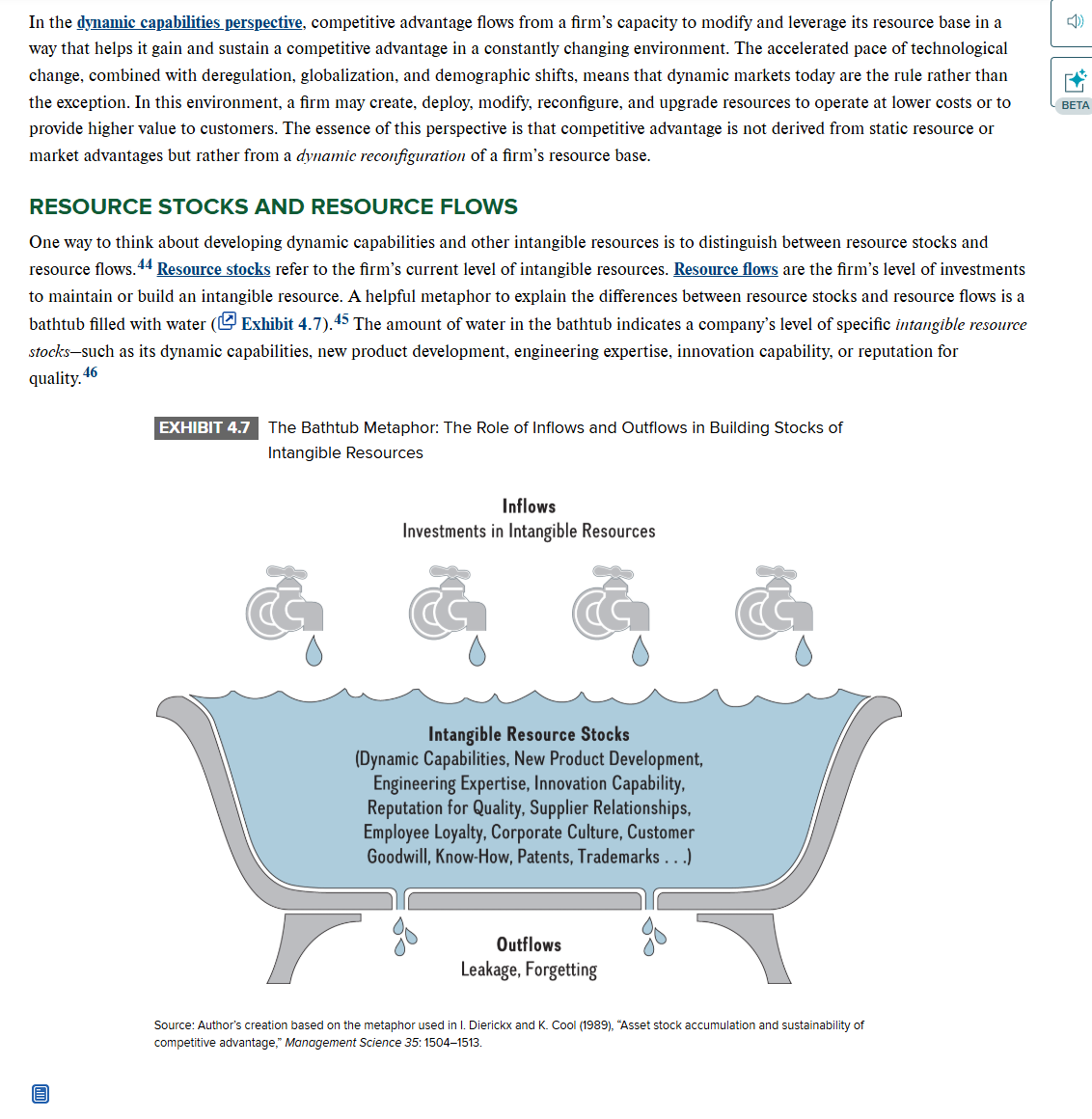
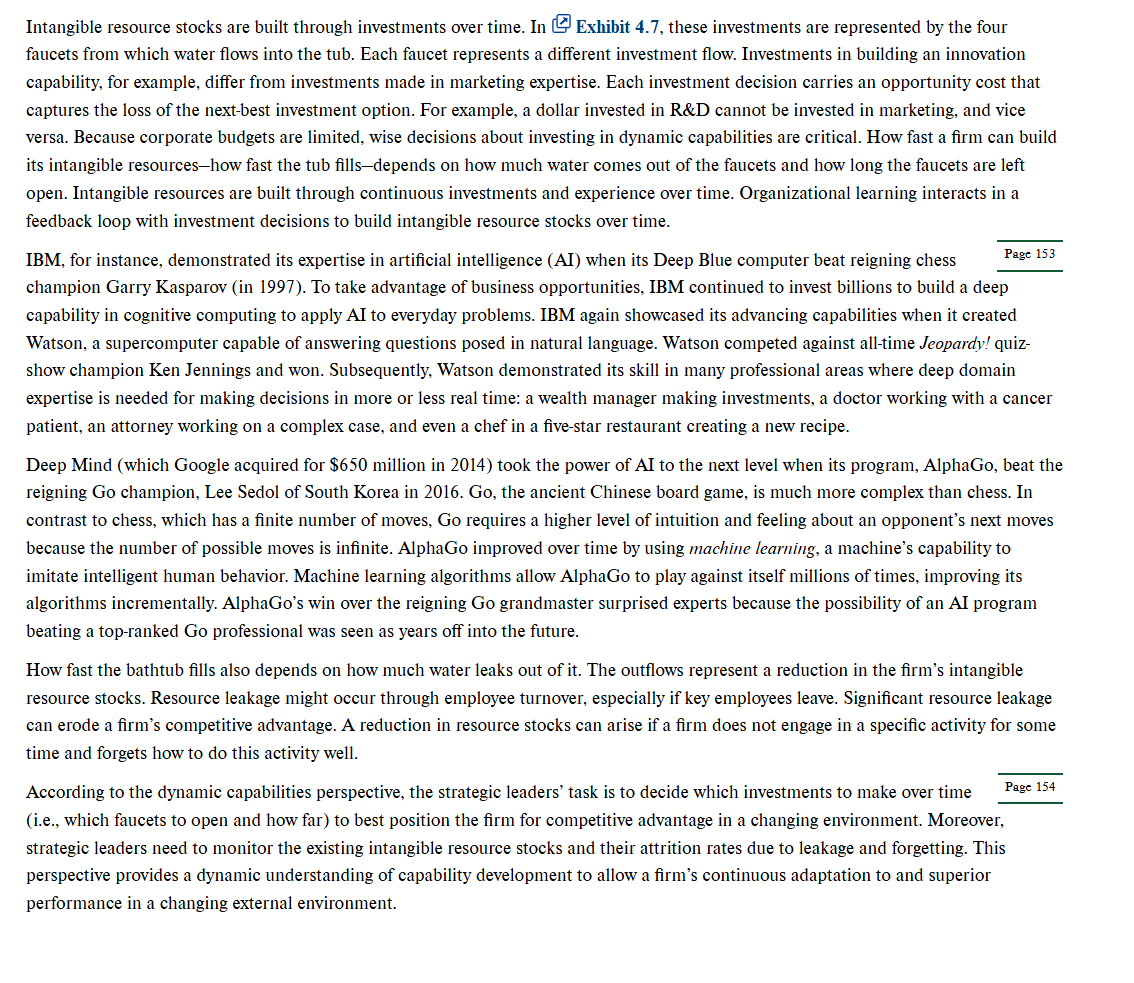
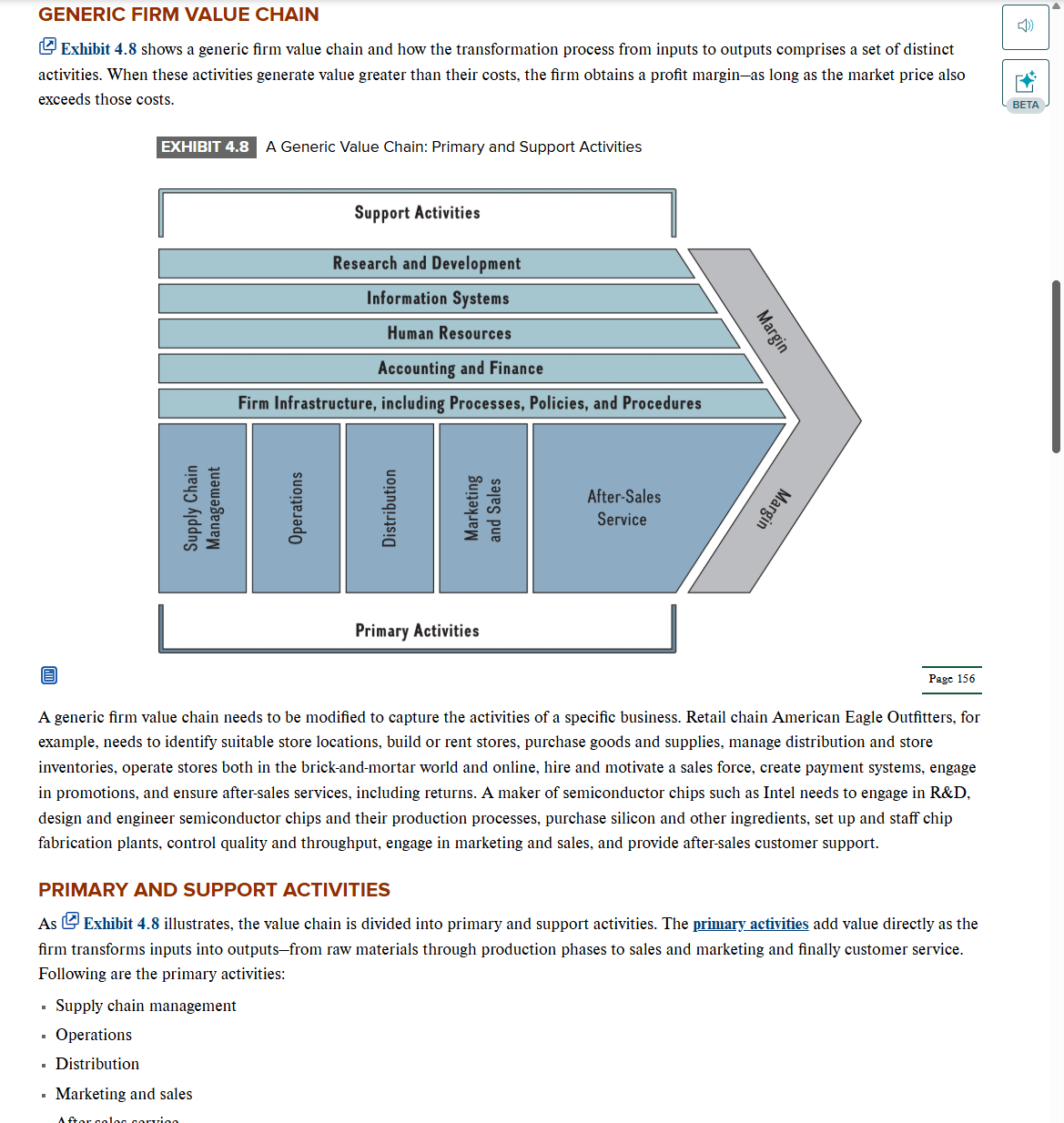
4.1 From External to Internal Analysis : LO 4-1 Explain why and how internal firm differences are the root of competitive advantage. In this chapter, we use analytical tools to explain why differences in firm performance exist even within the sare industry. For example, why does Five Guys outperform McDonald's, Burger King, In-N-Out Burger, Smashburger, and others in the (hamburger) restaurant industry? Because these companies compete in the same sector of an industry and face similar external opportunities and threats, the sources of some of the observable performance differences must be found inside the firm. In (S' Chapter 3, when discussing industry and firm effects and their relationship to superior performance, we noted that up to 55% of the overall performance differences are explained by firm-specific effects (see (S' Exhibit 3.2). Looking inside the firm to analyze its resources, capabilities, and core competencies allows us to understand its strengths and weaknesses. Linking these insights from a firm's internal analysis to the insights from an external analysis enables managers to determine their strategic options. Ideally, strategic leaders want to leverage their firms' internal strengths to exploit external opportunities and mitigate internal weaknesses and external threats. Exhibit 4.2 depicts how and why we move from the firm's external environment to its internal environment. To formulate and implement a strategy that enhances the firm's chances of gaining and sustaining a competitive advantage, the firm must have specific resources and capabilities that combine to form core competencies. The best firms conscientiously identify their core competencies, resources, and capabilities in their quest for superior performance. Strategic leaders determine how to manage and develop internal strengths to respond to the challenges and opportunities in the firm's external environment. In particular, strategic leaders evaluate and develop internal strengths in the context of external PESTEL forces and competition within their industry by applying the five forces model and the strategic group map (see (S' Chapter 3). Page 132 S(sl| sie 9) Inside the Firm: Competitive Advantage Based on Core Competencies, Resources, and Capabilities _- External Environment ~~ ZZ ~ : fo muses od / / \\ ha, N even \\ \\ Strategic Group \\ \\ } S | Sociocultural | / / 9 GO\" ~ Ecological Technological |- ~~ _External Environment Inside the Firm: Core Competencies, Resources, and Capabilities Legal \\ \\ 4.2 Core Competencies LO 4-2 Differentiate among a firm's core competencies, resources, capabilities, and activities. Products and services make up the visible side of competition, but residing deep within the firm lies a diverse set of invisible elements around which companies compete; these are the core competencies. Core competencies are unique strengths embedded deep within a firm (see (S' Exhibit 4.2). Core competencies allow a firm to differentiate its products and services from its rivals', creating higher value for the customer or offering products and services of comparable value at a lower cost. Core competencies find their expression in the structures, processes, and routines that strategic leaders put in place. The critical point here is that competitive advantage is frequently the result of a firm's core compete ncies.4 Consider Five Guys, featured in the ChapterCase, as an example of a company with a clearly defined core competency: a superior ability to deliver fresh, customized hamburgers and hand-cut fries using only the highest-quality ingredients. By doing things differently than its rivals, Five Guys built and honed its core competency over a long period. LEVERAGING CORE COMPETENCIES REQUIRES FOCUS ON WHAT TO DO AND WHAT NOT TO DO Strategy is as much about deciding to do things differently from competitors as it is about choosing nor to do certain things at all. Indeed, deciding what not to do is often critical in gaining a competitive advantage because it allows the firm to leverage its competency. Trying to do too many things dilutes focus and limits the potency of a firm's core competency. Jerry Murrell was clear and consistent about what Five Guys would do and what it would not do from the start. What did Five Guys decide to do? Five Guys sources only the highest-quality ingredients, including fresh, never frozen ground beef for its burgers; freshly baked buns from local bakeries; potatoes from Idaho; and tomatoes from Florida. Five Guys differentiates itself from its competitors by offering a wide range of free toppings from classics like ketchup and lettuce to specialties like grilled mushrooms, jalapefios, and green peppers. Some of Five Guys' ingredients cost four times what other chains pay for similar ingredients. Its fries are hand cut from potatoes grown in Idaho north of the 42nd parallel and cooked in pure peanut oil. Five Guys keeps its store designs simple, functional, and consistent: Its iconic red and white tiles are often seen in shopping and strip malls, where many of its stores are located. What did Five Guys decide NOT to do? Early on, Jerry Murrell made some important strategic decisions about what or to do, Page 133 including no menu bloat, no drive-throughs, no delivery, no WiFi, no place to hang out, and no marketing. It would vor, for instance, expand its menu and offer up to 125 items, as McDonald's did over the years. Instead, it kept its menu simple: burgers, fries, and hot dogs. This simplicity allowed each Five Guys team to deliver on its core competency: custom, made-to-order, high-quality burgers for each of its patrons. Five Guys took almost 30 years to add milkshakes to its menu. This new and popular item is available with free mix-in flavors such as classic chocolate, vanilla, strawberry, Oreo, and flavors unique to Five Guys, such as bacon. In addition, Five Guys does nor have drive-throughs. Because its food, unlike fast food, is made to order, drive-through wait times would be too long. Although food delivery via apps such as Uber Eats, Grubhub, and DoorDash is now commonplace, in the 1980s when Five Guys started selling burgers and fries, restaurants often delivered their food, especially large orders. However, Jerry Murrell decreed that Five Guys would never offer food delivery, regardless of who asks for itnot even when an admiral from the Pentagon requested a special lunch delivery for 25 people. (Jerry Murrell declined politely.) The next day Five Guys hung up a 2?-foot-long banner that read \"ABSOLUTELY NO DELIVERY.\" Business from the Pentagon picked up after that. Even former President Barack Obama had to wait in line. As part of its heritage as a takeout-only place, Five Guys does not encourage its patrons to linger. For instance, it does not offer free WiFi, and while the seating is functional, it isn't that comfortable. Five Guys focuses on getting the customer in and out expediently and efficiently to increase throughput? especially during peak lunch hours. Five Guys also does not spend money on marketing. Murrell believes that happy customers are the best salespeople for the company because they will share their experiences with their friends. Such word-of-mouth publicity is even more potent now with the prevalence of social media. Over the years, local press has provided free advertising, showering Five Guys with hundreds of glowing reviews. Many of these reviews are framed and hanging on the bathroom walls of its stores. Much of its early fame can also be attributed to Zagat, one of the most important restaurant guides in the United States. Together, these multiple and varied activities reinforce Five Guys' core competency, which enables it to differentiate its product offerings, create higher perceived value for its customers, and command premium prices for its products. It is important to note that before expanding geographically, the Murrells spent nearly two decades perfecting the core competency in their five northern Virginia stores. These stores were staffed and operated by family members. When the company started to franchise, Five Guys needed to maintain delivery of the core competency in multiple stores across the United States. To do so, Five Guys replicated its unique structure, processes, and routines, including its diverse set of strategic activities, orchestrating a supply chain that sourced only fresh, quality ingredients. Replicating so many activities with a perishable product is no small feat considering that core competencies and underlying knowledge often do not travel easily across geographic distances. Thus, as much as competition is about products and services, it is also about developing, nurturing, honing, and leveraging core Pee 134 competencies. And a good strategy is as much deciding what to do as it is choosing what not to do. Strategy Highlight 4.1 illustrates how Yeti created a cult following and a mass-market success by clearly defining, developing, and honing a few critical core competencies. Strategy Highlight 4.1 Yeti's Core Competency: Making Quality Cool Who is willing to pay several hundred dollars for a cooler? It turns out that a lot of people are. In 2022, Yeti, an all- American manufacturer specializing in outdoor lifestyle products such as coolers, drinkware, and accessories, had sales of $1.5 billion and generated $215 million in net income. Natives of Driftwood, Texas, a community of fewer than 150 people, Roy and Ryan Seider have been avid outdoors people all their lives. Their father introduced them to hunting and fishing at an early age. In 2006, the brothers founded Yeti due to their frustration with available coolers, which didn't meet their needs. For instance, they had to reinforce a cooler with plywood so the lid wouldn't cave in when used as a casting platform during a fishing trip (see photo). This eureka moment gave them the idea to make the perfect cooler they wanted for outdoor activities. Using a technique called rotational molding, they added a thick insulation layer to their new cooler, making it nearly indestructible and allowing it to store ice for days even in a scorching desert. Thus, Yeti was born. The only problem was that Yeti coolers retailed for $250 to $1,300, more than 10 times the price of ordinary coolers. aa neeeey 22 fe ones --- When Yeti went public in 2018, many analysts were skeptical that consumers would be willing to pay the hefty price tag of the company's products. By that time, Yeti had already amassed a cultlike following as a niche supplier to hardcore outdoor enthusiasts. Indeed, Yeti's products are so desirable that they regularly appear on lists of hard-to-find holiday gifts, and Yeti's expensive coolers are a favorite target of thieves, who have cut cable-secured coolers off boats and pickup trucks. How did Yeti build such a coveted brand and turn a plastic cooler into a status symbol? The answer comes down to Yeti's core competencies: superior quality and performance combined with a coolness factor. Yeti's success stems from its focus on producing high-quality outdoor gear that works and lasts. Before Yeti, none of the available products on the market met the needs of serious outdoors people. The Seider brothers designed and constructed a virtually indestructible cooler with exceptional ice retention, which changed consumers' perceptions of how coolers can perform even in extreme conditions. Any Yeti cooler component that is breakable can be easily replaced, thus prolonging the life and value of each cooler. Thanks to their high performance, Yeti's state-of-the-art coolers quickly became a staple in fishing and hunting communities, mainly in the southern United States. The Interagency Grizzly Bear Committee, a group that seeks to protect the habitats of grizzly bears, even awarded the coolers a seal of approval for their bear resistance. However, although Yeti thrived on grassroots marketing in the fishing and hunting communities as consumers bragged about their bear-proof coolers to their friends, it remained a niche supplier to hunters and anglers during its early years. Yeti expanded into the mainstream market in 2014 by introducing high-performance drinkware. Using a quality- Page 138 forward design process similar to that used for its coolers, Yeti created durable tumblers and bottles that were attractive not only to passionate outdoors people but also to status-conscious urban dwellers. The new product line turbocharged Yeti's revenues from $150 million in 2014 to $900 million just before the Covid-19 pandemic hit. As more Americans began spending time in the great outdoors to escape Covid-19, Yeti's sales grew even further, reaching over $1 billion in 2020. Some Yeti products have even become collectors' items, fueled by Yeti's release of limited-edition products and its customization options. The limited-edition products are often resold at multiples of their original retail price. Yeti products represent a way of lifefreedom, individualism, and ruggednessand thus have a built-in coolness factor. To promote its brand, Yeti creates super-high-quality cinematic videos featuring well-known brand ambassadors, capturing their epic adventures: flying, freediving, crossing a desert, skiing down an entire mountain range. Yeti's advertising establishes an emotional connection with consumers through these inspirational stories. Yeti has also received free promotional endorsements from a number of celebrities. In his number-one country chart song \"Buy Me a Boat,\" Chris Janson mentions Yeti. A-list celebrities including Kim Kardashian, Matt Damon, and Reese Witherspoon have all posted photos of themselves on social media using Yeti products. However, Yeti does not actively employ modern-day influencers to market its products. Instead, it leverages its network of roughly 130 brand ambassadors to establish and maintain its products' emotional appeal to consumers. Its advertisements feature the epic adventures of outdoor enthusiasts such as rugged fishers, brave hunters, hardy kayakers, and expert rodeo wranglers, showcasing the resiliency of not only Yeti users but also Yeti products. By turning a coolera conventional and cheap commodity productinto a highly differentiated status symbol, Yeti has been able to command a premium price for its product. In the process, Yeti revitalized stale categories and built an authentic lifestyle brand. In addition, Yeti's reputation and popularity have allowed the company to outperform traditional players in the outdoor and recreation market, such as Igloo, Coleman, and Hydro Flask. However, success attracts attention and competition. Many imitator products focusing on quality with a lower price point have sprung up to take a bite out of Yeti's revenue\" eee RESOURCES AND CAPABILITIES Because core competencies are critical to gaining and sustaining competitive advantage, it is crucial to understand how they are created. Companies develop core competencies through the interplay of resources and capabilities. Exhibit 4.4 shows this relationship. Resources are any assets such as cash, buildings, machinery, or intellectual property that a firm can draw on when crafting and executing a strategy. Resources can be either tangible or intangible. Capabilities are the organizational and managerial skills necessary to orchestrate a diverse set of resources and deploy them strategically. Capabilities are, by nature, intangible. They find their expression in a company's structure, routines, and culture. Page 137 See Linking Core Competencies, Resources, Capabilities, and Activities to Competitive Advantage As (& Exhibit 4.4 shows, a firm's core competencies are manifested in its activities, lead to competitive advantage, and result in superior firm performance. Activities are distinct and fine-grained business processes such as taking orders, delivering products, or invoicing customers. Each distinct activity enables firms to add incremental value by transforming inputs into goods and services. In the interplay between resources and capabilities, resources reinforce core competencies, while capabilities allow managers to orchestrate core competencies. Strategic choices find their expression in a specific set of the firm's activities, which leverage core competencies for competitive advantage. The arrows leading back from competitive advantage to resources and capabilities indicate that superior performance in the marketplace generates profits that to some extent need to be reinvested into the firm (retained earnings) to further hone and upgrade the firm's resources and capabilities in its pursuit of achieving and maintaining a strategic fit within a dynamic environment. . oy: Page 138 We should make two more observations about Exhibit 4.4 before we move on: ae 1. Core competencies that are not continuously nourished will lose their ability to yield a competitive advantage. 2. When analyzing a company's success in the market, it can be too easy to focus on the more risib/e manifestations of core competencies such as superior products or services. These are the outward demonstrations of core competencies, but It is even more important to understand the invisible part of core competencies. Core competencies that are not continuously nourished will lose their ability to yield a competitive advantage. As an example, consider the consumer electronics industry. For some years, Best Buy outperformed Circuit City based on its strengths in employee development, exclusive branding, and customer-centricity (segmenting customers based on demographic, attitudinal, and value tiers, and configuring stores to serve the needs of the customer segments in that region). Although Best Buy outperformed Circuit City (which filed for bankruptcy in 2009), more recently Best Buy has not honed and upgraded its core competencies sufficiently to compete effectively against Amazon, the world's largest online retailer. Amazon does not have the overhead expenses associated with maintaining buildings or a human sales force; therefore, it has a lower cost structure and thus can undercut in-store retailers on price. When a firm does not continually upgrade or improve core competencies, its competitors are more likely to develop equivalent or superior skills, as Amazon did. This insight allows us to explain differences between firms in the same industry and competitive dynamics over time. It also helps us identify the strategy that firms use to gain and sustain a competitive advantage and weather an adverse external environment. Companies need to look beyond the visible manifestations of core competencies such as superior products or services. In the (6' next section, we introduce tools to clarify the more opaque aspects of a firm's core competencies. We start by looking at both tangible resources and intangible resources. 4.3 The Resource-Based View a |i LO 4-3 Compare and contrast tangible and intangible resources. To gain a deeper understanding of how the interplay between resources and capabilities creates core competencies that drive firm activities leading to competitive advantage, we turn to the resource-based view of the firm. This model systematically aids in identifying core competencies. As its name suggests, this model sees resources as key to superior firm performance. As (S' Exhibit 4.5 illustrates, resources fall broadly into two categories: tangible and intangible. Tangible resources have physical attributes and are visible. Examples of tangible resources are labor, capital, land, buildings, plant, equipment, and supplies. Intangible resources have no physical attributes and thus are invisible. Intangible resources include firm culture, knowledge, brand equity, reputation, and intellectual property. Page 139 SS Tangible and Intangible Resources Consider Alphabet, a holding company overseeing diverse activities, with Google its most prominent subsidiary. Alphabet's tangible resources, valued at $85 billion, include its headquarters (The Googleplex) in Mountain View, California, a vast campus across four pieces of land near the edge of San Francisco Bay, and numerous clusters of computer servers across the globe.? The Google brand, an intangible resource, is valued at $460 billionmore than five times higher than Alphabet's tangible assets. 10 Alphabet's headquarters exemplifies both tangible and intangible resources. The Googleplex is composed of parcels of land containing futuristic buildings. Both the land and the buildings are tangible resources. However, the company's location in the heart of Silicon Valley is an intangible resource that provides the company with several benefits. Two benefits are (1) access to a valuable network of contacts, including a number of college graduates and a large and tech-savvy workforce, and (2) knowledge spillovers from numerous nearby universities. These intangible resources add to Google's technical and managerial capabilities, 1 Another benefit of being located in Silicon Valley is access to venture capital firms. Silicon Valley has the highest concentration of venture capital firms in the United States. Venture capitalists tend to prefer local investments because the more local they are, the more closely they can be monitored. The proximity of venture capitalists to the companies they fund provides mutual benefit./2 In fact, initial funding for Google came from the well-known venture capital firms Sequoia Capital and Kleiner Perkins, both located in Silicon Valley. Competitive advantage is more likely to spring from intangible resources than from tangible resources. Tangible assets, such as buildings or computer servers, can be bought on the open market by anyone who has the necessary cash. However, a brand name must be built, often over long periods. It took mainstay firms such as Apple, Microsoft, Visa, McDonald's, and MasterCardfive of the global Top 10 most valuable brandsmany years to build their value and earn brand recognition in the marketplace. Newer companies accomplished their enormous brand valuation more quickly, mainly because of their superior core competencies and global reach and scale. These companies include Google (founded in 1998 and part of Alphabet: brand value of over $460 billion), Amazon (founded in 1994: brand value of over $685 billion), Facebook (founded in 2004 and part of Meta; brand value of over $225 billion), and the Chinese technology companies Tencent (founded in 1998; brand value of $240 billion) and Alibaba (founded in 1999; brand value of some $200 billion).8 Page 140 LO 4-4 Evaluate the two critical assumptions about the nature of resources in the resource-based view. RESOURCE HETEROGENEITY AND RESOURCE IMMOBILITY In the resource-based view (RBV), a firm is a wnigue bundle of resources, capabilities, and competencies. The RBV defines resources broadly. According to the RBV, a resource is any asset, capability, or competency that a firm can draw upon when formulating and implementing strategy./4 The usefulness of the resource-based view to explain and predict competitive advantage rests on two critical assumptions about the nature of resources: 1. Resource heterogeneity 2. Resource immobility!5 RESOURCE HETEROGENEITY The first critical assumptionresource heterogeneitycomes from the insight that bundles of resources differ across firms. This insight requires us to look more critically at the resources of firms competing in the same industry or even the same strategic group because each bundle is unique to some extent. For example, Southwest Airlines (SWA) and Alaska Airlines (ASA) both compete in the same strategic group (low-cost, point-to-point airlines; see (S' Exhibit 3.8), but they draw on different resource bundles. SWA's employee productivity tends to be higher than ASA's because the two companies differ in their human and organizational resources. At SWA, job descriptions are informal, and employees pitch in to \"get the job done.\" Pilots may help load luggage to ensure an on-time departure; flight attendants clean airplanes to prepare them for on-time departure. Employees pitching in as needed allows SWA to keep its planes flying for longer and to lower its cost structure. SWA then passes these savings on to passengers in the form of lower ticket prices. RESOURCE IMMOBILITY The second critical assumptionresource immobilityrests on the insight that resources tend to be \"sticky\" and don't move easily from firm to firm. Because of that stickiness, the resource differences between firms are difficult to replicate and therefore can last a long time. For example, SWA has enjoyed a sustained competitive advantage, outperforming its competitors over several decades. That resource difference is not due to a lack of imitation attempts. Continental and Delta attempted to copy SWA with their Continental Lite and Song airline offerings. However, neither airline succeeded in imitating the resource bundles and firm capabilities that make SWA unique. Together, resource heterogeneity and resource immobility mean that resource bundles differ across firms, and such differences can persist for long periods. These two assumptions about resources are critical to explaining superior firm performance in the resource-based model. Note, by the way, that the critical assumptions of the resource-based model are fundamentally different from those describing a firm in the perfectly competitive industry structure introduced in (S' Chapter 3. In perfect competition, all firms have access to the same resources and capabilities, ensuring that one firm's advantage will be short-lived. When resources are freely available and mobile, competitors can quickly acquire the same resources that the current market leader utilizes. Although some commodity markets approach perfect competition, most other markets include firms whose resource endowments differ. Therefore, the resource-based view delivers useful insights about formulating a strategy that will enhance the firm's chances of gaining a competitive advantage. Page 141 THE VRIO FRAMEWORK LO 4-5 Apply the VRIO framework to assess the competitive implications of a firm's resources. In the resource-based view of the firm, specific resources attributes are essential to superior firm performance. ! For a resource to be the basis of competitive advantage, it must be: Valuable. Rare, and costly to Imitate. And, the firm itself must be Organized to capture the value of the resource. Following the lead of Jay Barney, one of the pioneers of the resource-based view of the firm, we call this model the VRIO framework. 1!' According to this model, a firm can gain and sustain a competitive advantage only when it has resources that satisfy all of the VRIO criteria. Remember that resources in the VRIO framework are broadly defined to include any assets, capabilities, and competencies that a firm can draw upon when formulating and implementing strategy. The presentation of the VRIO model summarizes our discussion thus far. Exhibit 4.6 captures the VRIO framework in action. You can use this decision tree to decide if the resource, capability, or competency under consideration fulfills the VRIO requirements. As you study the discussion of each VRIO attribute, you will notice that they need to accumulate to lead to sustainable competitive advantage. For the resource in question to be a core competency that underpins a firm's sustainable competitive advantage, you must be able to answer \"Yes\" to all four of the attributes listed in the decision tree. Sleek Applying the VRIO Framework to Reveal Competitive Advantage | SG as Applying the VRIO Framework to Reveal Competitive Advantage Is the Resource, Capability, or Competency... and Is the Firm... Competitive Disadvantage Sustainable Competitive Advantage Competitive Parity Temporary Competitive Advantage Temporary Competitive Advantage VALUABLE A valuable resource enables the firm to exploit an external opportunity or offset an external threat and positively affects the firm's competitive advantage. In particular, a valuable resource allows a firm to increase its economic value creation (V - C). Revenues rise if a firm can increase the perceived value (V) of its product or service in the eyes of consumers by offering superior design and adding attractive features (assuming costs are not increasing). Production costs (C) fall if the firm can put in place an efficient manufacturing process and tight supply chain management (assuming the perceived value is not decreasing). Five Guys' superior ability to deliver fresh, customized hamburgers and hand-cut fries using the highest-quality ingredients is Page 142 valuable because it enables the firm to command a premium price due to its perceived higher value creation. However, value creation on its own is not enough. Although Five Guys has succeeded in driving up the perceived value of its offerings, it also needs to control costs to ensure that this valuable resource can lay the foundation for a competitive advantage. RARE A resource is rare if only one or a few firms possess it. If the resource is common, the result is perfect competition in which no firm can maintain a competitive advantage (see the discussion in [S' Chapter 3). A valuable but not rare resource can lead to competitive parity at best. A firm is on the path to competitive advantage only if it possesses a valuable resource that is also rare. When founded in 1986, Five Guys' superior ability to deliver made-to-order hamburgers from the freshest ingredients and hand-cut fries made from the best potatoes was undoubtedly rare. So was its restaurant concept. Five Guys is neither a fast food place nor a traditional sit-down establishment. It offers a limited menu, no drive-through option, and a self-service formatand none of this has changed since the company's earliest days. Five Guys manages to charge premium prices that are much higher than those charged by its fast food competitors. Today, eateries like Five Guys are called fast-casual restaurants, a term that didn't enter the dining vernacular until the 2000s, despite well-known Five Guys competitors such as Chipotle Mexican Grill (founded in 1993) coming onto the scene earlier. To further underscore the idea that Five Guys was rare on multiple fronts, note that its more direct competitors and imitators in the [| \"better burger\" segmentShake Shack (founded in 2004), Smashburger (founded in 2007), and Burger Fi (founded in 2011 )}-were not launched until much later. The head start of almost 20 years gave Five Guys the ability to perfect its core competencies over a long period [+ of time before it decided to franchise (see (S' Exhibit 4.1). Five Guys enjoyed a first-mover advantage because it created the \"better burger\" segment. It locked in the best store locations and perhaps, more importantly, the best suppliers (e.g., Rick Miles of Rigby, Idaho, is Five Guys' sole supplier of potatoes). COSTLY TO IMITATE A resource is costly to imitate if firms that do not possess the resource cannot develop or buy the resource at a reasonable price. If the resource in question is valuable, rare, and costly to imitate, then it is an internal strength and a core competency. If the firm's competitors fail to duplicate the strategy based on the valuable, rare, and costly-to-imitate resource, then the firm can achieve a temporary competitive advantage. For more than 35 years, Five Guys has consistently delivered fresh, made-to-order premium burgers and fries. As a result, Five Guys enjoys a cultlike following among its customers, along with a 50% market share in the \"better burger\" segment. Five Guys spent almost 20 years refining, honing, upgrading, and perfecting its core competency before franchising nationally. Perfecting its core competencies enabled Five Guys to more easily duplicate its core competency in different geographic areas as it franchised throughout the United States and beyond. Although Five Guys' business model (\"make the best burger\") may seem simple, it is by no means simplistic. Coordinating a multilayered supply chain of a relatively large number of high-quality, fresh ingredients is a complex undertaking. For example, ensuring no food-borne illnesses requires strict adherence to established food-handling protocols and best practices in every one of its 1,700 stores. In addition, much of Five Guys' business was built around Jerry Murrell's gut feelingsomething that cannot be imitated. In fact, Murrell himself cannot explain the reasoning behind his many \"strategic hunches\" over the years.18 Unlike Five Guys, imitators such as Shake Shack, Smashburger, and Burger Fi franchised almost immediately after launching. Page 143 The Five Guys imitators rushed because of their relatively late entry into the market and their attempt to compete nationwide with Five Guys. In doing so, the imitators discovered that it is pretty costly to imitate Five Guys' core competency. Moreover, given that most of these chains franchised more or less immediately, they were unable to perfect their core competency before expanding. Together, the combination of the three resource attributes (V+ R + J) has allowed Five Guys to enjoy a competitive advantage (see (S' Exhibit 4.6). Direct Imitation A firm that enjoys a competitive advantage attracts significant attention from its competitors, which will attempt to negate a firm's resource advantage by directly imitating the resource in question (direct imitation) or by working around it to provide a comparable product or service (substitutior). We usually see direct imitation when firms have difficulty protecting their competitive advantage and a competitor wants to copy or imitate a valuable and rare resource. (We discuss barriers to imitation later.) Direct imitation can be swift and successful if intellectual property (IP) protection such as patents or trademarks can be easily circumvented. |: Tiffany & Co. has developed a core competency: elegant jewelry design and craftsmanship delivered through a superior customer experience. This experience Is valuable, rare, and costly for competitors to imitate. The company vigorously protects its trademarks, including its Tiffany Blue Box, but it never trademarked the so-called Tiffany setting for diamond rings. Many Jewelers now use this setting, and the term \"Tiffany setting\" has been co-opted for advertising by other retailers (including Costco), claiming it is a generic term commonly used in the jewelry industry. Lucas Oleniuk/Toronto Star/Getty Images Croes, the inventor of the iconic plastic clog, fell victim to direct imitation. Launched as spa shoes at the Fort Lauderdale, Florida, boat show, Crocs experienced explosive growth, selling millions of pairs each year. To protect its unique shoe design, the firm secured several patents. However, thanks to Crocs' explosive growth, numerous cheap imitators have sprung up to copy the colorful and comfortable plastic clog. Despite Crocs' patents and celebrity endorsements, other firms copied the shoe and bit strongly into Crocs' profits. This example illustrates that competitive advantage cannot be sustained if the underlying capability can easily be replicated and therefore directly imitated. Competitors created molds to mimic the original Crocs shoe's shape, look, and feel. Indeed, any competitive advantage in a fashion-driven industry will be short-lived if the company fails to continuously innovate or build strong brand recognition that prevents direct imitation. Although Crocs provides an interesting example in the business-to-consumer (B2C) space, the business-to-business (B2B) market is about 10 times larger, given that purchases consist of much more expensive items such as sophisticated and advanced equipment. The commercialization of the CAT scanner provides a classic example. Based on internal research, the British conglomerate EMI developed and launched the computed axial tomography (CAT) scanner. This technology, for which EMI received several patents, takes three- dimensional pictures of the human body and is considered the most important breakthrough in radiology since the discovery of X-rays. The invention of the CAT scanner also paved the way for follow-up innovations such as nuclear magnetic resonance imaging (MRI). Direct imitation through a workaround allowed a second mover, General Electric (GE), to mitigate the innovator's advantage and to gain and even sustain a competitive advantage.! Despite its initial success, EMI lost out quickly to GE. How can an innovator with a patent-protected technology lose out to a follower? GE was able to reverse-engineer EMI's CAT scanner to produce a model that worked around EMI's patents. Moreover, GE leveraged necessary complementary resources such as financing, manufacturing, distribution, marketing, and after-sales support. While EMI possessed a valuable and rare resource, it could not protect itself from GE's direct imitation. Five Guys' imitators in the \"better burger\" segment were all founded after Five Guys started to franchise in 2003, which gave Page 144 Five Guys almost a 20-year lead in perfecting its core competency. In addition, within 18 months of beginning to franchise, Five Guys sold out the U.S. territory, and its franchisees had locked down most of the best locations. Given the Five Guys competitors' entry into the marketplace, it is clear that they perceived the fast-casual burger segment as highly profitable, and they embarked on a direct imitation attempt. However, first-mover advantages in combination with perfected core competency made such direct imitation attempts more difficult, and Five Guys has been able to sustain its competitive advantage. Substitution The second avenue of imitation for a firm's valuable and rare resource is swdstitution. Imitation via substitution is often accomplished through strategie equivalence. Take the example of Jeff Bezos launching and developing Amazon.29 Before Amazon's inception, the retail book industry was dominated by a few large chains and many independent bookstores. As the internet was emerging in the 1990s, Bezos was looking for options in online retail. He zeroed in on books because of their non-differentiated commodity nature and ease of shipping. In purchasing a printed book online, customers knew exactly what they would be sent because the products were identical whether they were sold online or in a brick-and-mortar store. The only difference was the mode of transaction and delivery. Removing the worry that they would receive an inferior product made potential customers more likely to try this new way of shopping. The emergence of the internet allowed Bezos to develop a new distribution system that negated the need for retail stores and thus high real estate costs. Bezos' unique business model of ecommerce substituted for the traditional fragmented supply chain in book retailing and allowed Amazon to offer lower prices because of its lower operating costs. In other words, Amazon uses a strategic equivalent substitute to satisfy a customer need previously met by brick-and-mortar retail stores. Combining Imitation and Substitution In some instances, firms can combine direct imitation and substitution when attempting to mitigate a rival's competitive advantage. With its Galaxy line of smartphones, Samsung has successfully imitated the look and feel of Apple's iPhones. Samsung's Galaxy smartphones use Google's Android operating system and apps from Google Play Store as an alternative to Apple's iOS and App Store. Samsung's success in this space is based on a combination of direct imitation (look and feel) and swbstitution (using Google's mobile operating system and app store).24 Amazon started competing in the high-end grocery market by acquiring the brick-and-mortar Whole Foods (in 2017). As we will see in ChapterCase 8, Amazon's entry into high-end groceries involves both imitation and substitution. ORGANIZED TO CAPTURE VALUE The final criterion of whether a rare, valuable, and costly-to-imitate resource can form the basis of a sustainable competitive advantage depends on the firm's internal structure. To fully exploit the competitive potential of its resources, capabilities, and competencies, a firm must be organized to capture valuethat is, it must have in place an effective organizational structure and coordinating systems. We will study organizational design in detail in (S' Chapter 11. Before Apple or Microsoft had a significant share of the personal computer market, Xerox's Palo Alto Research Center (PARC) invented and developed an early word-processing application, the graphical user interface (GUI), the Ethernet, the mouse as a pointing device, and even the first personal computer. These technology breakthroughs laid the foundation of the personal computing industry.22 Xerox's invention competency built through a unique combination of resources and capabilities was valuable, rare, and costly to imitate with the potential to create a competitive advantage. However, due to a lack of organization, Xerox failed to appreciate and exploit PARC's many breakthroughs in computing Page 145 software and hardware. Why? The innovations did not fit within Xerox's business focus at the time. Under pressure in its core business from Japanese low-cost competitors, Xerox's top management was busy pursuing innovations in the photocopier business. Xerox did not organize to appreciate the competitive potential of the valuable, rare, and inimitable resources generated at PARC. Such organizational Eel problems were exacerbated by geography: Xerox headquarters is on the East Coast in Norwalk, Connecticut, across the country from PARC on the West Coast in Palo Alto, California.23 Nor did it help that development engineers at Xerox headquarters disdained the scientists engaging in basic research at PARC. In the meantime, both Apple and Microsoft developed operating systems, GUIs, and application software. Indeed, both Steve Jobs (co-founder of Apple) and Bill Gates (co-founder of Microsoft) took one look at Xerox's inventions during tours of the facility and immediately recognized the potential of PARC's inventions.24 And, as the adage goes, the rest is history. Suppose a firm is not effectively organized to exploit the competitive potential of a valuable, rare, and costly-to-imitate (VRI) resource. In that case, the best-case scenario is a temporary competitive advantage (see (S' Exhibit 4.6). In the case of Xerox, where the strategic leaders were not supportive of the resource, even a temporary competitive advantage would not have been realized even though the resource met the VRI requirements. In summary, for a firm to gain and sustain a competitive advantage, its resources and capabilities need to interact in such a way as to create unique core competencies (see (S' Exhibit 4.4). Ultimately, though, only a few competencies may turn out to be the specifie core competencies that fulfill the VRIO requirements.2> A company cannot do everything equally well and must carve out a unique strategic position for itself, making necessary trade-offs.26 Strategy Highlight 4.2 provides an application of the VRIO framework. Strategy Highlight 4.2 Applying VRIO: The Rise and Fall of Groupon After graduating with a degree in music from Northwestern University, Andrew Mason spent a couple of years as a web designer. In 2008, the then 27-year-old founded Groupon, a daily-deal website that connects local retailers and other merchants to consumers by offering goods and services at a discount. Groupon creates marketplaces by bringing the brick-and-mortar world of local commerce onto the internet. The company provides a \"group-coupon.\" If more than a predetermined number of Groupon users sign up for the offer, then the deal is extended to all Groupon users. For example, a local spa may offer a massage for $40 instead of the regular $80. If more than, say, 10 people sign up, the deal becomes a reality. The users prepay $40 for the coupon, which Groupen splits 50/50 with the local merchant. Inspired by how Amazon has become the global leader in ecommerce, Mason's strategic vision for Groupon was to be the global leader in local commerce. Groupon became one of the most successful internet startups, reaching over 260 million subscribers and serving more than 500,000 merchants in about 50 countries. Indeed, Groupon's success attracted a $6 billion buyout offer by Google in early 2011, which Mason declined. Then, in November 2011, Groupon held a successful initial public offering (IPO), valued at more than $16 billion with a share price over $26. But a year later, Groupon's share price had fallen 90% to just $2.63, resulting in a market cap of less than $1.8 billion. In early 2013, Mason posted a letter for Groupon employees on the web, arguing that it would leak anyway. He stated, \"After four and a half intense and wonderful years as CEO of Groupon, I've decided that I'd like to spend more time with my family. Just kidding! was fired today.\" Although Groupon is still in business, it is just one competitor among many and not a market leader. What went Page 146 wrong? The implosion of Groupon's market value can be explained using the VRIO framework. Groupon's competence in drumming up more business for local retailers by offering lower prices for its users was undoubtedly valuable. Before Groupon, local merchants used online and classified ads, direct mail, yellow pages, and other venues 4.4 The Dynamic Capabilities Perspective CORE RIGIDITIES A firm's external environment is rarely stable (as discussed in (S' Chapter 3). Indeed, in many industries the pace of change is ferocious. Firms that fail to adapt their core competencies to a changing external environment lose their competitive advantage and may go out of business. We've seen the relentless pace of change in consumer electronics retailing in the United States. Former market leader Circuit City's core competencies were efficient logistics and superior customer service, but the firm neglected to upgrade and hone them over time. Consequently, Best Buy and online retailer Amazon outflanked it, and it went bankrupt. Best Buy encountered the same difficulties competing against Amazon just a few years later. Core competencies might form the basis for a competitive advantage at one point, but as the environment changes the same core competencies may turn into core rigidities, hindering the firm's ability to change.4! A core competency can turn into a core rigidity if a firm relies too long on the competency without honing, refining, and upgrading it as the environment changes.?2 Over time, the original core competency is no longer a good fit with the external environment, and it turns from an asset into a liability. Reinvesting, honing, and upgrading resources and capabilities are crucial to sustaining any competitive advantage to prevent competencies from turning into core rigidities (see Exhibit 4.4). This ability to hone and upgrade lies at the heart of the dynamic capabilities perspective. We defined capabilities as the organizational and managerial skills necessary to orchestrate diverse resources and deploy them strategically. Capabilities are by nature intangible. They find their expression in a company's structure, routines, and culture. LO 4-7 Outline how dynamic capabilities can help a firm sustain a competitive advantage. Page 152 DYNAMIC CAPABILITIES Dynamic capabilities describe a firm's ability to create, deploy, modify, reconfigure, upgrade, and leverage its resources over time in its quest for competitive advantage. 43 For a firm to maintain its competitive edge, the fit between its internal strengths and the external environment must be dynamic. Rather than focusing on a static fit at one point in time, a firm must change its internal resource base as the external environment changes. Its goal should be to develop resources, capabilities, and competencies that create a strategic fit with the firm's ever-changing environment. Dynamic capabilities are essential for moving beyond a short-lived advantage and creating sustained competitive advantage. In addition to allowing firms to adapt to changing market conditions, dynamic capabilities enable firms to create market changes that can strengthen their strategic position. The market changes implemented by proactive firms introduce altered circumstances that can have a major effect on more reactive rivals. For example, Apple's dynamic capabilities allowed it to redefine the markets for mobile devices, computing, music, smartphones, and media content. Through its iPod and App Store, Apple generated environmental change in the music market to which Sony and others had to respond. With its iPhone, Apple redefined the smartphone market, creating environmental change that forced a response by competitors such as Samsung, BlackBerry, and Nokia. Apple's introduction of the iPad redefined the media and tablet computing market, forcing action by Amazon and Microsoft. The Apple Watch is shaping the market for computer wearables. Dynamic capabilities are especially important for surviving and competing in markets that shift quickly and constantly, such as the high-tech space in which Amazon, Apple, Alphabet, and Microsoft compete. In the dynamic capabilities perspective, competitive advantage flows from a firm's capacity to modify and leverage its resource base in a way that helps it gain and sustain a competitive advantage in a constantly changing environment. The accelerated pace of technological change, combined with deregulation, globalization, and demographic shifts, means that dynamic markets today are the rule rather than the exception. In this environment, a firm may create, deploy, modify, reconfigure, and upgrade resources to operate at lower costs or to provide higher value to customers. The essence of this perspective is that competitive advantage is not derived from static resource or market advantages but rather from a dynamic reconfiguration of a firm's resource base. RESOURCE STOCKS AND RESOURCE FLOWS One way to think about developing dynamic capabilities and other intangible resources is to distinguish between resource stocks and resource flows.44 Resource stocks refer to the firm's current level of intangible resources. Resource flows are the firm's level of investments to maintain or build an intangible resource. A helpful metaphor to explain the differences between resource stocks and resource flows is a bathtub filled with water (@ Exhibit 4.7).45 The amount of water in the bathtub indicates a company's level of specific intangible resource stockssuch as its dynamic capabilities, new product development, engineering expertise, innovation capability, or reputation for quality.4 =n i:ite- a) The Bathtub Metaphor: The Role of Inflows and Outflows in Building Stocks of Intangible Resources Inflows Investments in Intangible Resources Intangible Resource Stocks (Dynamic Capabilities, New Product Development, Engineering Expertise, Innovation Capability, Reputation for Quality, Supplier Relationships, Employee Loyalty, Corporate Culture, Customer Goodwill, Know-How, Patents, Trademarks . . .) 0 O ge Outflows Qe Leakage, Forgetting Source: Author's creation based on the metaphor used in |. Dierickx and K. Cool (1989), \"Asset stock accumulation and sustainability of competitive advantage,\" Management Science 35: 1504-1513. (+ BETA Intangible resource stocks are built through investments over time. In Exhibit 4.7, these investments are represented by the four faucets from which water flows into the tub. Each faucet represents a different investment flow. Investments in building an innovation capability, for example, differ from investments made in marketing expertise. Each investment decision carries an opportunity cost that captures the loss of the next-best investment option. For example, a dollar invested in R&D cannot be invested in marketing, and vice versa. Because corporate budgets are limited, wise decisions about investing in dynamic capabilities are critical. How fast a firm can build its intangible resourceshow fast the tub fills-depends on how much water comes out of the faucets and how long the faucets are left open. Intangible resources are built through continuous investments and experience over time. Organizational learning interacts in a feedback loop with investment decisions to build intangible resource stocks over time. IBM, for instance, demonstrated its expertise in artificial intelligence (AI) when its Deep Blue computer beat reigning chess Page 153 champion Garry Kasparov (in 1997). To take advantage of business opportunities, IBM continued to invest billions to build a deep capability in cognitive computing to apply AI to everyday problems. IBM again showcased its advancing capabilities when it created Watson, a supercomputer capable of answering questions posed in natural language. Watson competed against all-time Jeopardy! quiz- show champion Ken Jennings and won. Subsequently, Watson demonstrated its skill in many professional areas where deep domain expertise is needed for making decisions in more or less real time: a wealth manager making investments, a doctor working with a cancer patient, an attorney working on a complex case, and even a chef in a five-star restaurant creating a new recipe. Deep Mind (which Google acquired for $650 million in 2014) took the power of AI to the next level when its program, AlphaGo, beat the reigning Go champion, Lee Sedol of South Korea in 2016. Go, the ancient Chinese board game, is much more complex than chess. In contrast to chess, which has a finite number of moves, Go requires a higher level of intuition and feeling about an opponent's next moves because the number of possible moves is infinite. AlphaGo improved over time by using machine learning, a machine's capability to imitate intelligent human behavior. Machine learning algorithms allow AlphaGo to play against itself millions of times, improving its algorithms incrementally. AlphaGo's win over the reigning Go grandmaster surprised experts because the possibility of an AI program beating a top-ranked Go professional was seen as years off into the future. How fast the bathtub fills also depends on how much water leaks out of it. The outflows represent a reduction in the firm's intangible resource stocks. Resource leakage might occur through employee turnover, especially if key employees leave. Significant resource leakage can erode a firm's competitive advantage. A reduction in resource stocks can arise if a firm does not engage in a specific activity for some time and forgets how to do this activity well. According to the dynamic capabilities perspective, the strategic leaders' task is to decide which investments to make over time Page 154 (Le., which faucets to open and how far) to best position the firm for competitive advantage in a changing environment. Moreover, strategic leaders need to monitor the existing intangible resource stocks and their attrition rates due to leakage and forgetting. This perspective provides a dynamic understanding of capability development to allow a firm's continuous adaptation to and superior performance in a changing external environment. 4.5 The Firm Value Chain and Strategic Activity Systems LO 4-8 Apply a value chain analysis to understand which of the firm's activities in transforming inputs into outputs generate differentiation and which drive costs. FIRM VALUE CHAIN There are two types of value chains. Jndustry value chains are vertical value chains because they depict the transformation of raw materials into finished goods and services along distinct stages in a specific industry. Each stage of the vertical value chain typically represents a distinct fadustry in which a number of different firms are competing. Firm value chains are horizontal value chains depicting the areas in which a firm is active, ranging from basic research to after-sales support and customer service. Horizontal firm value chains intersect with industry value chains in each stage of transforming raw materials into finished goods and services. For instance, Intel, one of the leading semiconductor chip manufacturers globally, sources raw materials such as silicon, copper, aluminum, and various plastics from different suppliers. Intel's suppliers are active in different industries, including mining, smelting, and petroleum. Intel's firm value chain begins with research and development in designing cutting-edge semiconductors, which it manufactures in its fabs.47 Intel sells its chips to computer manufacturers such as Dell, HP, and Microsoft, and carmakers such as GM and Ford. In this chapter, we focus on the horizontal firm value chains. We discuss vertical industry value chains in Chapter 8 when studying corporate strategy. A firm's value chain describes its internal activities when transforming inputs into outputs.48 Each action the firm performs along the horizontal chain adds incremental value as raw materials and other inputs are transformed into components that are assembled into finished products or services for the end consumer. Each activity the firm performs along the jorizonta/ value chain also adds incremental costs. A careful analysis of the value chain allows strategic leaders to obtain a more detailed and fine-grained understanding of how the firm's economic value creation (V C) breaks down into distinct activities that help determine the perceived value (V) and the costs (C) to create it. The value chain concept can be applied to any firmmanufacturing, high-tech, or service. DISTINCT ACTIVITIES A firm's core competencies are deployed through its activities (see (S' Exhibit 4.4). Therefore, a firm's activities are one of the vital internal drivers of performance differences across firms. Activities are distinct actions that enable firms to add incremental value at each step in the value chain by transforming inputs into goods and services. Managing a supply chain, running the computer system, and providing customer support are examples of specific firm activities. Activities are narrower than functional areas such as marketing because each functional area comprises a set of distinct activities. Page 155 Five Guys' Activities Five Guys' core competency is offering a simple menu of fresh, high-quality burgers and fries and a great customer experience. To command a premium price for these products and service, Five Guys needs to engage in a number of distinct activities. Though it may seem simple, the ability to implement diverse sets of distinct activities every day across multiple geographic locations is no small feat. The activities begin with sourcing ingredients. From the start, the Murrell sons have always selected only the best ingredients without knowing their cost. They viewed cost as distracting them from identifying and choosing only the freshest, tastiest, highest-quality toppings and condiments. For example, the mayonnaise they selected after a blind taste test turned out to be the most expensive brand on the market. A notoriously tricky vendor sold it, but they stuck with him because he offered the best mayonnaise. In addition, sourcing locally is also important to the Five Guys brand. The 15 free toppings that Five Guys offers are locally sourced whenever possible. Likewise, the fresh-baked buns are local as well, in that they come from bakeries that Five Guys built near their stores to guarantee their freshness. In most chain restaurants, fries are a simple side dish. At Five Guys, though, fries are a specialty made with great care. According to founder Jerry Murrell, fries might look like the easiest item to make, but they are actually the hardest. Unlike other fast food chains that dump dehydrated frozen fries into hot oil, Five Guys hand-cuts Idaho potatoes that are grown north of the 42nd parallel and then soaks them in water to rinse off the starch. Soaking prevents the potatoes from absorbing the pure peanut oil as they are cooked, which gives them their unique Five Guys texture and taste. Obsessing about every detail does not end at the supply chain. The Murrell family also obsesses over the layout of each store, particularly the cooking area. Unlike other hamburger chains, which use the same grill for their meat and buns, Five Guys uses a dedicated grill for its burgers and a separate toaster for its buns. Although this approach requires additional equipment and thus increases cost and operational complexity, it allows for perfectly grilled burgers and perfectly toasted buns. All these activities contribute to Five Guys' higher perceived value among customers, allowing the firm to charge premium prices for its offerings us
Step by Step Solution
There are 3 Steps involved in it
1 Expert Approved Answer
Step: 1 Unlock
Question Has Been Solved by an Expert!
Get step-by-step solutions from verified subject matter experts
Step: 2 Unlock
Step: 3 Unlock
Students Have Also Explored These Related General Management Questions!









 Study Help