







Question: Please solve the second problem only using scheme programming. A sequence is a list of numbers that are calculated based on a certain rule. For
Please solve the second problem only using scheme programming.
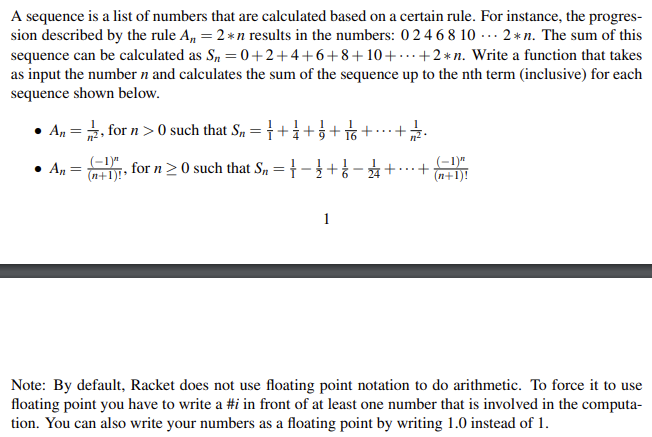
A sequence is a list of numbers that are calculated based on a certain rule. For instance, the progres- sion described by the rule A, = 2*n results in the numbers: 0 2 4 6 8 10 ... 2*n. The sum of this sequence can be calculated as Sn=0+2+4+6+8+10+ ... +2*n. Write a function that takes as input the number n and calculates the sum of the sequence up to the nth term (inclusive) for each sequence shown below. An= }, for n >0 such that Sn=1+4+5+To+ + An (-1)", for n> 0 such that Sn=1-1+5-3+ (+1! (-1)" (n+1)! 1 Note: By default, Racket does not use floating point notation to do arithmetic. To force it to use floating point you have to write a #i in front of at least one number that is involved in the computa- tion. You can also write your numbers as a floating point by writing 1.0 instead of 1. A sequence is a list of numbers that are calculated based on a certain rule. For instance, the progres- sion described by the rule A, = 2*n results in the numbers: 0 2 4 6 8 10 ... 2*n. The sum of this sequence can be calculated as Sn=0+2+4+6+8+10+ ... +2*n. Write a function that takes as input the number n and calculates the sum of the sequence up to the nth term (inclusive) for each sequence shown below. An= }, for n >0 such that Sn=1+4+5+To+ + An (-1)", for n> 0 such that Sn=1-1+5-3+ (+1! (-1)" (n+1)! 1 Note: By default, Racket does not use floating point notation to do arithmetic. To force it to use floating point you have to write a #i in front of at least one number that is involved in the computa- tion. You can also write your numbers as a floating point by writing 1.0 instead of 1
Step by Step Solution
There are 3 Steps involved in it

Get step-by-step solutions from verified subject matter experts
 Study Help