



Question: please solve the three questions at the end. must be less the 800 words and more than 500 words. the link of the vides https://www.youtube.com/watch?v=lmoI-PRMtsk
please solve the three questions at the end. 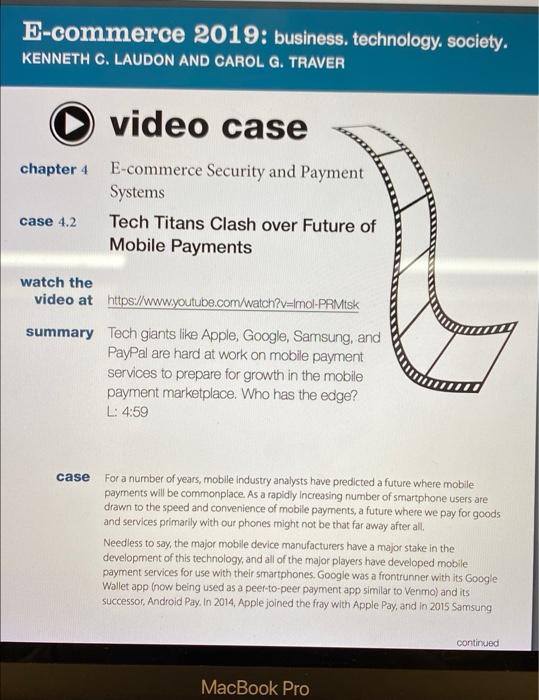
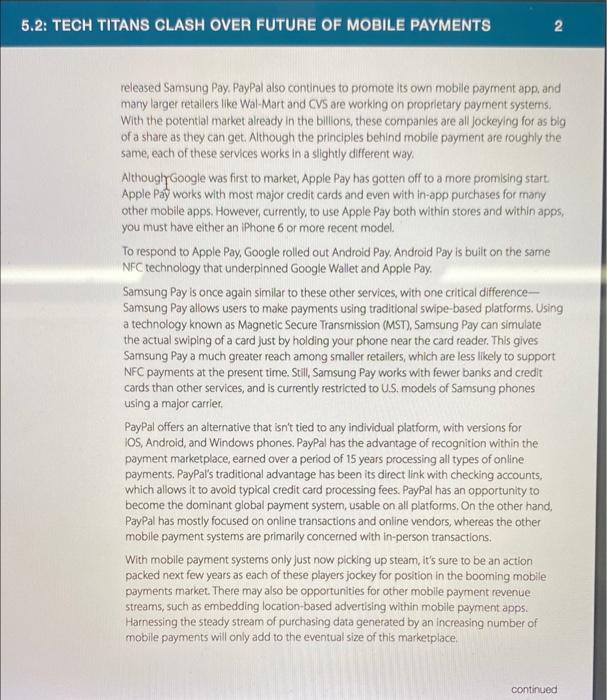
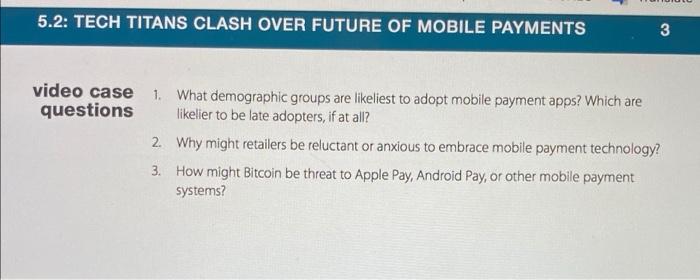
E-commerce 2019: business. technology. society. KENNETH C. LAUDON AND CAROL G. TRAVER video case chapter 4 E-commerce Security and Payment Systems case 4.2 Tech Titans Clash over Future of Mobile Payments watch the video at https://www.youtube.com/watch?v=Imol-PRMtsk summary Tech giants like Apple, Google, Samsung, and PayPal are hard at work on mobile payment services to prepare for growth in the mobile payment marketplace. Who has the edge? L: 4:59 case For a number of years, mobile Industry analysts have predicted a future where mobile payments will be commonplace. As a rapidly increasing number of smartphone users are drawn to the speed and convenience of mobile payments , a future where we pay for goods and services primarily with our phones might not be that far away after all, Needless to say, the major mobile device manufacturers have a major stake in the development of this technology, and all of the major players have developed mobile payment services for use with their smartphones, Google was a frontrunner with its Google Wallet app (now being used as a peer-to-peer payment app similar to Venmo) and its successor, Android Pay. In 2014, Apple joined the fray with Apple Pay, and in 2015 Samsung continued MacBook Pro 5.2: TECH TITANS CLASH OVER FUTURE OF MOBILE PAYMENTS 2 released Samsung Pay. PayPal also continues to promote its own mobile payment app, and many larger retailers like Wal-Mart and CVS are working on proprietary payment systerns. With the potential market already in the billions, these companies are all Jockeying for as big of a share as they can get. Although the principles behind mobile payment are roughly the same each of these services works in a slightly different way, Althougly Google was first to market, Apple Pay has gotten off to a more promising start Apple Pay works with most major credit cards and even with in-app purchases for many other mobile apps. However, currently, to use Apple Pay both within stores and within apps, you must have either an iPhone 6 or more recent model To respond to Apple Pay, Google rolled out Android Pay, Android Pay is built on the same NFC technology that underpinned Google Wallet and Apple Pay. Samsung Pay is once again similar to these other services, with one critical difference- Samsung Pay allows users to make payments using traditional swipe-based platforms. Using a technology known as Magnetic Secure Transmission (MST), Samsung Pay can simulate the actual swiping of a card just by holding your phone near the card reader. This gives Samsung Pay a much greater reach among smaller retailers, which are less likely to support NFC payments at the present time. Still, Samsung Pay works with fewer banks and credit cards than other services, and is currently restricted to U.S. models of Samsung phones using a major carrier PayPal offers an alternative that isn't tied to any individual platform, with versions for IOS, Android, and Windows phones. PayPal has the advantage of recognition within the payment marketplace, earned over a period of 15 years processing all types of online payments. PayPal's traditional advantage has been its direct link with checking accounts, which allows it to avoid typical credit card processing fees. PayPal has an opportunity to become the dominant global payment system, usable on all platforms. On the other hand, Paypal has mostly focused on online transactions and online vendors, whereas the other mobile payment systems are primarily concerned with in-person transactions. With mobile payment systems only just now picking up steam, It's sure to be an action packed next few years as each of these players jockey for position in the booming mobile payments market. There may also be opportunities for other mobile payment revenue streams, such as embedding location-based advertising within mobile payment apps. Harnessing the steady stream of purchasing data generated by an increasing number of mobile payments will only add to the eventual size of this marketplace. continued 5.2: TECH TITANS CLASH OVER FUTURE OF MOBILE PAYMENTS 3 3 video case 1. What demographic groups are likeliest to adopt mobile payment apps? Which are questions likelier to be late adopters, if at all? 2. Why might retailers be reluctant or anxious to embrace mobile payment technology? 3. How might Bitcoin be threat to Apple Pay, Android Pay, or other mobile payment systems
must be less the 800 words and more than 500 words.
the link of the vides
https://www.youtube.com/watch?v=lmoI-PRMtsk
Step by Step Solution
There are 3 Steps involved in it
1 Expert Approved Answer
Step: 1 Unlock

Question Has Been Solved by an Expert!
Get step-by-step solutions from verified subject matter experts
Step: 2 Unlock
Step: 3 Unlock