Question: please solve , this is the only provided data from the teacher everytime i post you will tell there is no enough information , but
please solve , this is the only provided data from the teacher
everytime i post you will tell there is no enough information , but the teacher only give this and he is asking us to solve
try to solve it please
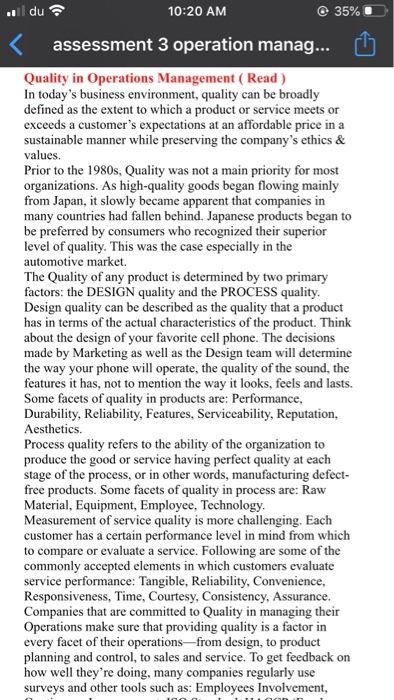
du 10:20 AM @ 35% assessment 3 operation manag... Quality in Operations Management (Read) In today's business environment, quality can be broadly defined as the extent to which a product or service meets or exceeds a customer's expectations at an affordable price in a sustainable manner while preserving the company's ethics & values. Prior to the 1980s, Quality was not a main priority for most organizations. As high-quality goods began flowing mainly from Japan, it slowly became apparent that companies in many countries had fallen behind. Japanese products began to be preferred by consumers who recognized their superior level of quality. This was the case especially in the automotive market. The Quality of any product is determined by two primary factors: the DESIGN quality and the PROCESS quality. Design quality can be described as the quality that a product has in terms of the actual characteristics of the product. Think about the design of your favorite cell phone. The decisions made by Marketing as well as the Design team will determine the way your phone will operate, the quality of the sound, the features it has, not to mention the way it looks, feels and lasts. Some facets of quality in products are: Performance, Durability, Reliability, Features, Serviceability, Reputation, Aesthetics. Process quality refers to the ability of the organization to produce the good or service having perfect quality at each stage of the process, or in other words, manufacturing defect- free products. Some facets of quality in process are: Raw Material, Equipment, Employee, Technology Measurement of service quality is more challenging. Each customer has a certain performance level in mind from which to compare or evaluate a service. Following are some of the commonly accepted elements in which customers evaluate service performance: Tangible, Reliability, Convenience, Responsiveness, Time, Courtesy, Consistency, Assurance. Companies that are committed to Quality in managing their Operations make sure that providing quality is a factor in every facet of their operations-from design, to product planning and control, to sales and service. To get feedback on how well they're doing, many companies regularly use surveys and other tools such as: Employees Involvement, surveys and other tools such as: Employees Involvement, Continuous Improvement, ISO Standard, HACCP (Food Industry), Six Sigma, TQM, etc. The aim of this assessment is to critically evaluate taught operations management concepts related to Quality and synthesize a proposal that will showcase the importance of Quality in achieving operational excellence. Student is strongly recommended to appraise their own work environment (current or previous employer, own company, or other) and critically evaluate operational challenges of a selected Product/Service (Design, Process) in terms of Quality Management. Select a single important product/ service that is facing Quality issues and synthesize a solution to overcome the problem. Student must critically appraise learned concepts and use any of the tools discussed in class such as: Check sheets, Scatter diagrams, Cause-and-effect diagrams, Pareto charts, Flowcharts, Histogram, Statistical process control chart, etc. Evaluate the 'As-ls' status of the product/service in terms of its Quality and propose an improvement initiative/s. This assessment requires student to perform the following: 1. Analyse chosen existing As_Is product / service. 2. Critically appraise the Quality Issues and their impact on Operations Efficiency 3. Critically evaluate and synthesise appropriate Operational improvement of the Quality of the Product/Service and propose the To_be solution that will elevate operational productivity 4. Qualitatively and quantitatively provide evidences to substantiate operational efficiency and effectiveness 6.2 Individual Report: 6.2.1 Submission Instruction: Appraise the company that you select and choose a product or a process that has a Quality issues. Submit a single research du 10:20 AM @ 35% assessment 3 operation manag... Quality in Operations Management (Read) In today's business environment, quality can be broadly defined as the extent to which a product or service meets or exceeds a customer's expectations at an affordable price in a sustainable manner while preserving the company's ethics & values. Prior to the 1980s, Quality was not a main priority for most organizations. As high-quality goods began flowing mainly from Japan, it slowly became apparent that companies in many countries had fallen behind. Japanese products began to be preferred by consumers who recognized their superior level of quality. This was the case especially in the automotive market. The Quality of any product is determined by two primary factors: the DESIGN quality and the PROCESS quality. Design quality can be described as the quality that a product has in terms of the actual characteristics of the product. Think about the design of your favorite cell phone. The decisions made by Marketing as well as the Design team will determine the way your phone will operate, the quality of the sound, the features it has, not to mention the way it looks, feels and lasts. Some facets of quality in products are: Performance, Durability, Reliability, Features, Serviceability, Reputation, Aesthetics. Process quality refers to the ability of the organization to produce the good or service having perfect quality at each stage of the process, or in other words, manufacturing defect- free products. Some facets of quality in process are: Raw Material, Equipment, Employee, Technology Measurement of service quality is more challenging. Each customer has a certain performance level in mind from which to compare or evaluate a service. Following are some of the commonly accepted elements in which customers evaluate service performance: Tangible, Reliability, Convenience, Responsiveness, Time, Courtesy, Consistency, Assurance. Companies that are committed to Quality in managing their Operations make sure that providing quality is a factor in every facet of their operations-from design, to product planning and control, to sales and service. To get feedback on how well they're doing, many companies regularly use surveys and other tools such as: Employees Involvement, surveys and other tools such as: Employees Involvement, Continuous Improvement, ISO Standard, HACCP (Food Industry), Six Sigma, TQM, etc. The aim of this assessment is to critically evaluate taught operations management concepts related to Quality and synthesize a proposal that will showcase the importance of Quality in achieving operational excellence. Student is strongly recommended to appraise their own work environment (current or previous employer, own company, or other) and critically evaluate operational challenges of a selected Product/Service (Design, Process) in terms of Quality Management. Select a single important product/ service that is facing Quality issues and synthesize a solution to overcome the problem. Student must critically appraise learned concepts and use any of the tools discussed in class such as: Check sheets, Scatter diagrams, Cause-and-effect diagrams, Pareto charts, Flowcharts, Histogram, Statistical process control chart, etc. Evaluate the 'As-ls' status of the product/service in terms of its Quality and propose an improvement initiative/s. This assessment requires student to perform the following: 1. Analyse chosen existing As_Is product / service. 2. Critically appraise the Quality Issues and their impact on Operations Efficiency 3. Critically evaluate and synthesise appropriate Operational improvement of the Quality of the Product/Service and propose the To_be solution that will elevate operational productivity 4. Qualitatively and quantitatively provide evidences to substantiate operational efficiency and effectiveness 6.2 Individual Report: 6.2.1 Submission Instruction: Appraise the company that you select and choose a product or a process that has a Quality issues. Submit a single research










 Study Help