Question: Please solve this problem .. Note: I need it urgently, please 1.3. Consider the situation from Example 1.3 for an arbitrary sample size n. Assume
Please solve this problem.. Note: I need it urgently, please
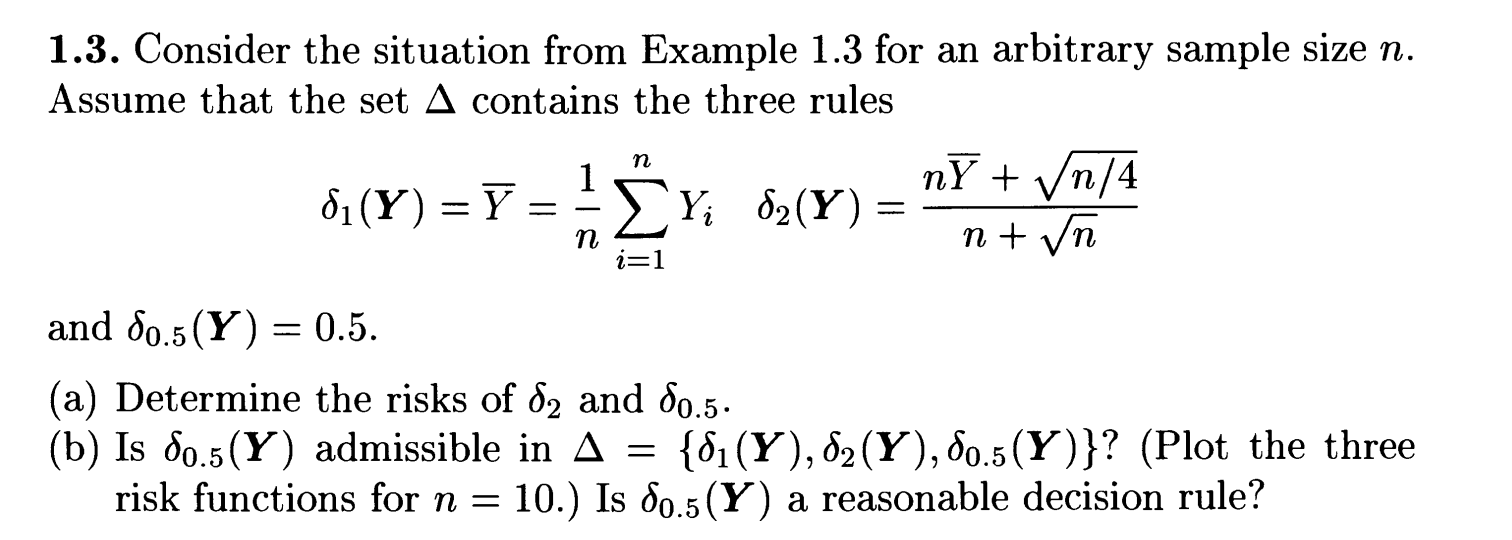
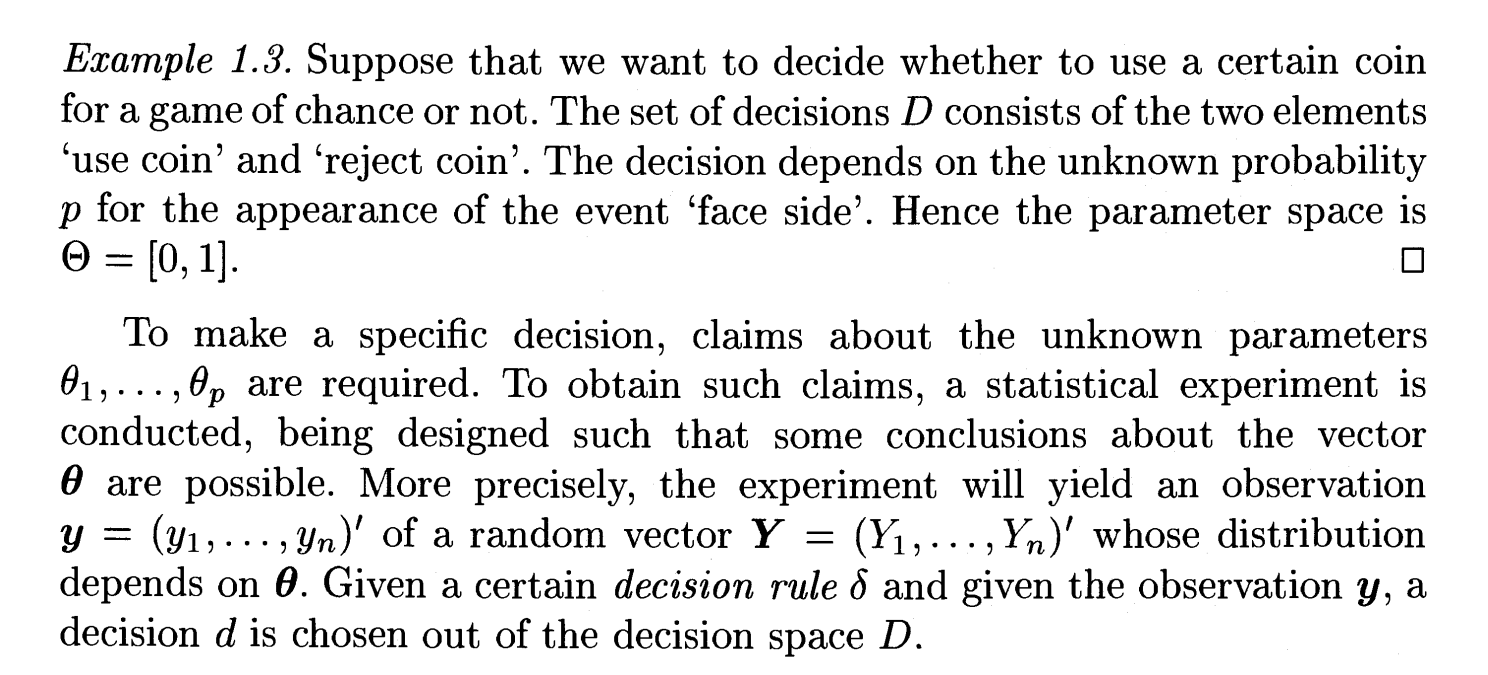
1.3. Consider the situation from Example 1.3 for an arbitrary sample size n. Assume that the set A contains the three rules di(Y) = Y = -3Y; $(Y) = n + Vn/4 ntvn i=1 and 80.5(Y) = 0.5. (a) Determine the risks of 82 and 80.5. (b) Is 80.5(Y) admissible in A = {81(Y), 82(Y), 80.5(Y)}? (Plot the three risk functions for n = 10.) Is 80.5(Y) a reasonable decision rule? Example 1.3. Suppose that we want to decide whether to use a certain coin for a game of chance or not. The set of decisions D consists of the two elements use coin' and 'reject coin. The decision depends on the unknown probability p for the appearance of the event 'face side'. Hence the parameter space is = [0, 1]. To make a specific decision, claims about the unknown parameters 01,...,Op are required. To obtain such claims, a statistical experiment is conducted, being designed such that some conclusions about the vector e are possible. More precisely, the experiment will yield an observation y = (y1, ..., Yn)' of a random vector Y = (Y1,...,Yn) whose distribution depends on 8. Given a certain decision rule 8 and given the observation y, a decision d is chosen out of the decision space D. 1.3. Consider the situation from Example 1.3 for an arbitrary sample size n. Assume that the set A contains the three rules di(Y) = Y = -3Y; $(Y) = n + Vn/4 ntvn i=1 and 80.5(Y) = 0.5. (a) Determine the risks of 82 and 80.5. (b) Is 80.5(Y) admissible in A = {81(Y), 82(Y), 80.5(Y)}? (Plot the three risk functions for n = 10.) Is 80.5(Y) a reasonable decision rule? Example 1.3. Suppose that we want to decide whether to use a certain coin for a game of chance or not. The set of decisions D consists of the two elements use coin' and 'reject coin. The decision depends on the unknown probability p for the appearance of the event 'face side'. Hence the parameter space is = [0, 1]. To make a specific decision, claims about the unknown parameters 01,...,Op are required. To obtain such claims, a statistical experiment is conducted, being designed such that some conclusions about the vector e are possible. More precisely, the experiment will yield an observation y = (y1, ..., Yn)' of a random vector Y = (Y1,...,Yn) whose distribution depends on 8. Given a certain decision rule 8 and given the observation y, a decision d is chosen out of the decision space D









 Study Help