







Question: Please solve this problem with MATLAB code Population dynamics of rabbits and foxes (a) A simple Lotka-Volterra Model We have discussed in detail the Lotka-Volterra
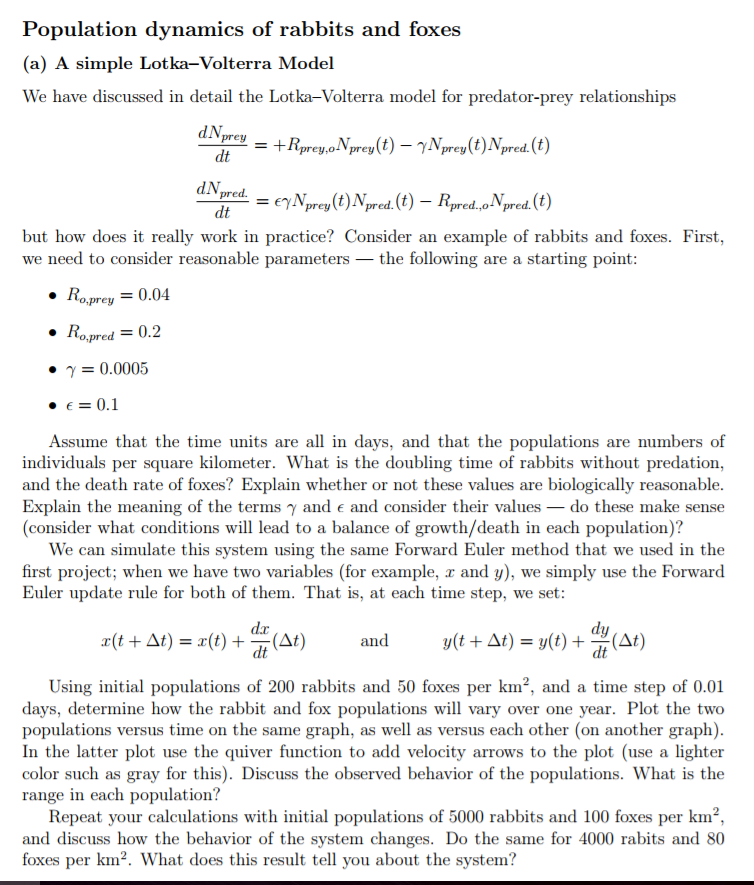
Please solve this problem with "MATLAB" code
Population dynamics of rabbits and foxes (a) A simple Lotka-Volterra Model We have discussed in detail the Lotka-Volterra model for predator-prey relationships dN dt dN prey,oprey pred. Rpred.0 but how does it really work in practice? Consider an example of rabbits and foxes. First, we need to consider reasonable parameters _the following are a starting point Ro,prey-0.04 Ro.pred = 0.0005 = 0.2 Assume that the time units are all in days, and that the populations are numbers of individual and the death rate of foxes? Explain whether or not these values are biologically reasonable Explain the meaning of the terms and and consider their values-do these make sense (consider what conditions will lead to a balance of growth/death in each population)? s per square kilometer. What is the doubling time of rabbits without predation, We can simulate this system using the same Forward Euler method that we used in the first project; when we have two variables (for example, r and y), we simply use the Forward Euler update rule for both of them. That is, at each time step, we set dt dt Using initial populations of 200 rabbits and 50 foxes per km2, and a time step of 0.01 days, determine how the rabbit and fox populations will vary over one year. Plot the two populations versus time on the same graph, as well as versus each other (on another graph) In the latter plot use the quiver function to add velocity arrows to the plot (use a lighter color such as gray for this). Discuss the observed behavior of the populations. What is the range in each population? Repeat your calculations with initial populations of 5000 rabbits and 100 foxes per km2 and discuss how the behavior of the system changes. Do the same for 4000 rabits and 80 foxes per km2. What does this result tell you about the system? Population dynamics of rabbits and foxes (a) A simple Lotka-Volterra Model We have discussed in detail the Lotka-Volterra model for predator-prey relationships dN dt dN prey,oprey pred. Rpred.0 but how does it really work in practice? Consider an example of rabbits and foxes. First, we need to consider reasonable parameters _the following are a starting point Ro,prey-0.04 Ro.pred = 0.0005 = 0.2 Assume that the time units are all in days, and that the populations are numbers of individual and the death rate of foxes? Explain whether or not these values are biologically reasonable Explain the meaning of the terms and and consider their values-do these make sense (consider what conditions will lead to a balance of growth/death in each population)? s per square kilometer. What is the doubling time of rabbits without predation, We can simulate this system using the same Forward Euler method that we used in the first project; when we have two variables (for example, r and y), we simply use the Forward Euler update rule for both of them. That is, at each time step, we set dt dt Using initial populations of 200 rabbits and 50 foxes per km2, and a time step of 0.01 days, determine how the rabbit and fox populations will vary over one year. Plot the two populations versus time on the same graph, as well as versus each other (on another graph) In the latter plot use the quiver function to add velocity arrows to the plot (use a lighter color such as gray for this). Discuss the observed behavior of the populations. What is the range in each population? Repeat your calculations with initial populations of 5000 rabbits and 100 foxes per km2 and discuss how the behavior of the system changes. Do the same for 4000 rabits and 80 foxes per km2. What does this result tell you about the system
Step by Step Solution
There are 3 Steps involved in it

Get step-by-step solutions from verified subject matter experts
 Study Help