







Question: Please solve this question. All the necessary information is given. Thanks. Given each question, write a relational algebra expression to answer it. Your answers should
 Please solve this question. All the necessary information is given. Thanks.
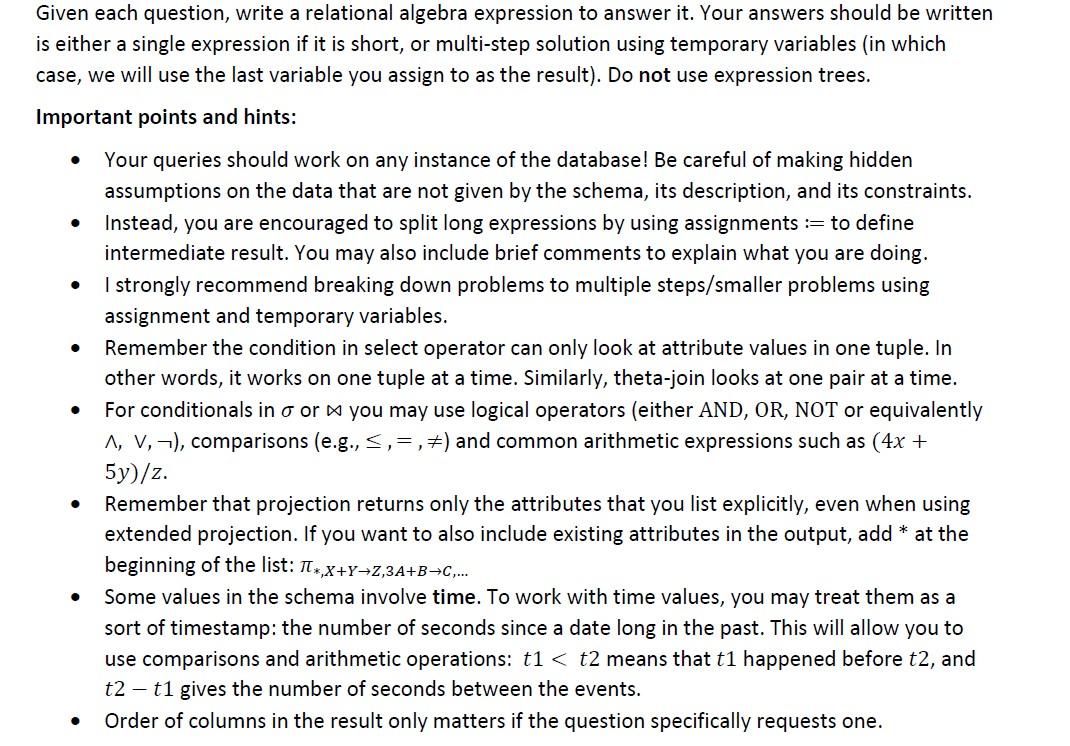
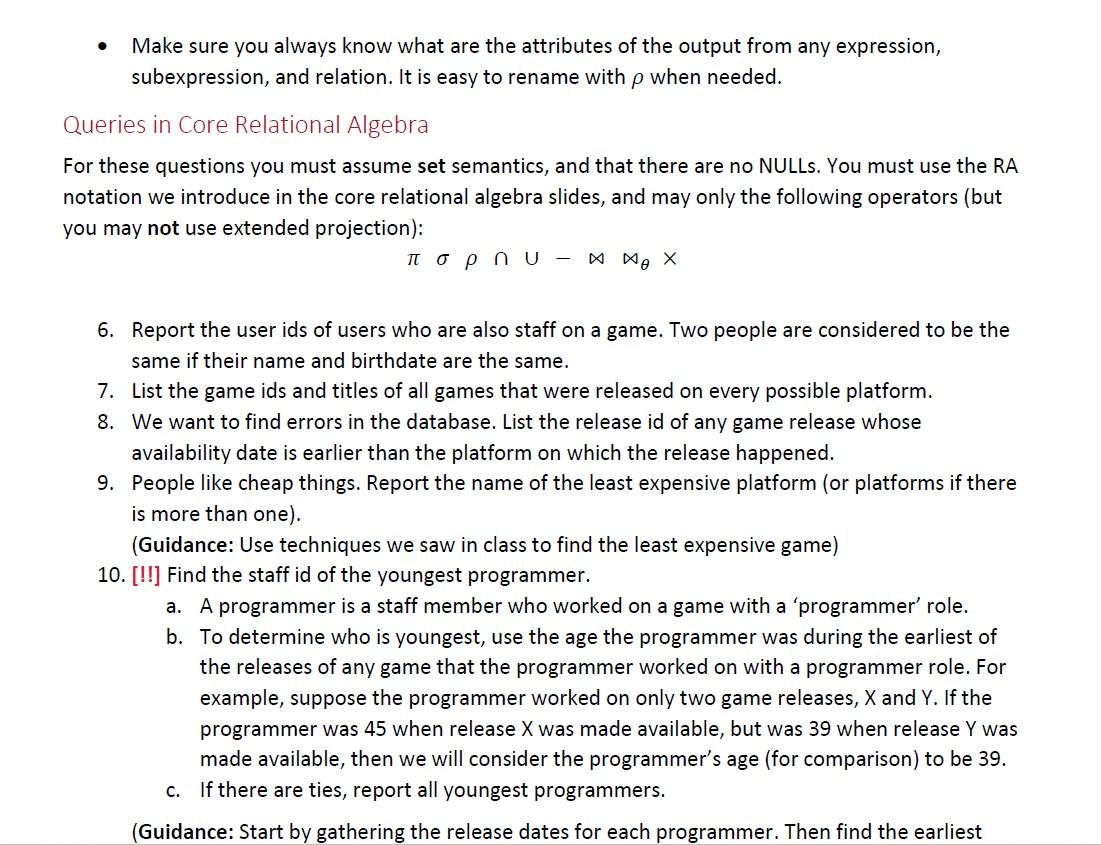
Given each question, write a relational algebra expression to answer it. Your answers should be written is either a single expression if it is short, or multi-step solution using temporary variables (in which case, we will use the last variable you assign to as the result). Do not use expression trees. Important points and hints: - Your queries should work on any instance of the database! Be careful of making hidden assumptions on the data that are not given by the schema, its description, and its constraints. - Instead, you are encouraged to split long expressions by using assignments := to define intermediate result. You may also include brief comments to explain what you are doing. - I strongly recommend breaking down problems to multiple steps/smaller problems using assignment and temporary variables. - Remember the condition in select operator can only look at attribute values in one tuple. In other words, it works on one tuple at a time. Similarly, theta-join looks at one pair at a time. - For conditionals in or you may use logical operators (either AND, OR, NOT or equivalently ,,), comparisons (e.g., ,=,=) and common arithmetic expressions such as (4x+ 5y)/z - Remember that projection returns only the attributes that you list explicitly, even when using extended projection. If you want to also include existing attributes in the output, add * at the beginning of the list: ,X+YZ,3A+BC,. - Some values in the schema involve time. To work with time values, you may treat them as a sort of timestamp: the number of seconds since a date long in the past. This will allow you to use comparisons and arithmetic operations: t1
Step by Step Solution
There are 3 Steps involved in it

Get step-by-step solutions from verified subject matter experts
 Study Help