







Question: Please solve this with clarification No coding is needed Consider the list: (Po, 1.n-1) being represented in the -calculus as follows: (Po): x.((x0)4) (Do, 0):
Please solve this with clarification
No coding is needed
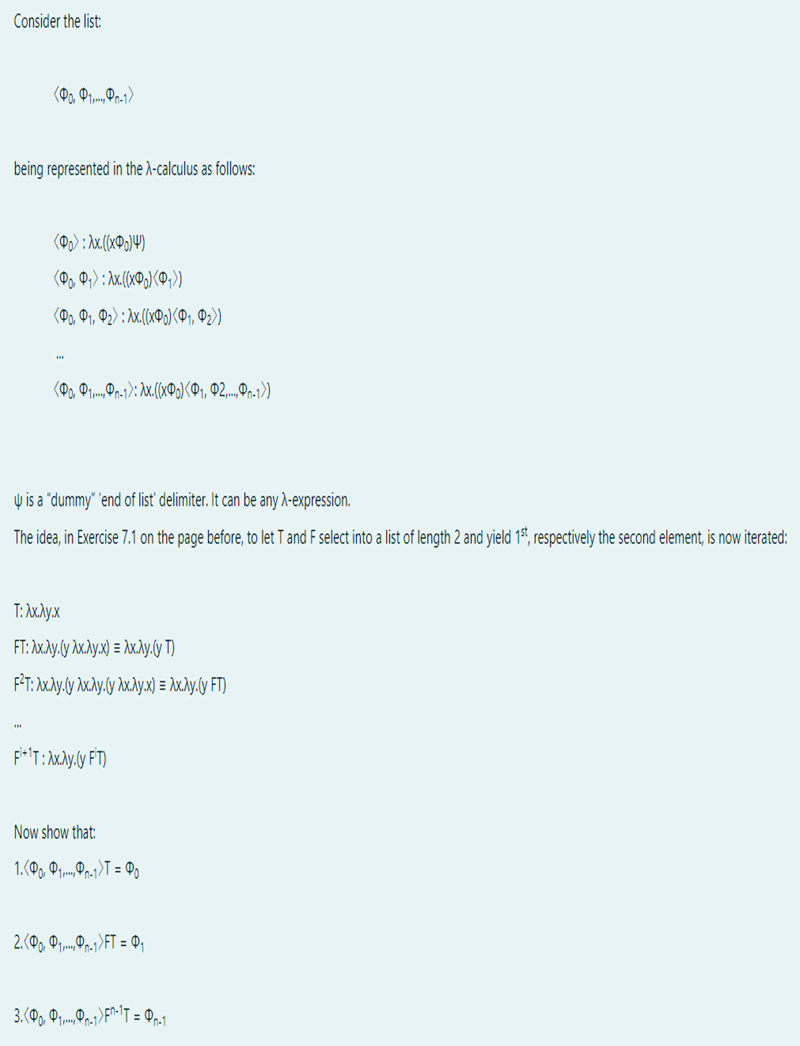
Consider the list: (Po, 1.n-1) being represented in the -calculus as follows: (Po): x.((x0)4) (Do, 0): x.((x)()) (Po, P, P): x.((x0) 0, 02)) (Po, P1, Pn-1): Ax.((x0) 0, 02, 0.1)) is a "dummy" 'end of list' delimiter. It can be any -expression. The idea, in Exercise 7.1 on the page before, to let T and F select into a list of length 2 and yield 1st, respectively the second element, is now iterated: T:Ax.ay.x FT: x.Ay.(y x.Ay.x) = x.Ay.(yT) FT: Ax.Ay.(y Ax.Ay.(y x.Ay.x) = x.Ay.(y FT) Fi+T: Ax.Ay.(y FT) Now show that: 1.00, 1-1 T = Po 2.00, 1-1)FT = 3.00 1-1 F-1 = -1
Step by Step Solution
3.39 Rating (152 Votes )
There are 3 Steps involved in it
To solve this problem we will apply the definitions and lambda calculus expressions provided in the ... View full answer

Get step-by-step solutions from verified subject matter experts
 Study Help