







Question: Please solve those questions in R studio and post the code 33. # Part 2. Round goby patch occpancy| 34 35- ## Round gobies are
Please solve those questions in R studio and post the code 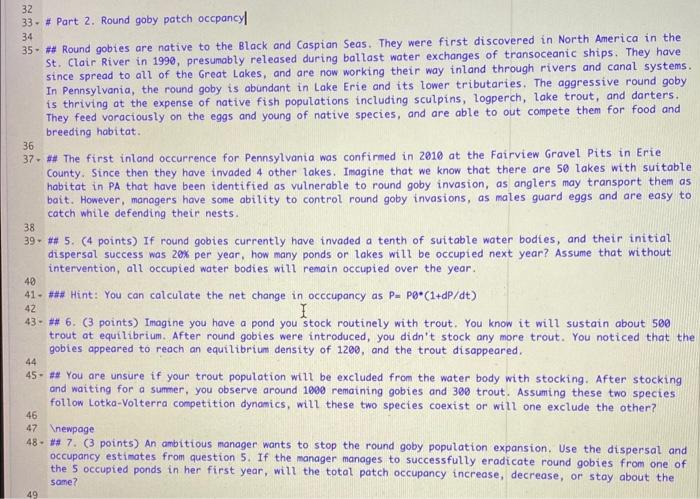
33. # Part 2. Round goby patch occpancy| 34 35- ## Round gobies are native to the Black and Caspian Seas. They were first discovered in North America in the St. Clair River in 1990 , presumably released during ballast water exchanges of transoceanic ships. They have since spread to all of the Great Lakes, and are now working their way inland through rivers and canal systems. In Pennsylvania, the round goby is abundant in Lake Erie and its lower tributaries. The aggressive round goby is thriving at the expense of native fish populations including sculpins, logperch, lake trout, and darters. They feed voraciously on the eggs and young of native species, and are able to out compete them for food and breeding habitat. 36 37. ## The first inland occurrence for Pennsylvania was confirmed in 2010 at the Fairview Gravel Pits in Erie County. Since then they have invaded 4 other lakes. Imagine that we know that there are 50 lakes with suitable habitat in PA that have been identified as vulnerable to round goby invasion, as anglers may transport them as bait. However, managers have some ability to control round goby invasions, as males guard eggs and are easy to catch while defending their nests. 38 39. ## 5. (4 points) If round gobies currently have invaded a tenth of suitable water bodies, and their initial dispersal success was 20% per year, how many ponds or lakes will be occupied next year? Assume that without intervention, all occupied water bodies witl remain occupied over the year. 41 - ## Hint: You can calculate the net change in occcupancy as P=PQ(1+dP/dt) 43 - # 6. (3 points) Imagine you have a pond you stock routinely with trout, You know it will sustain about 500 43-# 13. (3 points) Imagine you have a pond you stock routinely with trout. You know it will sustain about soo trout at equilibrium. After round gobies were introduced, you didn't stock any more trout. You noticed that the gobies appeared to reach an equilibrium density of 1200, and the trout disappeared. 45 - $3 You are unsure if your trout population will be excluded from the water body with stocking. After stocking and waiting for a sumer, you observe around 1000 remaining gobies and 300 trout. Assuming these two species follow Lotka-Volterra competition dynamics, will these two species coexist or will one exclude the other? 46 47. Vewpage 48. # 7. (3 points) An ambitious manager wants to stop the round goby population expansion. Use the dispersal and occupancy estimates from question 5. If the manager manages to successfully eradicate round gobies from one of the 5 occupied ponds in her first year, will the totol patch occupancy increase, decrease, or stay about the same? 33. # Part 2. Round goby patch occpancy| 34 35- ## Round gobies are native to the Black and Caspian Seas. They were first discovered in North America in the St. Clair River in 1990 , presumably released during ballast water exchanges of transoceanic ships. They have since spread to all of the Great Lakes, and are now working their way inland through rivers and canal systems. In Pennsylvania, the round goby is abundant in Lake Erie and its lower tributaries. The aggressive round goby is thriving at the expense of native fish populations including sculpins, logperch, lake trout, and darters. They feed voraciously on the eggs and young of native species, and are able to out compete them for food and breeding habitat. 36 37. ## The first inland occurrence for Pennsylvania was confirmed in 2010 at the Fairview Gravel Pits in Erie County. Since then they have invaded 4 other lakes. Imagine that we know that there are 50 lakes with suitable habitat in PA that have been identified as vulnerable to round goby invasion, as anglers may transport them as bait. However, managers have some ability to control round goby invasions, as males guard eggs and are easy to catch while defending their nests. 38 39. ## 5. (4 points) If round gobies currently have invaded a tenth of suitable water bodies, and their initial dispersal success was 20% per year, how many ponds or lakes will be occupied next year? Assume that without intervention, all occupied water bodies witl remain occupied over the year. 41 - ## Hint: You can calculate the net change in occcupancy as P=PQ(1+dP/dt) 43 - # 6. (3 points) Imagine you have a pond you stock routinely with trout, You know it will sustain about 500 43-# 13. (3 points) Imagine you have a pond you stock routinely with trout. You know it will sustain about soo trout at equilibrium. After round gobies were introduced, you didn't stock any more trout. You noticed that the gobies appeared to reach an equilibrium density of 1200, and the trout disappeared. 45 - $3 You are unsure if your trout population will be excluded from the water body with stocking. After stocking and waiting for a sumer, you observe around 1000 remaining gobies and 300 trout. Assuming these two species follow Lotka-Volterra competition dynamics, will these two species coexist or will one exclude the other? 46 47. Vewpage 48. # 7. (3 points) An ambitious manager wants to stop the round goby population expansion. Use the dispersal and occupancy estimates from question 5. If the manager manages to successfully eradicate round gobies from one of the 5 occupied ponds in her first year, will the totol patch occupancy increase, decrease, or stay about the same
Step by Step Solution
There are 3 Steps involved in it
1 Expert Approved Answer
Step: 1 Unlock

Question Has Been Solved by an Expert!
Get step-by-step solutions from verified subject matter experts
Step: 2 Unlock
Step: 3 Unlock
 Study Help