







Question: PLEASE SOLVE USING BUCKINGHAM PI METHOD, DO NOT SOLVE USING ANOTHER WAY PLEASE! 5) (20 pts) If the viscosity of the liquid is not too
 PLEASE SOLVE USING BUCKINGHAM PI METHOD, DO NOT SOLVE USING ANOTHER WAY PLEASE!
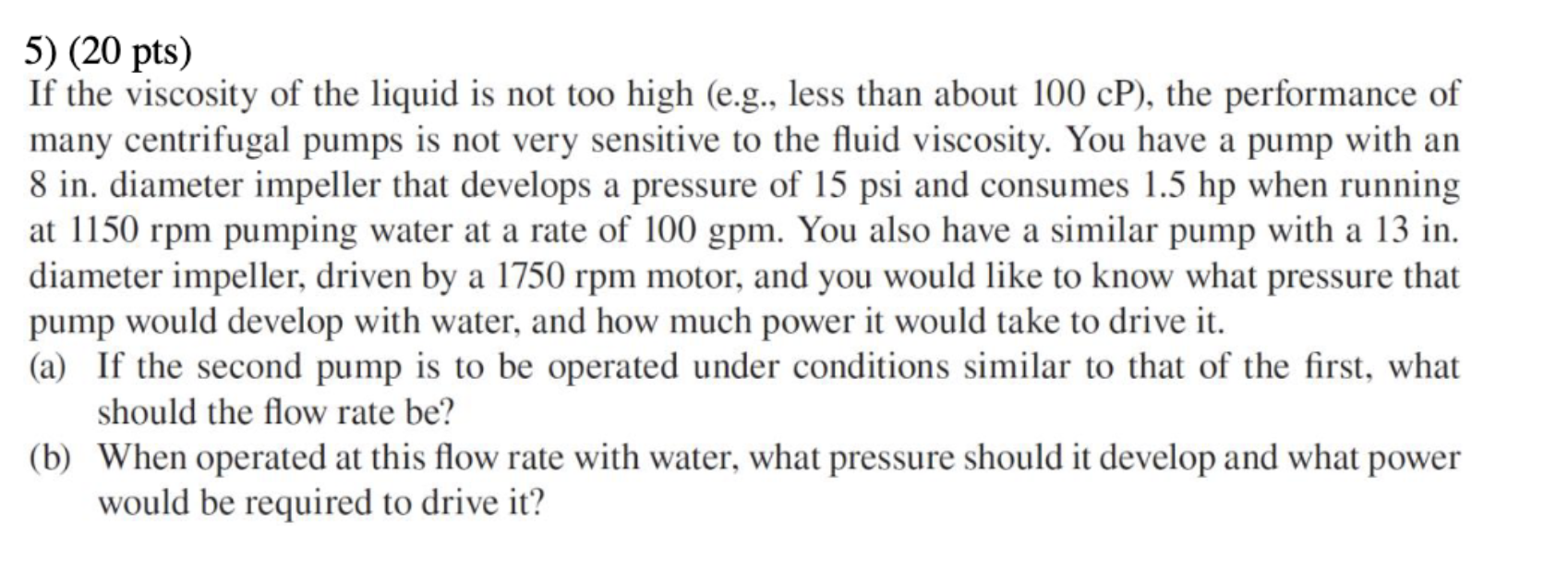
5) (20 pts) If the viscosity of the liquid is not too high (e.g., less than about 100 cP), the performance of many centrifugal pumps is not very sensitive to the fluid viscosity. You have a pump with an 8 in. diameter impeller that develops a pressure of 15 psi and consumes 1.5 hp when running at 1150 rpm pumping water at a rate of 100 gpm. You also have a similar pump with a 13 in. diameter impeller, driven by a 1750 rpm motor, and you would like to know what pressure that pump would develop with water, and how much power it would take to drive it. (a) If the second pump is to be operated under conditions similar to that of the first, what should the flow rate be? (b) When operated at this flow rate with water, what pressure should it develop and what power would be required to drive it? 5) (20 pts) If the viscosity of the liquid is not too high (e.g., less than about 100 cP), the performance of many centrifugal pumps is not very sensitive to the fluid viscosity. You have a pump with an 8 in. diameter impeller that develops a pressure of 15 psi and consumes 1.5 hp when running at 1150 rpm pumping water at a rate of 100 gpm. You also have a similar pump with a 13 in. diameter impeller, driven by a 1750 rpm motor, and you would like to know what pressure that pump would develop with water, and how much power it would take to drive it. (a) If the second pump is to be operated under conditions similar to that of the first, what should the flow rate be? (b) When operated at this flow rate with water, what pressure should it develop and what power would be required to drive it
Step by Step Solution
There are 3 Steps involved in it

Get step-by-step solutions from verified subject matter experts
 Study Help