







Question: Please solve using MATLAB ONLY You are tasked with helping a cardiologist colleague use her echocardiography measurements to model velocity, pressure drop, and wall shear
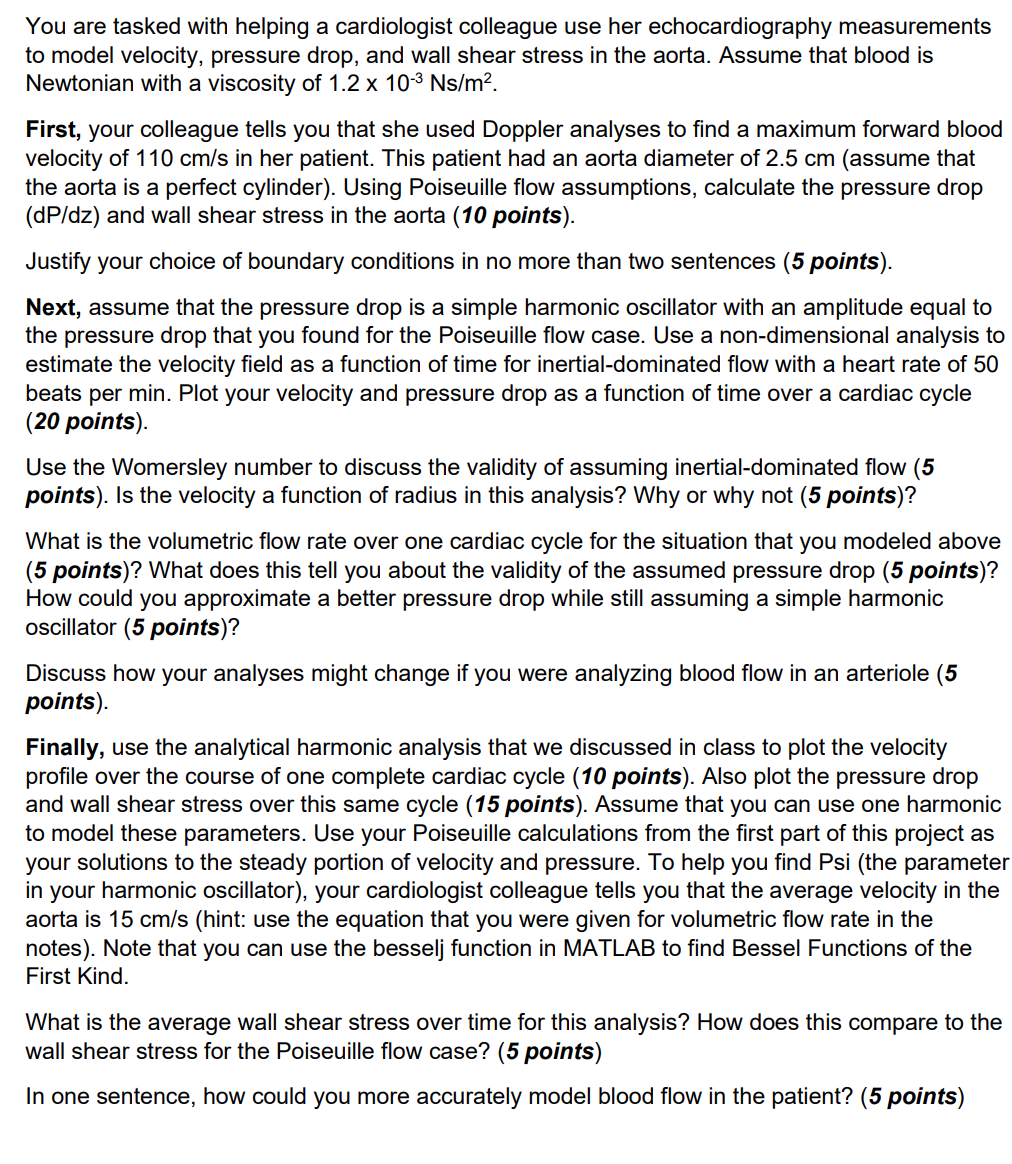 Please solve using MATLAB ONLY
You are tasked with helping a cardiologist colleague use her echocardiography measurements to model velocity, pressure drop, and wall shear stress in the aorta. Assume that blood is Newtonian with a viscosity of 1.2 x 10⁻³ Ns/m2. First, your colleague tells you that she used Doppler analyses to find a maximum forward blood velocity of 110 cm/s in her patient. This patient had an aorta diameter of 2.5 cm (assume that the aorta is a perfect cylinder). Using Poiseuille flow assumptions, calculate the pressure drop (dP/dz) and wall shear stress in the aorta (10 points). Justify your choice of boundary conditions in no more than two sentences (5 points). Next, assume that the pressure drop is a simple harmonic oscillator with an amplitude equal to the pressure drop that you found for the Poiseuille flow case. Use a non-dimensional analysis to estimate the velocity field as a function of time for inertial-dominated flow with a heart rate of 50 beats per min. Plot your velocity and pressure drop as a function of time over a cardiac cycle (20 points) Use the Womersley number to discuss the validity of assuming inertial-dominated flow (5 points). Is the velocity a function of radius in this analysis? Why or why not (5 points)? What is the volumetric flow rate over one cardiac cycle for the situation that you modeled above (5 points)? What does this tell you about the validity of the assumed pressure drop (5 points)? How could you approximate a better pressure drop while still assuming a simple harmonic oscillator (5 points)? Discuss how your analyses might change if you were analyzing blood flow in an arteriole (5 points) Finally, use the analytical harmonic analysis that we discussed in class to plot the velocity profile over the course of one complete cardiac cycle (10 points). Also plot the pressure drop and wall shear stress over this same cycle (15 points). Assume that you can use one harmonic to model these parameters. Use your Poiseuille calculations from the first part of this project as your solutions to the steady portion of velocity and pressure. To help you find Psi (the parameter in your harmonic oscillator), your cardiologist colleague tells you that the average velocity in the aorta is 15 cm/s (hint: use the equation that you were given for volumetric flow rate in the notes). Note that you can use the besselj function in MATLAB to find Bessel Functions of the First Kind. What is the average wall shear stress over time for this analysis? How does this compare to the wall shear stress for the Poiseuille flow case? (5 points) In one sentence, how could you more accurately model blood flow in the patient? (5 points)
Step by Step Solution
There are 3 Steps involved in it

Get step-by-step solutions from verified subject matter experts
 Study Help