







Question: Please solved the question #8. Thank you. 8. Question: For each of the overhead rates computed in Requirement 7, calculate unit bid prices for Jobs
Please solved the question #8. Thank you.
8. Question: For each of the overhead rates computed in Requirement 7, calculate unit bid prices for Jobs A500 and B75. Assume that the companys aggressive bidding policy is unit cost plus 50 percent. Did departmental overhead rates have any effect on Beauvilles winning or losing bids? What recommendation would you make? Explain. Now, adjust the costs and bids for departmental rate bids using the proposed standard costs for the Coloring and Bolting Department. Did this make a difference? What does this tell you?
Beauville Furniture Corporation produces sofas, recliners, and lounge chairs. Beauville is located in a medium-sized community in the southeastern part of the United States. It is a major employer in the community. In fact, the economic well-being of the community is tied very strongly to Beauville. Beauville operates a sawmill, a fabric plant, and a furniture plant in the same community.
The sawmill buys logs from independent producers. The sawmill then processes the logs into four grades of lumber: firsts and seconds, No. 1 common, No. 2 common, and No. 3 common. All costs incurred in the mill are common to the four grades of lumber. All four grades of lumber are used by the furniture plant. The mill transfers everything it produces to the furniture plant, and the grades are transferred at cost. Trucks are used to move the lumber from the mill to the furniture plant. Although no outside sales exist, the mill could sell to external customers, and the selling prices of the four grades are known.
The fabric plant is responsible for producing the fabric that is used by the furniture plant. To produce three totally different fabrics (identified by fabric ID codes FB60, FB70, and FB80, respectively), the plant has three separate production operationsone for each fabric. Thus, production of all three fabrics occurs at the same time in different locations in the plant. Each fabrics production operation has two processes: the weaving and pattern process and the coloring and bolting process. In the weaving and pattern process, yarn is used to create yards of fabric with different designs. In the next process, the fabric is dyed, cut into 25-yard sections, and wrapped around cardboard rods to form 25-yard bolts. The bolts are transported by forklift to the furniture plants Receiving Department. All of the output of the fabric plant is used by the furniture plant (to produce the sofas and chairs). For accounting purposes, the fabric is transferred at cost to the furniture plant.
The furniture plant produces orders for customers on a special-order basis. The customers specify the quantity, style, fabric, lumber grade, and pattern. Typically, jobs are large (involving at least 500 units). The plant has two production departments: Cutting and Assembly. In the Cutting Department, the fabric and wooden frame components are sized and cut. Other components are purchased from external suppliers and are removed from stores as needed for assembly. After the fabric and wooden components are finished for the entire job, they are moved to the Assembly Department. The Assembly Department takes the individual components and assembles the sofas (or chairs).
Beauville Furniture has been in business for over two decades and has a good reputation. However, during the past five years, Beauville experienced eroding profits and declining sales. Bids were increasingly lost (even aggressive bids) on the more popular models. Yet, the company was winning bids on some of the more-difficult-to-produce items. Lance Hays, the owner and manager, was frustrated. He simply couldnt understand how some of his competitors could sell for such low prices. On a common sofa job involving 500 units, Beauvilles bids were running $25 per unit, or $12,500 per job more than the winning bids (on average). Yet, on the more difficult items, Beauvilles bids were running about $60 per unit less than the next closest bid. Gisela Berling, vice president of finance, was assigned the task of preparing a cost analysis of the companys product lines. Lance wanted to know if the companys costs were excessive. Perhaps the company was being wasteful, and it was simply costing more to produce furniture than it was costing its competitors.
Gisela prepared herself by reading recent literature on cost management and product costing and attending several conferences that explored the same issues. She then reviewed the costing procedures of the companys mill and two plants and did a preliminary assessment of their soundness. The production costs of the mill were common to all lumber grades and were assigned using the physical units method. Since the output and production costs were fairly uniform throughout the year, the mill used an actual costing system. Although Gisela had no difficulty with actual costing, she decided to explore the effects of using the sales-value-at-split-off method. Thus, cost and production data for the mill were gathered so that an analysis could be conducted. The two plants used normal costing systems. The fabric plant used process costing, and the furniture plant used job-order costing. Both plants used plantwide overhead rates based on direct labor hours. Based on her initial reviews, she concluded that the costing procedures for the fabric plant were satisfactory. Essentially, there was no evidence of product diversity. A statistical analysis revealed that about 90 percent of the variability in the plants overhead cost could be explained by direct labor hours. Thus, the use of a plantwide overhead rate based on direct labor hours seemed justified. What did concern her, though, was the material waste that she observed in the plant. Maybe a standard cost system would be useful for increasing the overall cost efficiency of the plant. Consequently, as part of her report to Lance, she decided to include a description of the fabric plants costing proceduresat least for one of the fabric types. She also decided to develop a standard cost sheet for the chosen fabric. The furniture plant, however, was a more difficult matter. Product diversity was present and could be causing some distortions in product costs. Furthermore, statistical analysis revealed that only about 40 percent of the variability in overhead cost was explained by the direct labor hours. She decided that additional analysis was needed so that a sound product costing method could be recommended. One possibility would be to increase the number of overhead rates. Thus, she decided to include departmental data so that the effect of moving to departmental rates could be assessed. Finally, she also wanted to explore the possibility of converting the sawmill and fabric plant into profit centers and changing the existing transfer pricing policy.
With the cooperation of the cost accounting manager for the mill and each plants controller, she gathered the following data for last year:
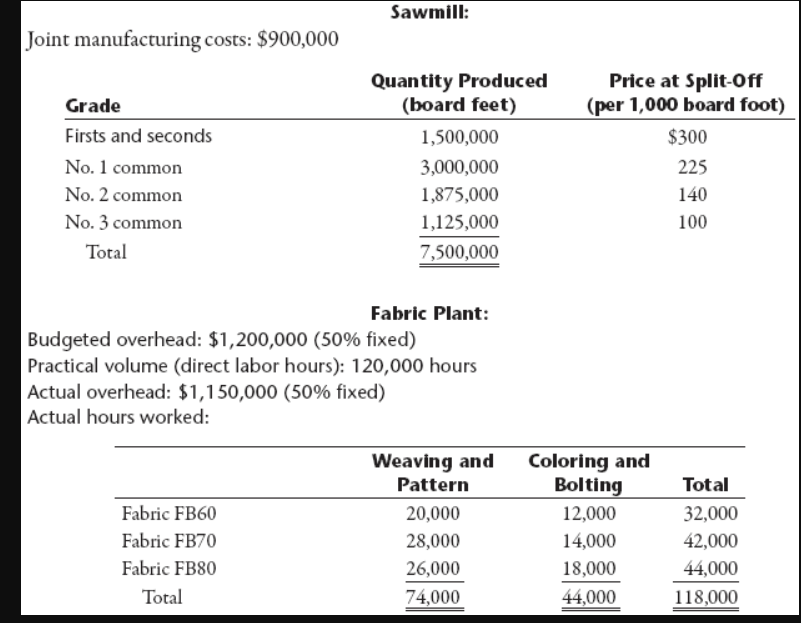
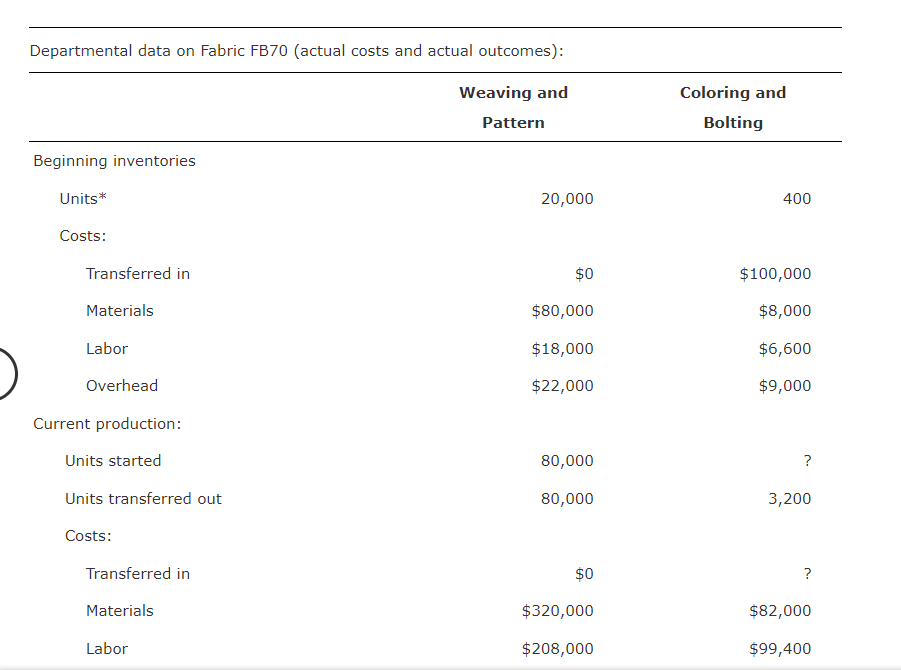
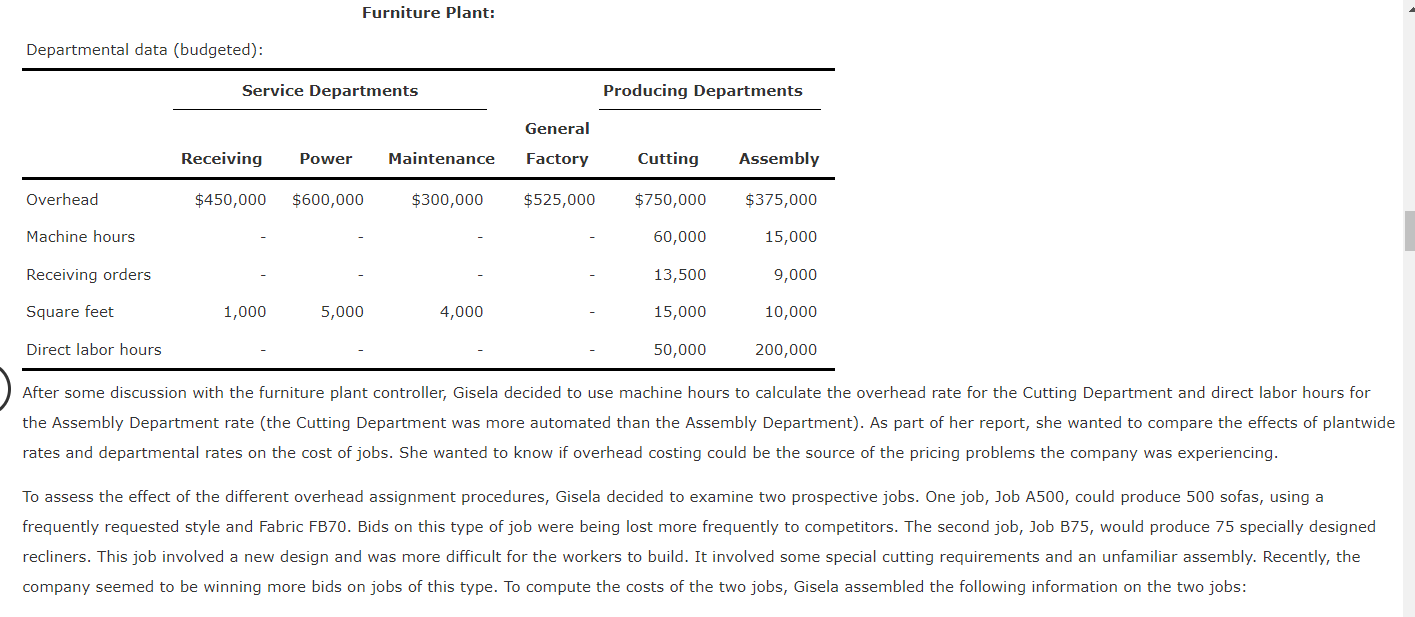
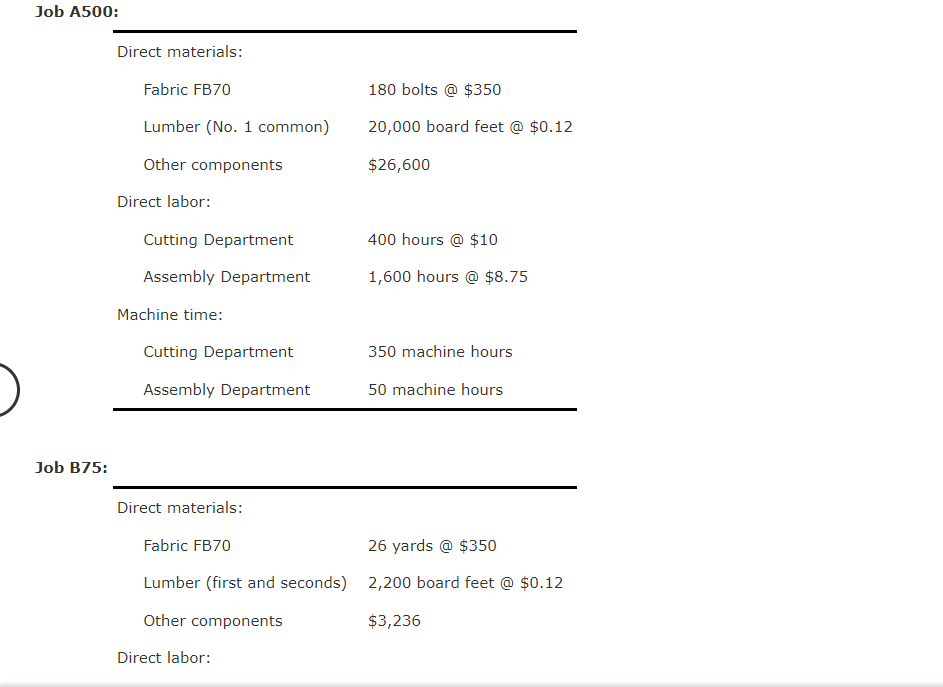
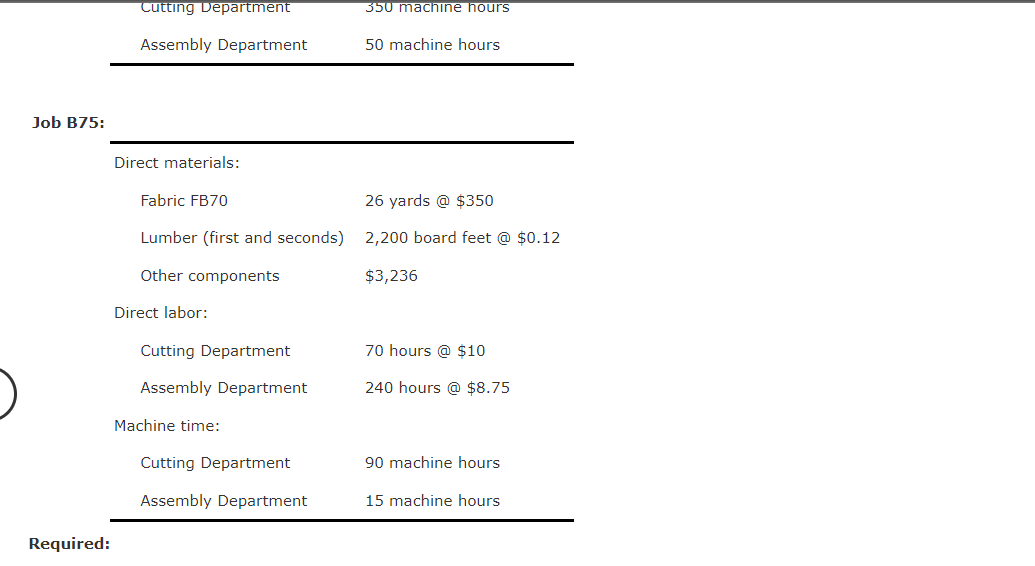
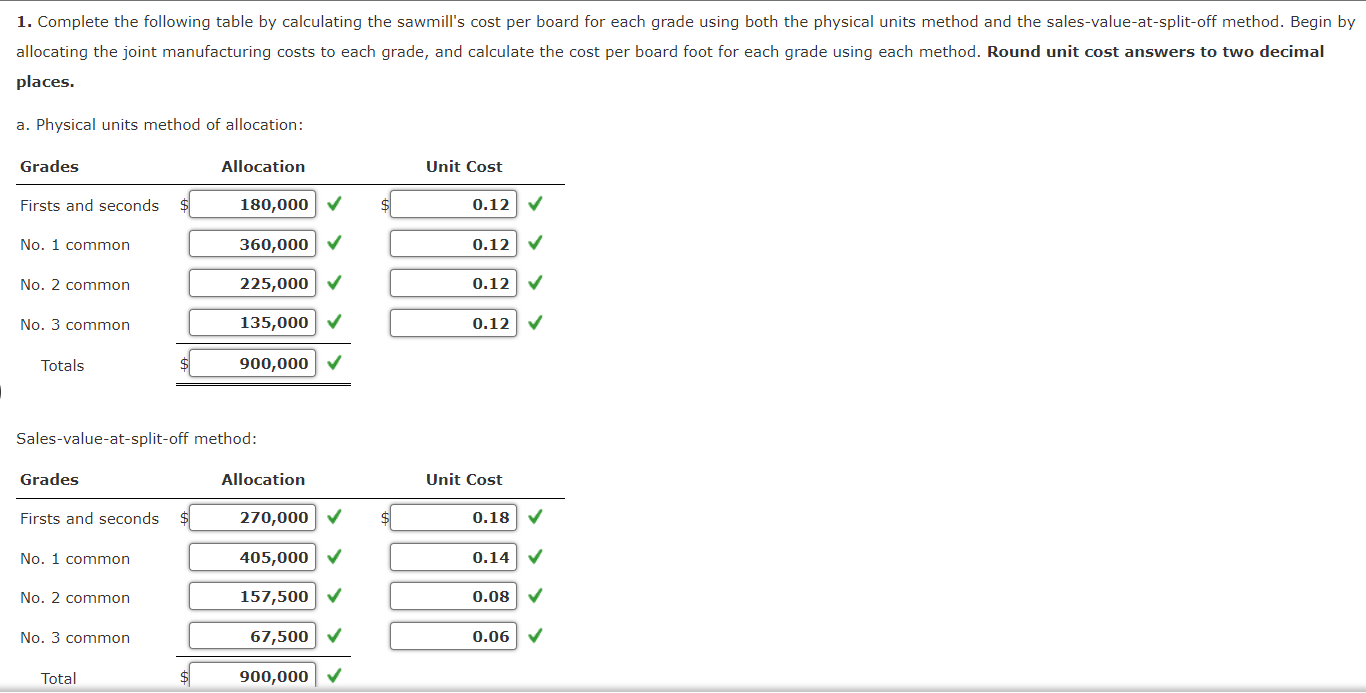
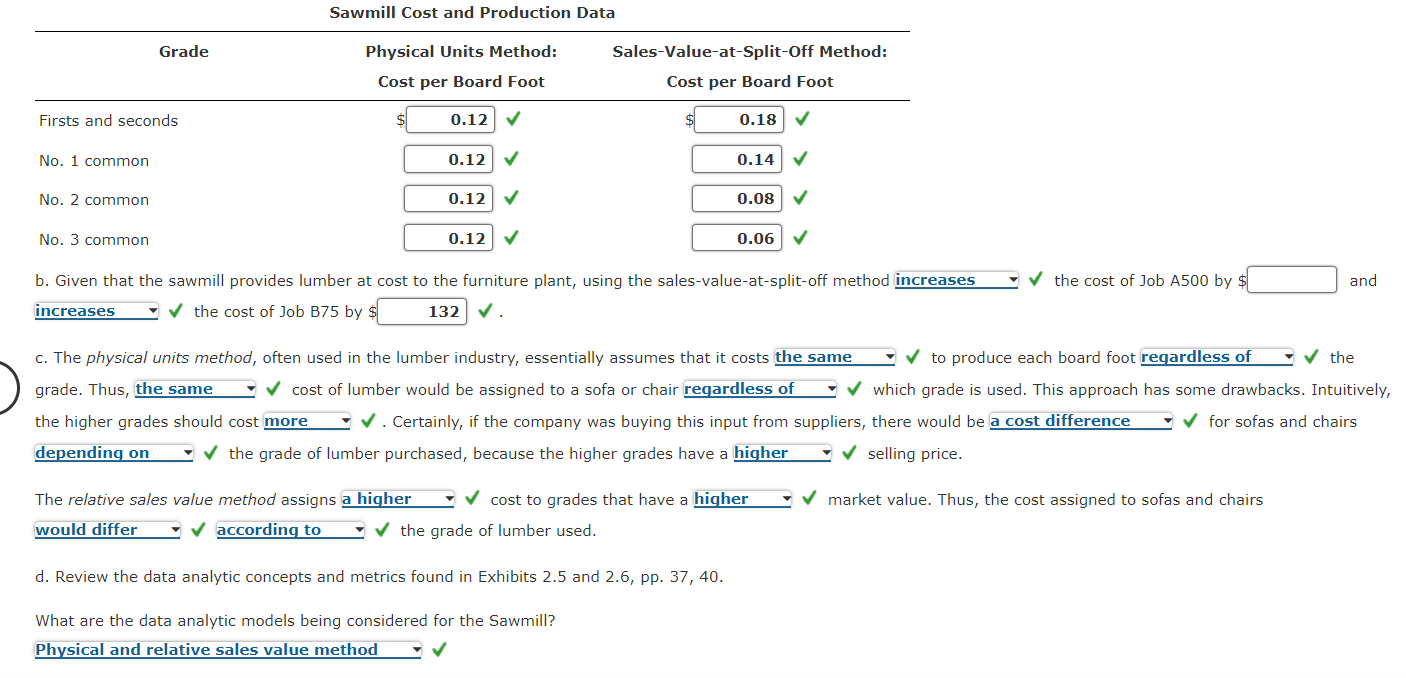
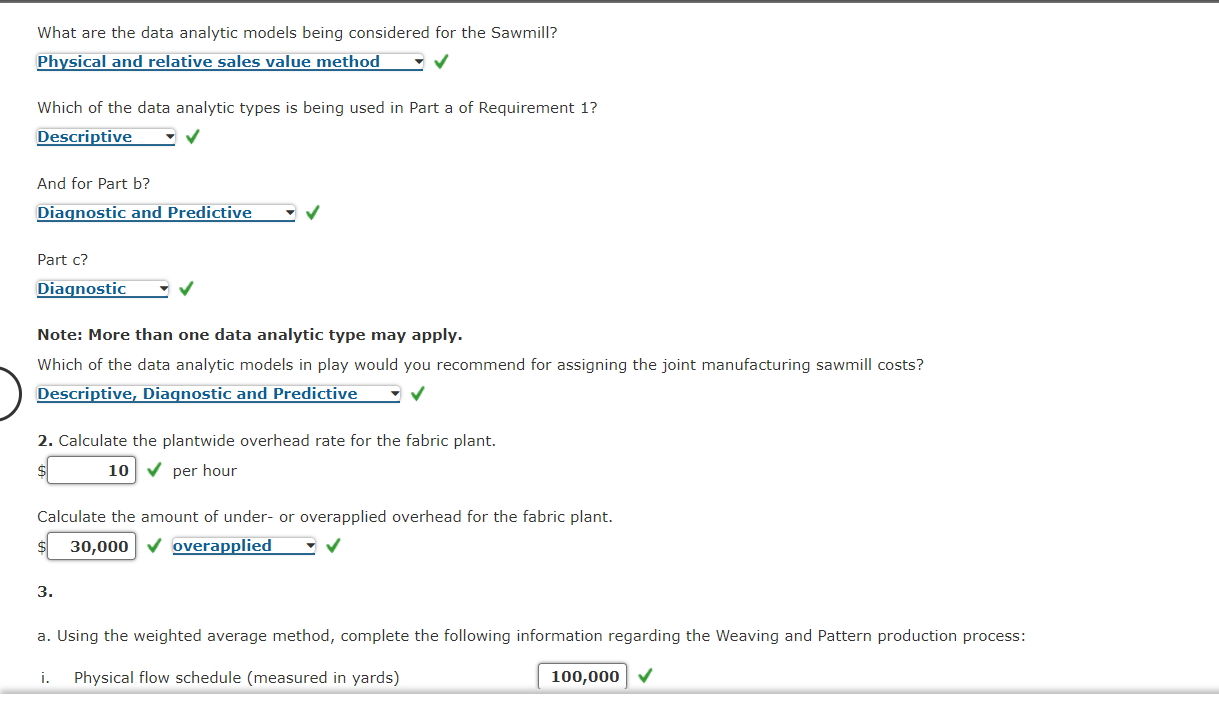
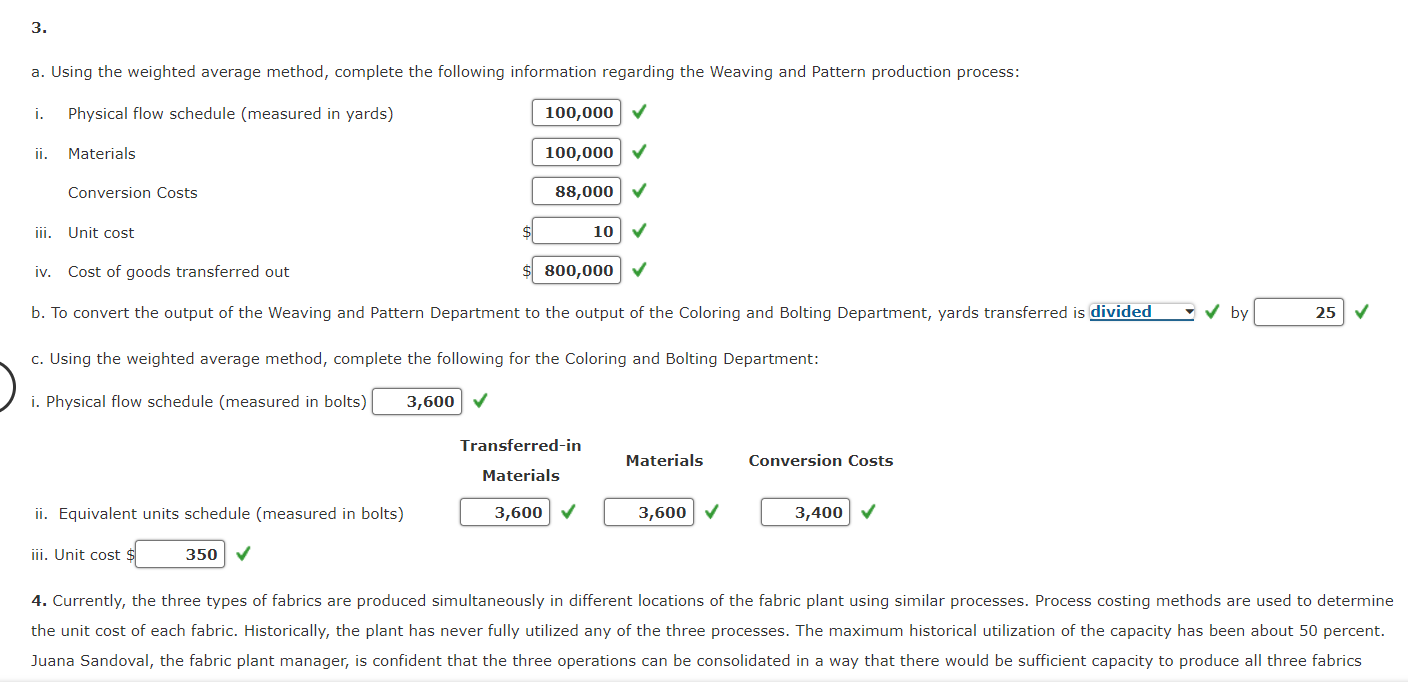
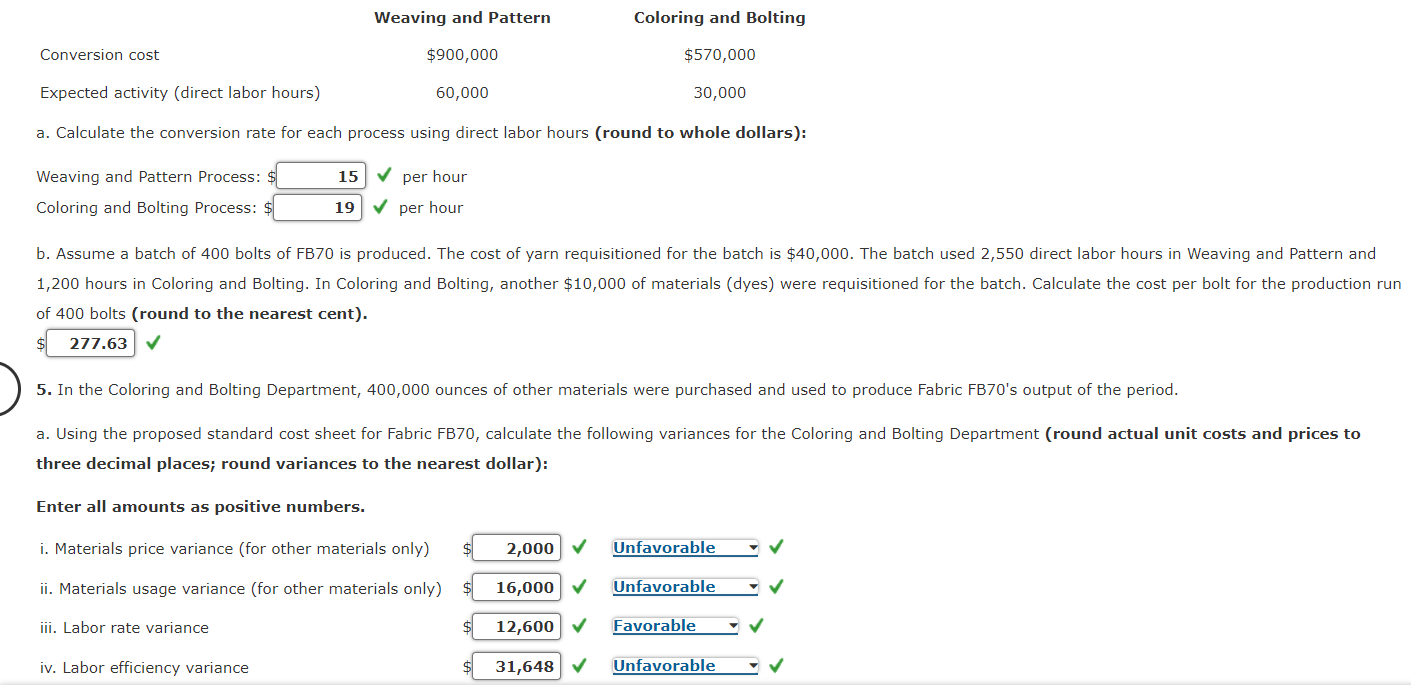
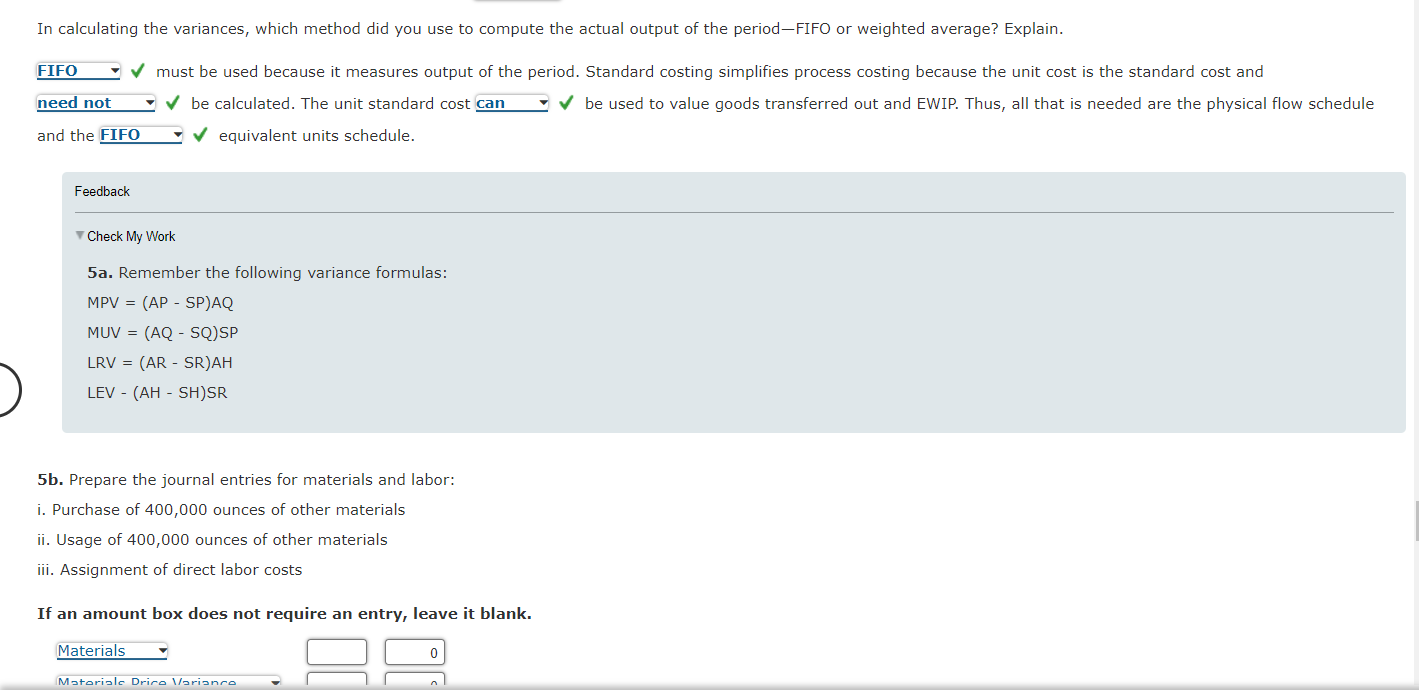
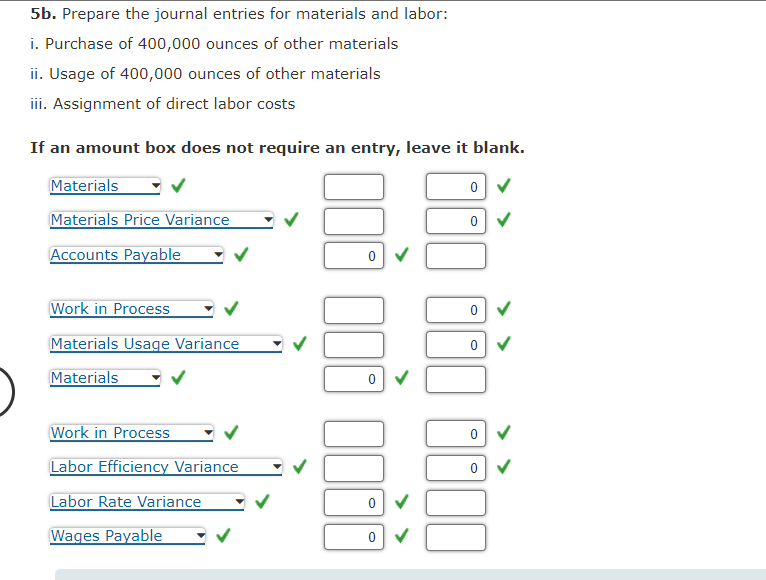
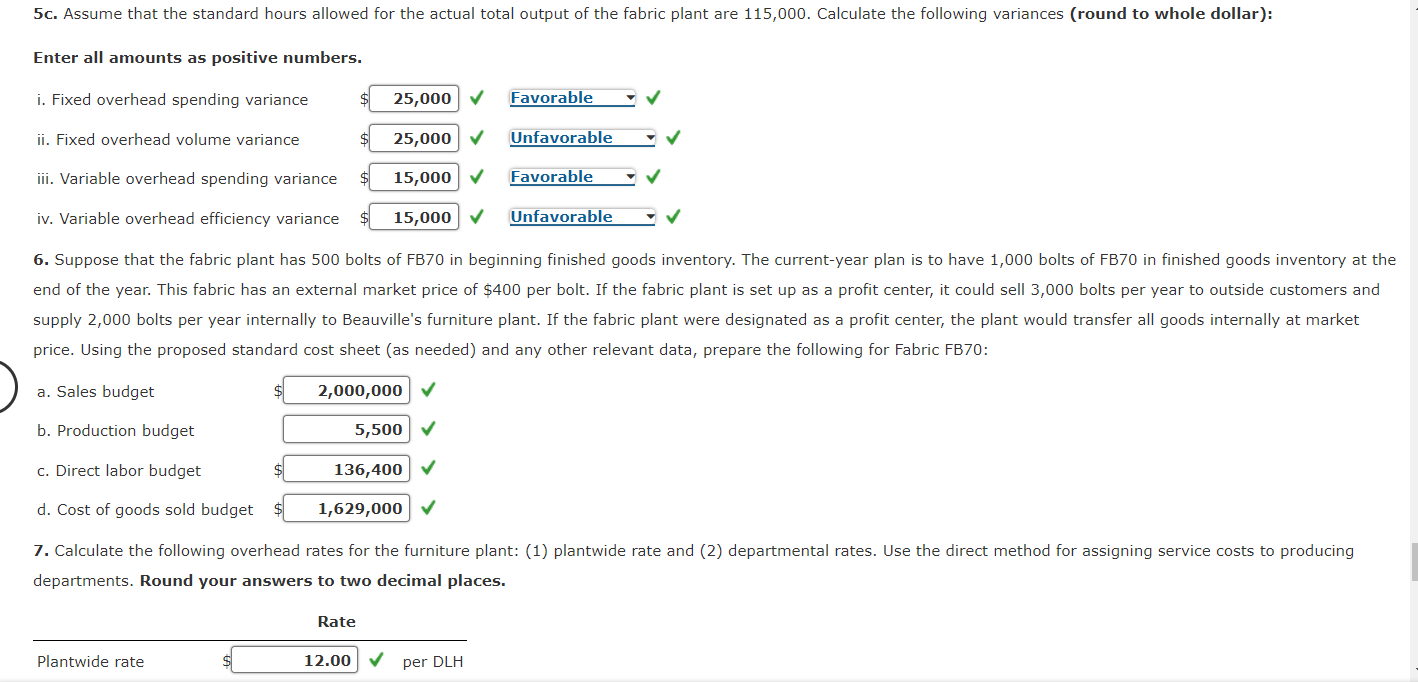
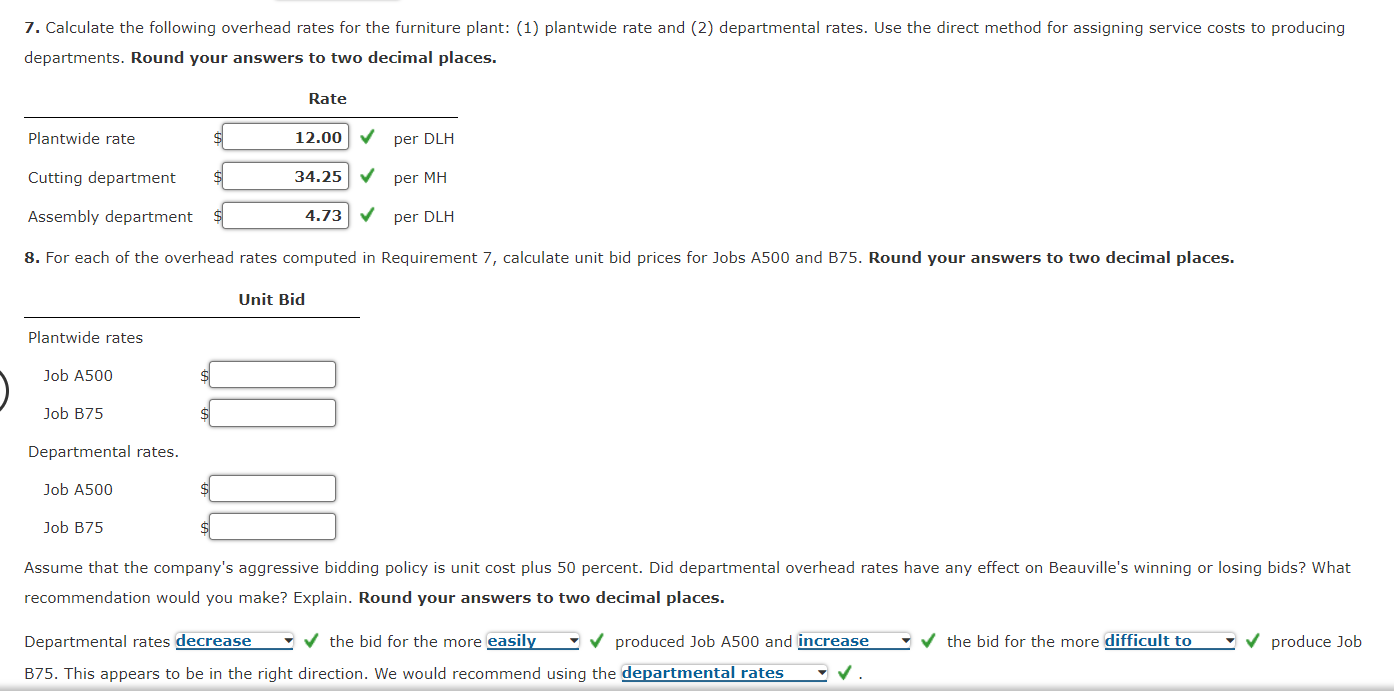
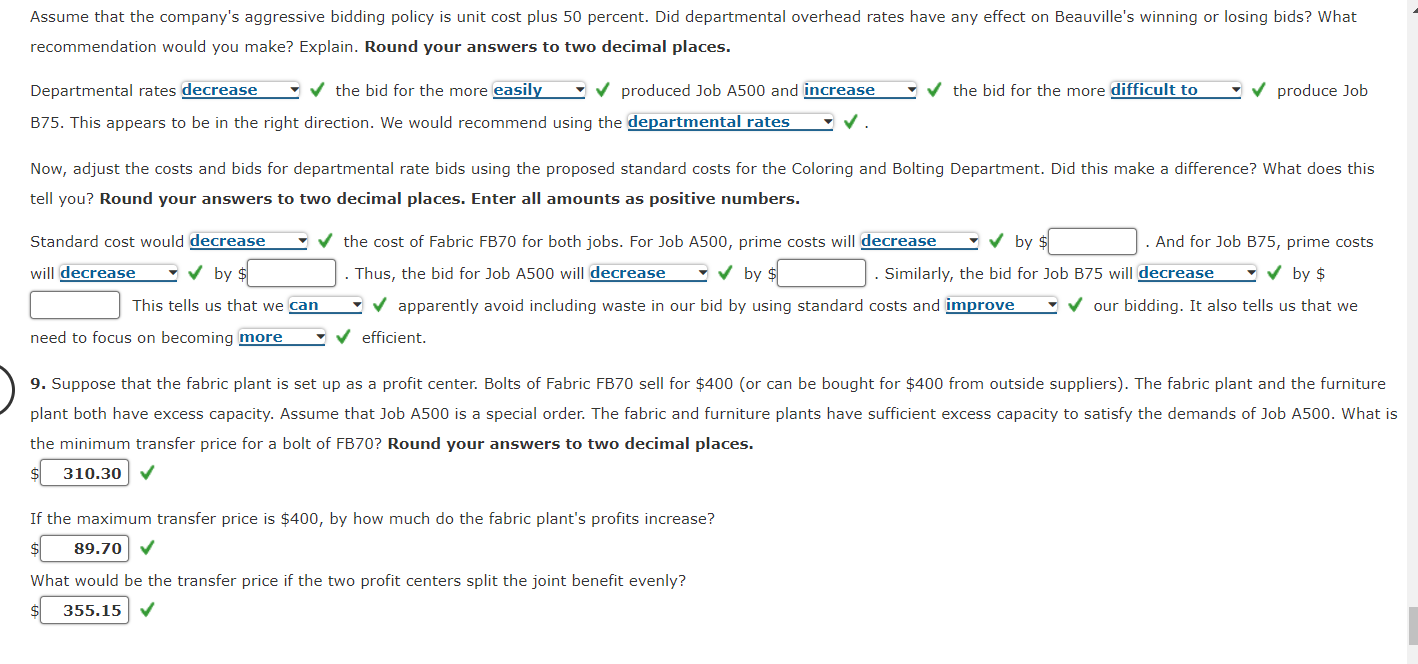
Joint manufacturing costs: $900,000 Fabric Plant: Budgeted overhead: $1,200,000 (50\% fixed) Practical volume (direct labor hours): 120,000 hours Actual overhead: $1,150,000 (50\% fixed) Actual hours worked: Departmental data on Fabric FB70 (actual costs and actual outcomes): \begin{tabular}{lcc} \hline & \begin{tabular}{c} Weaving and \\ Pattern \end{tabular} & Coloring and \\ & & \\ Beginning inventories & 20,000 & 400 \\ Units* & & \\ Costs: & $0 & $100,000 \\ Transferred in & $80,000 & $8,000 \\ Materials & $18,000 & $6,600 \\ Labor & $22,000 & $9,000 \\ Overhead & & \\ Current production: & 80,000 & \\ Units started & 80,000 & \\ Units transferred out & & $3,200 \end{tabular} Furniture Plant: Departmental data (budgeted): Job A500: \begin{tabular}{ll} \hline Direct materials: & \\ Fabric FB70 & 180 bolts @ $350 \\ Lumber (No. 1 common) & 20,000 board feet @ $0.12 \\ Other components & $26,600 \\ Direct labor: & \\ Cutting Department & 400 hours @ $10 \\ Assembly Department & 1,600 hours @ $8.75 \\ Machine time: & \\ Cutting Department & 350 machine hours \\ Assembly Department & 50 machine hours \\ \hline \end{tabular} Job B75: \begin{tabular}{ll} \hline Direct materials: & \\ Fabric FB70 & 26 yards @ $350 \\ Lumber (first and seconds) & 2,200 board feet @ $0.12 \\ Other components & $3,236 \end{tabular} Direct labor: Cutting vepartment 350 machine hours Assembly Department 50 machine hours Job B75: Direct materials: Fabric FB70 26 yards @ $350 Lumber (first and seconds) 2,200 board feet @ \$0.12 Other components $3,236 Direct labor: Cutting Department 70 hours @ \$10 Assembly Department 240 hours @ \$8.75 Machine time: Cutting Department 90 machine hours Assembly Department 15 machine hours Required: 1. Complete the following table by calculating the sawmill's cost per board for each grade using both the physical units method and the sales-value-at-split-off method. Begin by allocating the joint manufacturing costs to each grade, and calculate the cost per board foot for each grade using each method. Round unit cost answers to two decimal places. a. Physical units method of allocation: Sales-value-at-split-off method: Sawmill Cost and Production Data b. Given that the sawmill provides lumber at cost to the furniture plant, using the sales-value-at-split-off method the cost of Job A500 by $ and thecostofJobB75by$. c. The physical units method, often used in the lumber industry, essentially assumes that it costs to produce each board foot the grade. Thus, cost of lumber would be assigned to a sofa or chair which grade is used. This approach has some drawbacks. Intuitively, the higher grades should cost . Certainly, if the company was buying this input from suppliers, there would be for sofas and chairs the grade of lumber purchased, because the higher grades have a selling price. The relative sales value method assigns cost to grades that have a the grade of lumber used. market value. Thus, the cost assigned to sofas and chairs d. Review the data analytic concepts and metrics found in Exhibits 2.5 and 2.6, pp. 37, 40. What are the data analytic models being considered for the Sawmill? Which of the data analytic types is being used in Part a of Requirement 1 ? And for Part b? Part c? Note: More than one data analytic type may apply. Which of the data analytic models in play would you recommend for assigning 2. Calculate the plantwide overhead rate for the fabric plant. q per hour Calculate the amount of under- or overapplied overhead for the fabric plant. a. Using the weighted average method, complete the following information regarding the Weaving and Pattern production process: b. To convert the output of the Weaving and Pattern Department to the output of the Coloring and Bolting Department, yards transferred is by c. Using the weighted average method, complete the following for the Coloring and Bolting Department: i. Physical flow schedule (measured in bolts) a. Calculate the conversion rate for each process using direct labor hours (round to whole dollars): Weaving and Pattern Process: $ Coloring and Bolting Process: $ per hour per hour of 400 bolts (round to the nearest cent). $ 5. In the Coloring and Bolting Department, 400,000 ounces of other materials were purchased and used to produce Fabric FB70's output of the period. three decimal places; round variances to the nearest dollar): In calculating the variances, which method did you use to compute the actual output of the period-FIFO or weighted average? Explain. and the equivalent units schedule. Feedback Check My Work 5a. Remember the following variance formulas: MPV=(APSP)AQMUV=(AQSQ)SPLRV=(ARSR)AHLEV(AHSH)SR 5b. Prepare the journal entries for materials and labor: i. Purchase of 400,000 ounces of other materials ii. Usage of 400,000 ounces of other materials iii. Assignment of direct labor costs If an amount box does not require an entry, leave it blank. 5b. Prepare the journal entries for materials and labor: i. Purchase of 400,000 ounces of other materials ii. Usage of 400,000 ounces of other materials iii. Assignment of direct labor costs If an amount box does not require an entry, leave it blank. Enter all amounts as positive numbers. 6. Suppose that the fabric plant has 500 bolts of FB70 in beginning finished goods inventory. The current-year plan is to have 1,000 bolts of FB70 in finished goods inventory at the end of the year. This fabric has an external market price of $400 per bolt. If the fabric plant is set up as a profit center, it could sell 3,000 bolts per year to outside customers and supply 2,000 bolts per year internally to Beauville's furniture plant. If the fabric plant were designated as a profit center, the plant would transfer all goods internally at market price. Using the proposed standard cost sheet (as needed) and any other relevant data, prepare the following for Fabric FB70: 7. Calculate the following overhead rates for the furniture plant: (1) plantwide rate and (2) departmental rates. Use the direct method for assigning service costs to producing departments. Round your answers to two decimal places. departments. Round your answers to two decimal places. recommendation would you make? Explain. Round your answers to two decimal places. Departmental rates the bid for the more produced Job A500 and the bid for the more produce Job B75. This appears to be in the right direction. We would recommend using the recommendation would you make? Explain. Round your answers to two decimal places. Departmental rates the bid for the more produced Job A500 and the bid for the more produce Job B75. This appears to be in the right direction. We would recommend using the ! tell you? Round your answers to two decimal places. Enter all amounts as positive numbers. Standard cost would will by $ This tells us that we need to focus on becoming the cost of Fabric FB70 for both jobs. For Job A500, prime costs will . Thus, the bid for Job A500 will apparently avoid including waste in our bid by using standard costs and efficient. by $ . Similarly, the bid for Job B75 will our bidding. It also tells us that we the minimum transfer price for a bolt of FB70? Round your answers to two decimal places. If the maximum transfer price is $400, by how much do the fabric plant's profits increase? What would be the transfer price if the two profit centers split the joint benefit evenly? $
Step by Step Solution
There are 3 Steps involved in it

Get step-by-step solutions from verified subject matter experts
 Study Help