Question: please someone provide me correct options for these mcqs i have attached till from 1 to 31. write only the correct answers as a,b,c or
please someone provide me correct options for these mcqs i have attached till from 1 to 31. write only the correct answers as a,b,c or d infront of numbers. ( ps please i need answers for all attached below) of my communication skills course
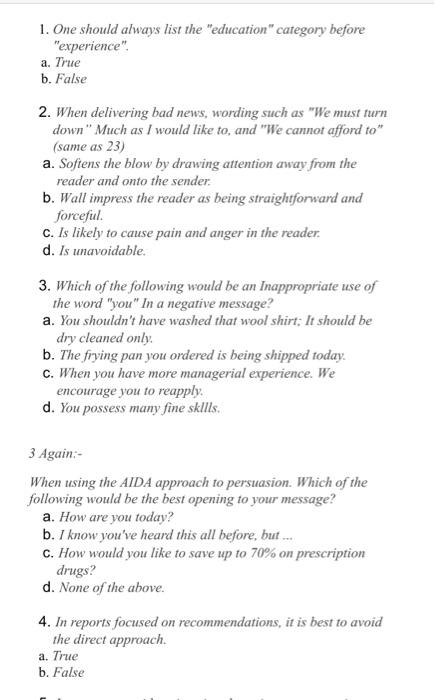
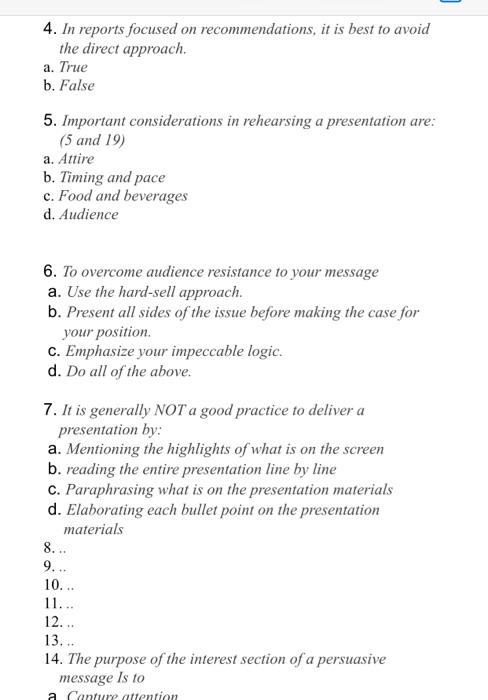
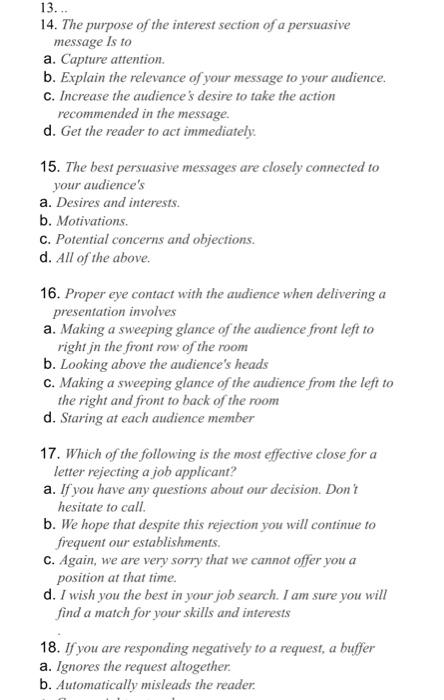
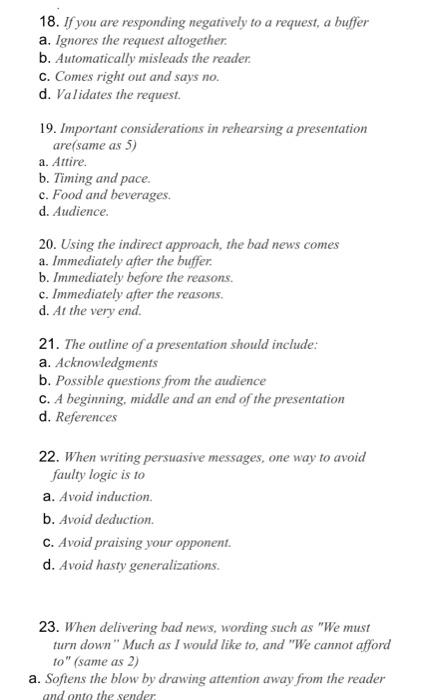
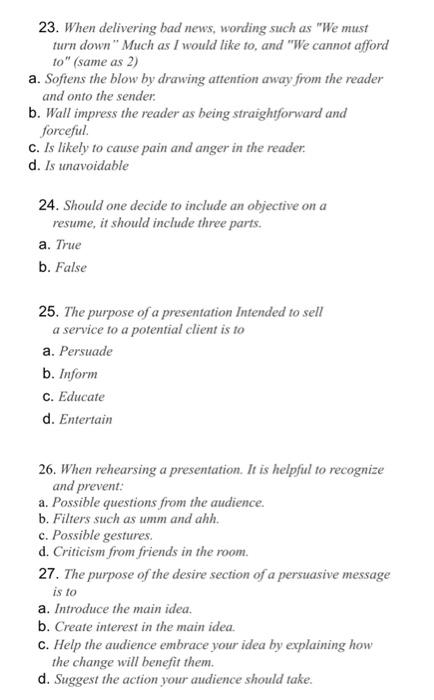
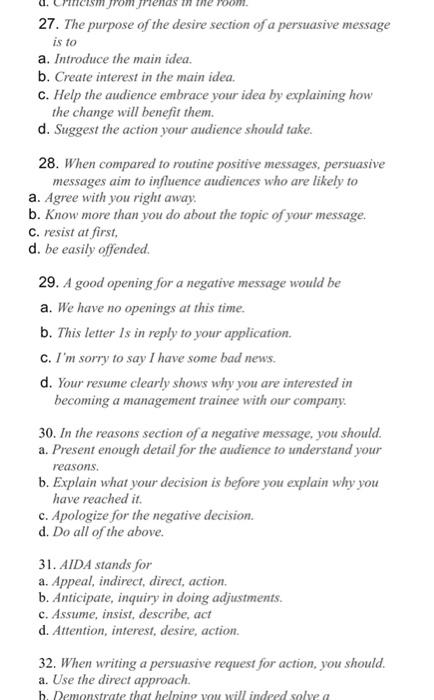
1. One should always list the "education" category before "experience" a. True b. False 2. When delivering bad news, wording such as "We must turn down" Much as I would like to, and "We cannot afford to" (same as 23) a. Softens the blow by drawing attention away from the reader and onto the sender. b. Wall impress the reader as being straightforward and forceful. C. Is likely to cause pain and anger in the reader. d. Is unavoidable. 3. Which of the following would be an Inappropriate use of the word "you" In a negative message? a. You shouldn't have washed that wool shirt: It should be dry cleaned only b. The frying pan you ordered is being shipped today C. When you have more managerial experience. We encourage you to reapply. d. You possess many fine skills. 3 Again:- When using the AIDA approach to persuasion. Which of the following would be the best opening to your message? a. How are you today? b. I know you've heard this all before, but... C. How would you like to save up to 70% on prescription drugs? d. None of the above 4. In reports focused on recommendations, it is best to avoid the direct approach. a. True b. False 4. In reports focused on recommendations, it is best to avoid the direct approach. a. True b. False 5. Important considerations in rehearsing a presentation are: (5 and 19) a. Attire b. Timing and pace c. Food and beverages d. Audience 6. To overcome audience resistance to your message a. Use the hard-sell approach. b. Present all sides of the issue before making the case for your position. C. Emphasize your impeccable logic. d. Do all of the above. 7. It is generally NOT a good practice to deliver a presentation by: a. Mentioning the highlights of what is on the screen b. reading the entire presentation line by line c. Paraphrasing what is on the presentation materials d. Elaborating each bullet point on the presentation materials 8... 9... 10... 11... 12... 13... 14. The purpose of the interest section of a persuasive message Is to a Canture attention 13... 14. The purpose of the interest section of a persuasive message Is to a. Capture attention. b. Explain the relevance of your message to your audience. C. Increase the audience's desire to take the action recommended in the message. d. Get the reader to act immediately. 15. The best persuasive messages are closely connected to your audience's a. Desires and interests. b. Motivations. C. Potential concerns and objections. d. All of the above. 16. Proper eye contact with the audience when delivering a presentation involves a. Making a sweeping glance of the audience front left to right in the front row of the room b. Looking above the audience's heads C. Making a sweeping glance of the audience from the left to the right and front to back of the room d. Staring at each audience member 17. Which of the following is the most effective close for a letter rejecting a job applicant? a. If you have any questions about our decision. Don? hesitate to call. b. We hope that despite this rejection you will continue to frequent our establishments. C. Again, we are very sorry that we cannot offer you a position at that time. d. I wish you the best in your job search. I am sure you will find a match for your skills and interests 18. If you are responding negatively to a request, a buffer a. Ignores the request altogether. b. Automatically misleads the reader. 18. If you are responding negatively to a request, a buffer a. Ignores the request altogether. b. Automatically misleads the reader C. Comes right out and says no. d. Validates the request. 19. Important considerations in rehearsing a presentation are(same as 5) a. Attire. b. Timing and pace. c. Food and beverages. d. Audience. 20. Using the indirect approach, the bad news comes a. Immediately after the buffer. b. Immediately before the reasons. c. Immediately after the reasons. d. At the very end. 21. The outline of a presentation should include: a. Acknowledgments b. Possible questions from the audience C. A beginning, middle and an end of the presentation d. References 22. When writing persuasive messages, one way to avoid faulty logic is to a. Avoid induction b. Avoid deduction C. Avoid praising your opponent. d. Avoid hasty generalizations 23. When delivering bad news, wording such as "We must turn down" Much as I would like to, and "We cannot afford to" (same as 2) a. Softens the blow by drawing attention away from the reader and onto the sender 23. When delivering bad news, wording such as "We must turn down "Much as I would like to, and "We cannot afford to" (same as 2) a. Softens the blow by drawing attention away from the reader and onto the sender b. Wall impress the reader as being straightforward and forceful C. Is likely to cause pain and anger in the reader. d. Is unavoidable 24. Should one decide to include an objective on a resume, it should include three parts. a. True b. False 25. The purpose of a presentation Intended to sell a service to a potential client is to a. Persuade b. Inform C. Educate d. Entertain 26. When rehearsing a presentation. It is helpful to recognize and prevent: a. Possible questions from the audience. b. Filters such as umm and ahh. c. Possible gestures. d. Criticism from friends in the room. 27. The purpose of the desire section of a persuasive message is to a. Introduce the main idea. b. Create interest in the main idea. c. Help the audience embrace your idea by explaining how the change will benefit them. d. Suggest the action your audience should take. 27. The purpose of the desire section of a persuasive message is to a. Introduce the main idea. b. Create interest in the main idea. C. Help the audience embrace your idea by explaining how the change will benefit them. d. Suggest the action your audience should take. 28. When compared to routine positive messages, persuasive messages aim to influence audiences who are likely to a. Agree with you right away. b. Know more than you do about the topic of your message, C. resist at first, d. be easily offended. 29. A good opening for a negative message would be a. We have no openings at this time. b. This letter Is in reply to your application. C. I'm sorry to say I have some bad news. d. Your resume clearly shows why you are interested in becoming a management trainee with our company. 30. In the reasons section of a negative message, you should. a. Present enough detail for the audience to understand your reasons. b. Explain what your decision is before you explain why you have reached it. c. Apologize for the negative decision. d. Do all of the above. 31. AIDA stands for a. Appeal, indirect, direct, action, b. Anticipate, inquiry in doing adjustments. c. Assume, insist, describe, act d. Attention, interest, desire, action. 32. When writing a persuasive request for action, you should. a. Use the direct approach. b. Demonstrate that helning you will indeed solve a









 Study Help