


Question: Please submit a response to the following questions: Complete the exercise in the attached image below from Chapter 7 of Human Resource Development: Talent Development

Please submit a response to the following questions:

  1. Complete the exercise in the attached image below from Chapter 7 of Human Resource Development: Talent Development Werner, J. (2022). HUMAN RESOURCE DEVELOPMENT : talent development. (8th ed.). Cengage Learning Custom P. (Original work published 2025): Calculating the Costs and Benefits of Training.
Please submit a response to the following
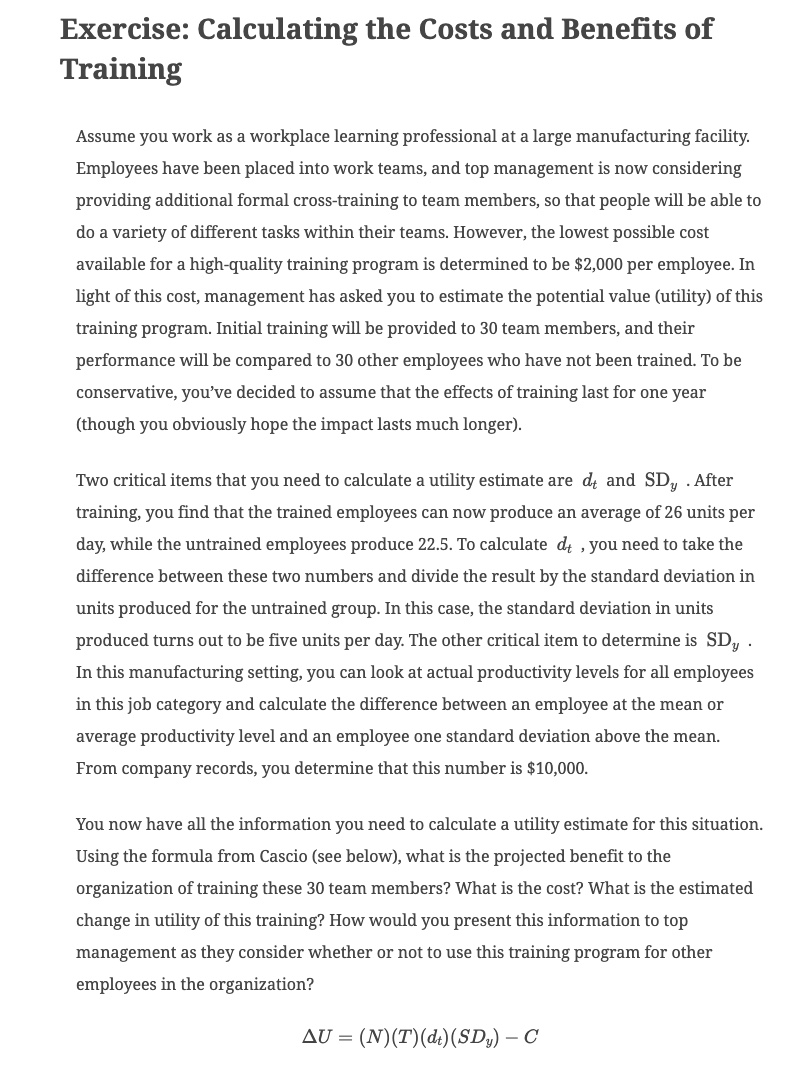
Exercise: Calculating the Costs and Benefits of Training Assume you work as a workplace learning professional at a large manufacturing facility. Employees have been placed into work teams, and top management is now considering providing additional formal cross-training to team members, so that people will be able to do a variety of different tasks within their teams. However, the lowest possible cost available for a high-quality training program is determined to be $2,000 per employee. In light of this cost, management has asked you to estimate the potential value (utility) of this training program. Initial training will be provided to 30 team members, and their performance will be compared to 30 other employees who have not been trained. To be conservative, you've decided to assume that the effects of training last for one year (though you obviously hope the impact lasts much longer). Two critical items that you need to calculate a utility estimate are d; and SD, . After training, you find that the trained employees can now produce an average of 26 units per day, while the untrained employees produce 22.5. To calculate d; , you need to take the difference between these two numbers and divide the result by the standard deviation in units produced for the untrained group. In this case, the standard deviation in units produced turns out to be five units per day. The other critical item to determine is SD, . In this manufacturing setting, you can look at actual productivity levels for all employees in this job category and calculate the difference between an employee at the mean or average productivity level and an employee one standard deviation above the mean. From company records, you determine that this number is $10,000. You now have all the information you need to calculate a utility estimate for this situation. Using the formula from Cascio (see below), what is the projected benefit to the organization of training these 30 team members? What is the cost? What is the estimated change in utility of this training? How would you present this information to top management as they consider whether or not to use this training program for other employees in the organization? AU = (N)(T)(d.)(SD,) C

Step by Step Solution

There are 3 Steps involved in it

1 Expert Approved Answer
Step: 1 Unlock blur-text-image

Question Has Been Solved by an Expert!

Get step-by-step solutions from verified subject matter experts

Step: 2 Unlock
Step: 3 Unlock

Students Have Also Explored These Related Accounting Questions!