







Question: Please summerise above papers DEVELOP YOUR POWER There are two sources of power in negotiation. First, information in general is an important source of power.
Please summerise above papers
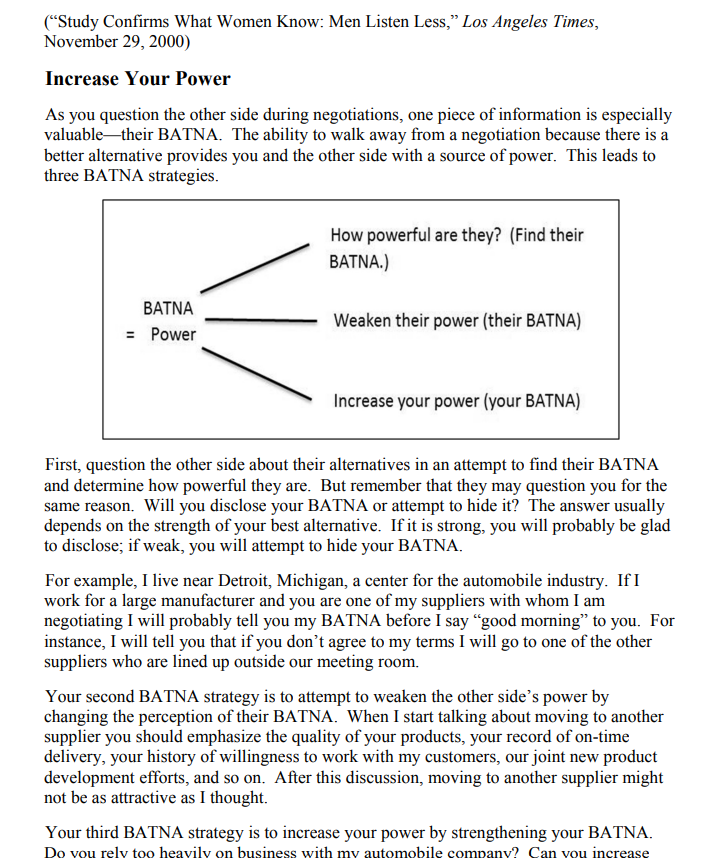
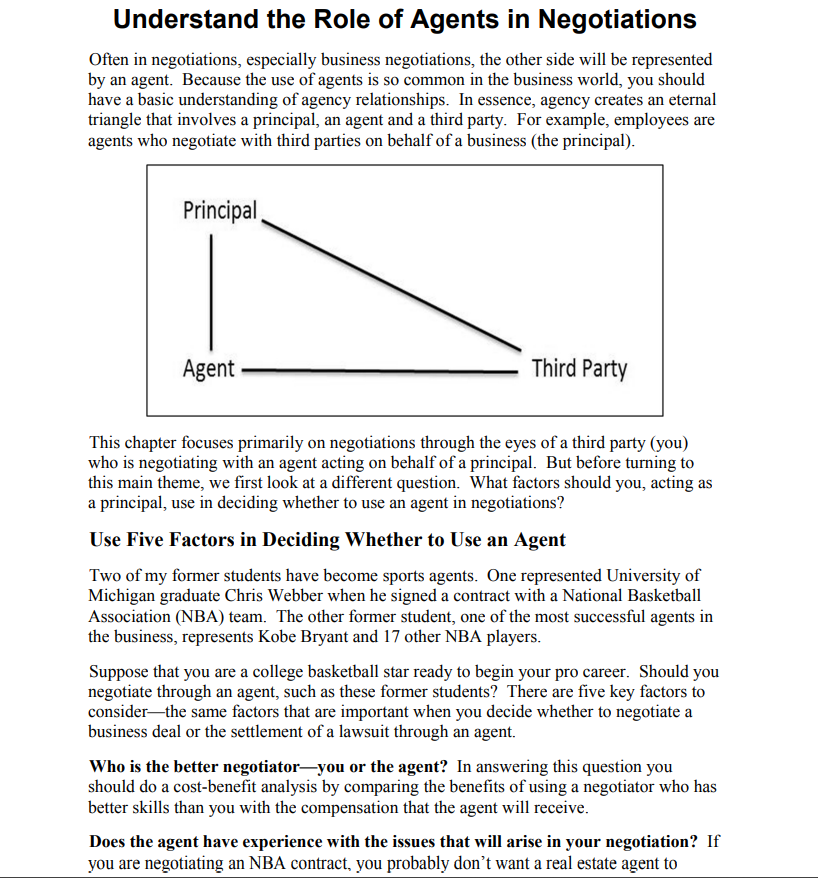
DEVELOP YOUR POWER There are two sources of power in negotiation. First, information in general is an important source of power. Second, specific information about your and the other side's BATNA (best alternative to a negotiated agreement) can be used to increase your power and weaken the power of the other side. Gather General Information from the Other Side I have noticed that many business leaders and students begin my course thinking that their goal in negotiations is to persuade the other side to give them what they want. They soon learn that negotiation success depends more on asking questions to harvest information than on persuasion. In the words of prominent Wharton professor Richard Shell in his book Bargaining for Advantage, "The research on negotiation effectiveness repeatedly underscores a simple fact about skilled negotiators: They focus more than average negotiators do on receiving, as opposed to delivering, information." Joel Kahn, my late colleague and teaching partner at the University of Michigan, put it more simply when he reminded his students that there is a reason God gave us two ears and only one mouth. To "receive" information, negotiators must not only ask questions; they must listen carefully to answers. The ability to listen distinguishes skilled negotiators from average negotiators and it is also an important leadership skill. I worked for several years with a large international consulting firm. Over lunch one day I posed this question to one of the firm's leaders: "You have worked with business leaders around the world. Why is it that some very talented individuals end up in middle-management positions while others move on to leadership roles?" Without hesitation he responded that those who move on to leadership roles possess two important attributes. First, they have a strong conceptual knowledge of their business. Second, they have the ability "to hear." By that he meant the ability to listen. There are signs that as organizations become flatter and leaner the ability to listen is becoming even more important. As legendary management expert Peter Drucker put it, "The leader of the past knew how to tell, the leader of the future will know how to ask." (Goldsmith, Five Global Leadership Factors) Unfortunately, the results from brain-scanning studies indicate that half of the world's population is biologically challenged in the ability to develop the listening skills that are so important in negotiation and leadership. Specifically, males are able to listen with only half their brains. Women probably realized this long before the brain studies! ("Study Confirms What Women Know: Men Listen Less," Los Angeles Times, November 29,2000 ) Increase Your Power As you question the other side during negotiations, one piece of information is especially valuable - their BATNA. The ability to walk away from a negotiation because there is a better alternative provides you and the other side with a source of power. This leads to three BATNA strategies. First, question the other side about their alternatives in an attempt to find their BATNA and determine how powerful they are. But remember that they may question you for the same reason. Will you disclose your BATNA or attempt to hide it? The answer usually depends on the strength of your best alternative. If it is strong, you will probably be glad to disclose; if weak, you will attempt to hide your BATNA. For example, I live near Detroit, Michigan, a center for the automobile industry. If I work for a large manufacturer and you are one of my suppliers with whom I am negotiating I will probably tell you my BATNA before I say "good morning" to you. For instance, I will tell you that if you don't agree to my terms I will go to one of the other suppliers who are lined up outside our meeting room. Your second BATNA strategy is to attempt to weaken the other side's power by changing the perception of their BATNA. When I start talking about moving to another supplier you should emphasize the quality of your products, your record of on-time delivery, your history of willingness to work with my customers, our joint new product development efforts, and so on. After this discussion, moving to another supplier might not be as attractive as I thought. Your third BATNA strategy is to increase your power by strengthening your BATNA. Understand the Role of Agents in Negotiations Often in negotiations, especially business negotiations, the other side will be represented by an agent. Because the use of agents is so common in the business world, you should have a basic understanding of agency relationships. In essence, agency creates an eternal triangle that involves a principal, an agent and a third party. For example, employees are agents who negotiate with third parties on behalf of a business (the principal). This chapter focuses primarily on negotiations through the eyes of a third party (you) who is negotiating with an agent acting on behalf of a principal. But before turning to this main theme, we first look at a different question. What factors should you, acting as a principal, use in deciding whether to use an agent in negotiations? Use Five Factors in Deciding Whether to Use an Agent Two of my former students have become sports agents. One represented University of Michigan graduate Chris Webber when he signed a contract with a National Basketball Association (NBA) team. The other former student, one of the most successful agents in the business, represents Kobe Bryant and 17 other NBA players. Suppose that you are a college basketball star ready to begin your pro career. Should you negotiate through an agent, such as these former students? There are five key factors to consider-the same factors that are important when you decide whether to negotiate a business deal or the settlement of a lawsuit through an agent. Who is the better negotiator-you or the agent? In answering this question you should do a cost-benefit analysis by comparing the benefits of using a negotiator who has better skills than you with the compensation that the agent will receive. Does the agent have experience with the issues that will arise in your negotiation? If you are negotiating an NBA contract, you probably don't want a real estate agent to
Step by Step Solution
There are 3 Steps involved in it

Get step-by-step solutions from verified subject matter experts
 Study Help