Question: Please thoroughly study Chapters 1 and 2 and carefully read the case , Ford Motor Company Alligned Business Framework, in your book (pp. 41-43) .
Please thoroughly study Chapters 1 and 2 and carefully read the case , Ford Motor Company Alligned Business Framework, in your book (pp. 41-43) . You are required to answer the following discussion questions. In addition, each student must comment on at least four other students initial post and/or other student comments.
- As Tony Brown, how would you proceed with implementation of ABF?
- How would you build trust with your suppliers and address their concerns regarding the new relationship between Ford and its suppliers?
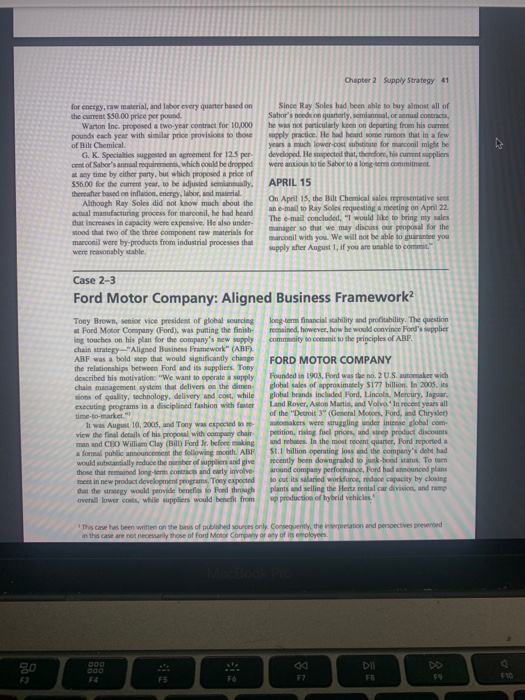
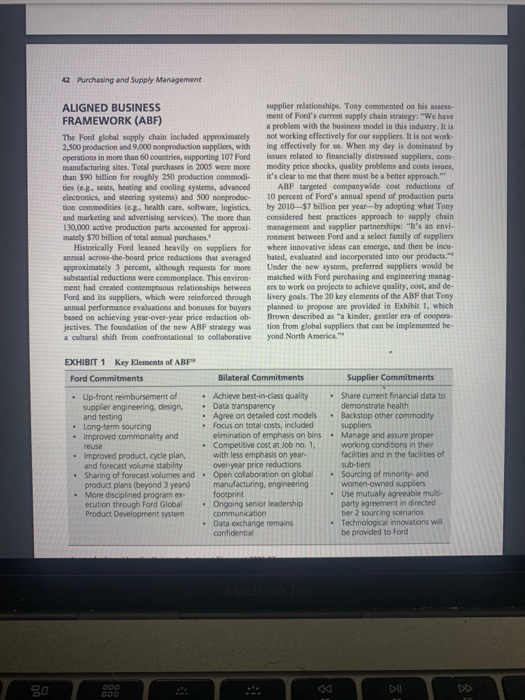
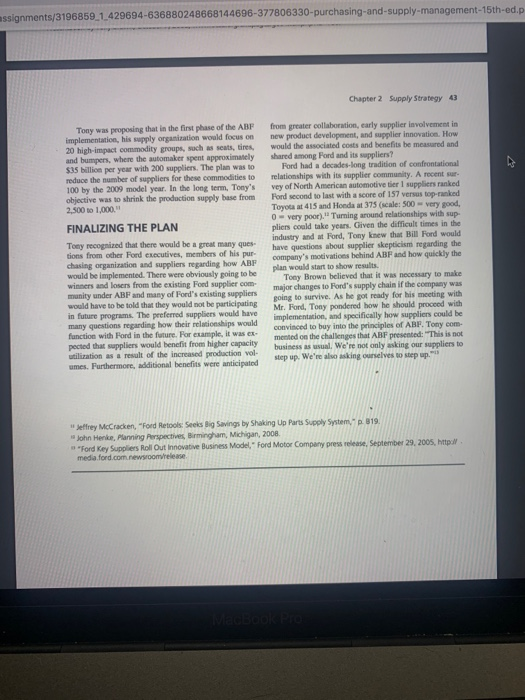
Chapter 2 Supply Strategy 41 for energy, raw material, and labor every quarter based on the current $50.00 price per pound. Warton Inc. proposed a two-year contract for 10,000 pounds each year with similar price provisions to those of Bilt Chemical G. K. Specialties suggested an agreement for 12.5 per cent of Sabor's annual requirements, which could be dropped at any time by either party, but which proposed a price of $56.00 for the current year, to be adjusted semiannually, thereafter based on inflation, energy, labor, and material Although Ray Soles did not know much about the actual manufacturing process for marconil, he had heard that increases in capacity were expensive. He also under- stood that two of the three component raw materials for marconil were by-products from industrial processes that were reasonably stable Since Ray Soles had been able to buy almost all of Sabor's needs on quarterly, semiannual, or annual contracts, he was not particularly keen on departing from his current supply practice. He had heard some rumors that in a few years a much lower cost subunite for marconil might be developed. He suspected that, therefore, this current suppliers were anxious to the Sabor to a long-term commitment. APRIL 15 On April 15, the Bilt Chemical sales representative sent an e-mail to Ray Soles requesting a meeting on April 22. The e-mail concluded, "I would like to bring my sales manager so that we may discuss our proposal for the marconil with you. We will not be able to guarantee you supply after August 1, if you are unable to commit." Case 2-3 Ford Motor Company: Aligned Business Framework long-term financial stability and profitability. The question remained, however, how he would convince Ford's supplier community to commit to the principles of ABR. Tony Brown, senior vice president of global sourcing at Ford Motor Company (Ford), was putting the finish- ing touches on his plan for the company's new supply chain strategy "Aligned Business Framework (ABF). ABF was a bold step that would significantly change the relationships between Ford and its suppliers. Tony described his motivation: "We want to operate a supply chain management system that delivers on the dimen sions of quality, technology, delivery and cost, while executing programs in a disciplined fashion with faster time-to-market." It was August 10, 2005, and Tony was expected to re- view the final details of his proposal with company chair man and CEO William Clay (Bill) Ford Jr. before making a formal public announcement the following month. ABF would substantially reduce the number of suppliers and give those that remained long-term contracts and early involve ment in new product development programs. Tony expected that the strategy would provide benefits to Feed through overall lower costs, while suppliers would benefit from FORD MOTOR COMPANY Founded in 1903. Ford was the no. 2 U.S. automaker with global sales of approximately 5177 billion. In 2005, its global brands included Ford, Lincoln, Mercury, Jaguar, Land Rover, Aston Martin, and Volvo. In recent years all of the "Detroit 3" (General Motors, Ford, and Chrysler) automakers were struggling under intense global com petition, rising fuel prices, and step product discounts and rebotes. In the most recent quarter, Ford reported a SI.1 billion operating loss and the company's debt had recently been downgraded to junk-bond status. To turn around company performance, Ford had announced plans to cut its salaried workforce, reduce capacity by closing plants and selling the Hertz rental car division, and ramp up production of hybrid vehicles This case has been written on the basis of published sources only. Consequently, the interpretation and perspectives presented in this case are not necessarily those of Ford Motor Company or any of its employees 80 000 COD DI F8 F5 F6 F7 79 510 42 Purchasing and Supply Management ALIGNED BUSINESS FRAMEWORK (ABF) The Ford global supply chain included approximately 2,500 production and 9,000 nonproduction suppliers, with operations in more than 60 countries, supporting 107 Ford manufacturing sites. Total purchases in 2005 were more than $90 billion for roughly 250 production commodi- ties (e-.. sets, heating and cooling systems, advanced electronics, and steering systems) and 500 nonproduc tion commodities (eg, health care, software, logistics, and marketing and advertising services). The more than 130,000 active production parts accounted for approxi mately $70 billion of total anual purchases. Historically Ford leaned heavily on suppliers for annual across the board price reductions that averaged approximately 3 percent, although requests for more substantial reductions were commonplace. This environ- ment had created contemptuous relationships between Ford and its suppliers, which were reinforced through annual performance evaluations and bonuses for buyers based on achieving year-over-year price reduction ob- jectives. The foundation of the new ABF strategy was a cultural shift from confrontational to collaborative supplier relationships. Tony commented on his assess- ment of Ford's current supply chain strategy: "We have a problem with the business model in this industry. It is not working effectively for our suppliers. It is not work ing effectively for us. When my day is dominated by issues related to financially distressed suppliers, com- modity price shocks, quality problems and costs issues, it's clear to me that there must be a better approach." ABF targeted company wide cost reductions of 10 percent of Ford's annual spend of production parts by 2010-$7 billion per year-by adopting what Tony considered best practices approach to supply chain management and supplier partnerships: "It's an envi ronment between Ford and a select family of suppliers where innovative ideas can emerge, and then be incu- bated, evaluated and incorporated into our products.* Under the new system, preferred suppliers would be matched with Ford purchasing and engineering manag- ers to work on projects to achieve quality, cost, and de- livery goals. The 20 key elements of the ABF that Tony planned to propose are provided in Exhibit 1, which Brown described as "kinder, gentler era of coopera. tion from global suppliers that can be implemented be- yond North America, EXHIBIT 1 Key Elements of ABF Ford Commitments Bilateral Commitments Up-front reimbursement of Achieve best-in-class quality supplier engineering, design, Data transparency and testing Agree on detailed cost models Long-term sourcing Focus on total costs, included wed commonality and elimination of emphasis on bins reuse Competitive cost at Job no. 1, Improved product, cycle plan, with less emphasis on year and forecast volume stability over-year price reductions Sharing of forecast volumes and . Open colaboration on global product plans (beyond 3 years) manufacturing, engineering More disciplined program ex footprint ecution through Ford Global Ongoing senior leadership Product Development system communication Data exchange remains confidential Supplier Commitments Share current financial data to demonstrate health Backstop other commodity suppliers Manage and assure proper working conditions in their facilities and in the facilities of sub-tiers . Sourcing of minority and women-owned suppliers Use mutualy agreeable multi- party agreement in directed tier 2 sourcing scenarios Technological innovations will be provided to Ford 000 go assignments/3196859_1_429694-636880248668144696-377806330-purchasing-and-supply-management-15th-ed.p Chapter 2 Supply Strategy 43 Tony was proposing that in the first phase of the ABF implementation, his supply organization would focus on 20 high-impact commodity groups, such as seats, tires, and bumpers, where the automaker spent approximately $35 billion per year with 200 suppliers. The plan was to reduce the number of suppliers for these commodities to 100 by the 2009 model year. In the long term, Tony's objective was to shrink the production supply base from 2.500 to 1,000. FINALIZING THE PLAN Tony recognized that there would be a great many ques tions from other Ford Executives, members of his pur chasing organization and suppliers regarding how ABF would be implemented. There were obviously going to be winners and losers from the existing Food supplier com munity under ABF and many of Ford's existing suppliers would have to be told that they would not be participating in future programs. The preferred suppliers would have many questions regarding how their relationships would function with Ford in the future. For example, it was ex- pected that suppliers would benefit from higher capacity utilization as a result of the increased production vol. umes. Furthermore, additional benefits were anticipated from greater collaboration, early supplier involvement in new product development, and supplier innovation. How would the associated costs and benefits be measured and shared among Ford and its suppliers? Ford had a decades-long tradition of confrontational relationships with its supplier community. A recent sur vey of North American automotive tier 1 suppliers ranked Ford second to last with a score of 157 versus top-ranked Toyota at 415 and Honda at 375 (scale: 500 - very good, 0 - very poor)." Turning around relationships with sup pliers could take yours. Given the difficult times in the industry and at Ford, Tony knew that Bill Ford would have questions about supplier skepticism regarding the company's motivations behind ABF and how quickly the plan would start to show results. Tony Brown believed that it was necessary to make major changes to Ford's supply chain if the company was going to survive. As he got ready for his meeting with Mr. Ford, Tony pondered how he should proceed with implementation, and specifically how suppliers could be convinced to buy into the principles of ABF. Tony com. mented on the challenges that ABF presented: "This is not business as usual. We're not only asking our suppliers to step up. We're also asking ourselves to step up." "Jeffrey McCracken, "Ford Retools Seeks Big Savings by Shaking Up Parts Supply System, p. 319 John Henke, Planning Perspectives Birmingham, Michigan, 2008 "Ford Key Suppliers Roll Out innovative Business Model Ford Motor Company press release, September 29, 2005, http:// media.ford.com.newsroomrelease









 Study Help