







Question: please try to give answer for the 3 steps Cumulative Case-Tesla: Traditional Challenges at a Modern Organization Tosla CEO and cofounder Elon Musk was ahwys
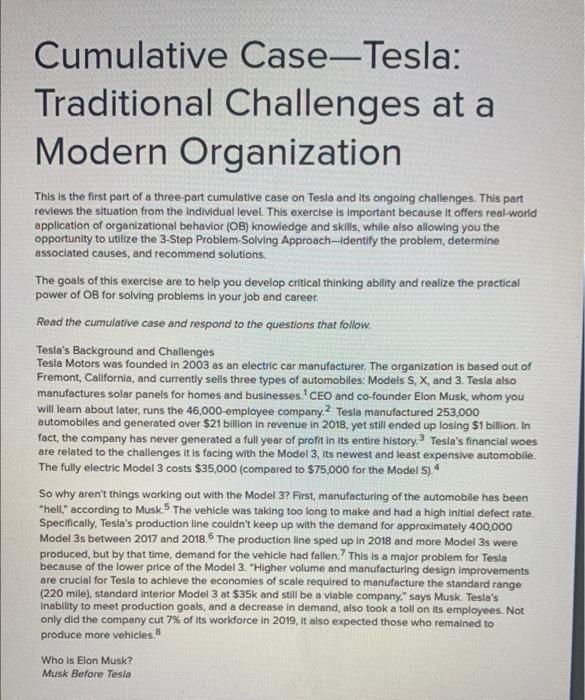
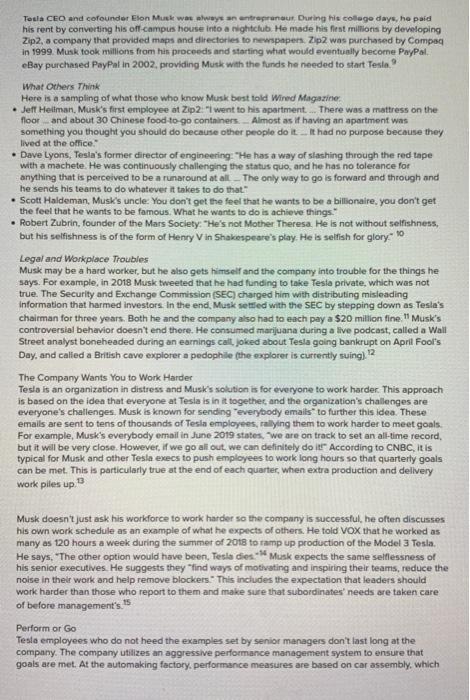
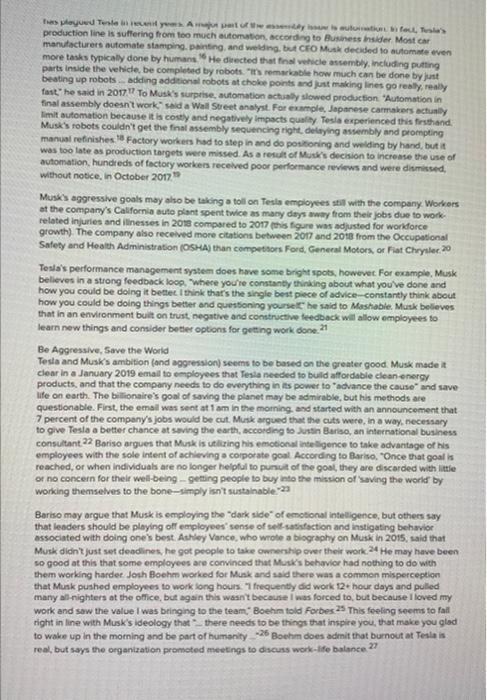
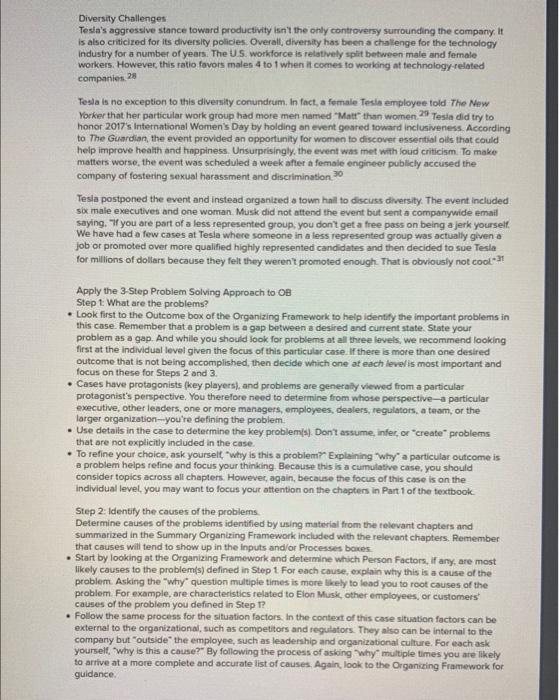
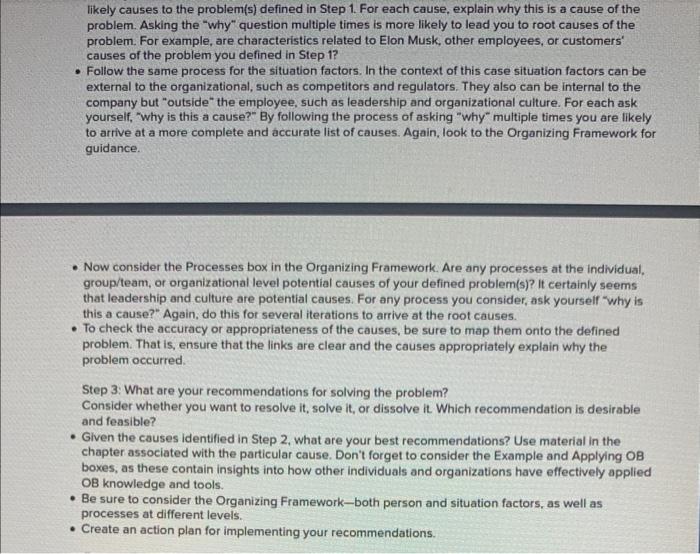
Cumulative Case-Tesla: Traditional Challenges at a Modern Organization Tosla CEO and cofounder Elon Musk was ahwys an entreprandur. During his college days, he paid his rent by coriverting his off-campus house into a nightclub. He made his first milloris by developing Zip2, a company that provided maps and directories to newspapers. Zip2 was parchased by Compoq in 1999. Musk took millions from his proceeds and starting what would eventually become Paypal. eBay purchased PayPal in 2002, providing Musk with the funds he needed to start Tesla.? What Others Think Here is a sampling of what those who know Musk best told Wined Magazine: - Jeff Heitman, Musk's first employee at Zip2: "I went to his apartment. .. There was a mattress on the floor - and about 30 Chinese food to-go conthiners. Almost as if having an apartment was something you thought you should do because other people do it.. it had no purpose because they lived at the otfice. - Dave Lyans, Tesla's former director of engineering: "He has a way of slashing through the red tape with a machete. He was continuously challenging the status quo, and he has no tolerance for anylhing that is perceived to be a runaround at all. . The only way to go is forward and through and he sends his teams to do whatever it takes to do that" - Scott Haldeman, Musk's uncle: You don't get the feel that he wants to be a billionaire, you don't get the feel that he wants to be famous. What he wants to do is achiove things." - Robert Zubrin, founder of the Mars Soclety: "He's not Mother Theresa. He is not without selfishness, but his selfishness is of the form of Henry V in Shakespeare's play. He is selfish for glory. 10 Legal and Workplace Troubles Musk may be a hard worker, but he also gets himself and the company into frouble for the things he says. For example, in 2018 Musk tweeted that he had funding to take fesia private, which was not. true. The Security and Exchange Commission (SEC) charged him with distributing misleading information that harmed investors. In the end, Musk settled with the SEC by stepping down as Tesla's chairman for three years. Both he and the company also had to each pay a $20 million fine. "11 Musk's controversial behavior doesn't end there. He consumed marjuana during a live podcast, called a Wall Street analyst boneheaded during an earnings calt, joked about Tesla going bankrupt on April Fool's Day, and called a British cave explorer a pedophile (the explorer is curtently suing) 12 The Company Wants You to Work Harder Teslo is an organization in distress and Musk's solution is for everyone to work harder. This approach is based on the idea that everyone at Tesia is in it togethet, and the organization's challenges are everyone's challenges, Musk is known for sending Teverybody emails" to further this idea. These emails are sent to tens of thousands of Tesia employees, rallying them to work harder to meet goals For example, Musk's everybody email in June 2019 states, We are on track to set an all-time record, but it will be very close. However, if we go all out, we can definitely do ite According to CNBC, it is typical for Musk and other Tesla execs to push employees to work long hours so that quarterly goals can be met. This is particularly true at the end of each quarter, when extra production and delivery work piles up 13 Musk doesn't just ask his workforce to work harder so the company is successful, he often discusses his own work schedule as an example of what he expects of others. He told vOX that he worked as many as 120 hours a week during the summer of 2018 to ramp up production of the Model 3 Tesla. He says, "The other option would have been, Tesla dies-" - Musk expects the same selflessness of his senior executives. He suggests they "find ways of motivating and inspiring their teams, reduce the noise in their work and help remove blockers." This includes the expectation that leaders should work harder than those who report to them and make sure that subordinates' needs are taken care of before management's. 15 Pertorm or G0 Tesla employees who do not heed the examples set by senior managers don't last long at the company. The company utilizes an aggressive performance management system to ensure that goals ate met. At the automaking factory. performance measures are based on car assembly. which production line is suffering from too much automation, according to Business halder. Most ear. manutacturers automate stamping. paineng, and welding. but Cro Musk decided to automate even. more tasks typicaly done by humans. 16 . He deected that fnal vehicle assembly. including puting parts inside the vehicte, be cornpletard by robots. "ars remarkable how much can be dorie by just. beating up robots - adding additional robots at choke points and just making ines go really, realy fant," he said in 2017 . To Musk's surprise, automation actialy slowed production. 'Automation in final assembly doesn work" sadd a Wal Steet anolyt. For example, Japanese carmakers achaally limit automation because it is cosely and negatively impacts eually. Tesia experienced this frsthand.: Musk's robots couldn't get the final assembly sequencing right, delfying assembly and prompting manusi refinishes: Factory workers had to step in and do posiforing and welding by hand, but it was too late as production torgets were missed. As a result of Mutk's decision to increase the use of automation. hundreds of factory workers received poor perlormance revisws and were diamissed, without notice, in October 2017th Musk's aggressive goals mby also be taking a toll on Tesls empioyees stil with the company Workers at the company's California aute piant spent twice as many days wwary from their jobs due to work. related injurles and lilinesses in 2018 compared to 2017 (this figure was adjusted for workforce growth). The company also received more citations between 2017 and 20 ts from the Occupational Safety and Health Administration (05MA) than competsors Ford, Feneeal Motors, or Fiat Chrylec 20 Tesla's performance management system does hwre some bright spobs, howevec. For example, Musk believes in a strong feedback loop. "whece you're constanby thinking about what you've done and how you could be doing it bethec I think thar's the single best piece of advice-constartly think about how you could be doing things better and questoning yoursert he said to Mashabie. Mauk belleves that in an environment buit on trust negative and constructive teedback will allow employees to learn new things and consider betier options for getting work done. 21 Be Aggressive, Save the World Tesla and Musk's ambition (ond aggression) seems to be based on the greater good. Musk made it clear in a January 2019 email to employees that fesia needed to buld affordable clean energy products, and that the company needs to do everything in its power to "advance the cause" and save life on earth. The billionaire's goal of saving the planet may be admirable, but his methods are questionable. First, the eensil was sent at 1 am in the morning and started with an announcement that 7 percent of the company's jobs would be cut. Murk argund that the cuts were, in a way. necessacy to give Tesia a better chance at suving the earth, according to Justin Buriso, an international business consultant 22 Bariso argues that Musk is utlizing his emobonal intellgence to take advantage of his employees with the sole intent of achleving a corporate goal According to Aariso, "Once that goal is reached, or when individuals are no longer helpful to puruit of the gool, they are discarded with littie or no concern for their weil-being - getiing people to buy inte the mission of 'saving the world by working themselves to the bone-simply isn? tustainable.-23 Bariso may arque that Musk is employing the "dark side" of emotional intelligence, but others say that leaders should be playing off eaployees' sense of set-satiffaction and instigating behsvior essociated with doing one's best. Achley Vance, who wrote a biography on Musk in 2015 , said that Musk didn' just set deodines, he got people to take ownership over their work. 24 He may have been so good at this that some employees are cominced that Musk's behavior had nothing to do with them working hardee Jeth Aoehto worked for Musk and said there was a commen misperception that Munk pushed employees to work long hours. 7 frequently did work 12+ hour days and pulled many all-nighters at the office, but again this wasn't because I was forced to, but because Il loved my work and saw the value I was bringing to the team," Boehin told forber 25 This feeling seems to fail right in line with Musk's ideology that " - there needs to be things that inspire you, that make you glad to wake up in the morning and be part of humonity _ -26 Boehm does admit that burnout at Tesle is rea, but says the organization promoted meetings to discuss work-ite balance 27 Diversity Challenges Tesia's aggressive stance toward productivity isnt the only controversy surrounding the campany, it is also criticized for its diversity policies. Overall, diversity has been a challenge for the technology industry for a number of years. The U.5. workforce is relatively spit between male and female workers. However, this ratio favors males 4 to 1 when it comes to working at technology-related comparien 25 Tesla is no exception to this diversity conundrum. In fact, a female Tesia employee told The Mew Yocker that her particular work group had more men named "Matr' than women 20 Tesia did try to honor 2017 's Interrational Women's Day by holding an event geared toward inclusiveness. According to The Gunrdian, the event provided an opportunity for women to discover essential oils that could heip improve health and happiness. Unsuprisingly, the event was met with loud criticism. To make matters worse, the event was scheduled a week after a female engineer publicly accused the company of fostering sexual harassment and discrimination. 30 Tesla postponed the event and instead organited a town hall to discuss diversity. The event included six male executives and one worman. Musk did not attend the event but sent a companywide email saying. If you are part of a less represented group, you dont get a free pass on being a jerk yourself. We have had a few cases at Tesla where someone in a less represented group was actually ghven a job or promoted over more qualitied highly represented candidates and then decided to sue Tesla for millions of dollars because they felt they werent promoted enough. That is obviously not cool*3t Apply the 3-Step Problem Solving Approach to OE Step t: What are the problems? - Look first to the Outcome box of the Organizing Framework to help identify the important problems in this case. Remember that a problem is a gap between a desired and current state. State your problem as a gap. And while you should look for problems at all three levels, we recommend looking first at the individual level given the focus of this particular case. If there is more than one desired outcome that is not being accomplished, then decide which one at each levelis most important and focus on these for Steps 2 and 3. - Cases have protagonists (key players), and problems are generaly viewed from a particular protagonist's perspective. You therefore need to determine from whose perspective-al particular executive, other leaders, one or more managers, employees, dealers, regulators, a taam, or the larger organization-you're defining the problem. - Use details in the case to determine the key problem(s). Dont assume, infer, or "create" problems that are not explicitly included in the case. - To refine your choice, ask yourself, "why is this a problem? Explaining "why" a particular outcome is a problem helps refine and focus your thinking. Because this is a cumulative case, you should consider topics across all chapters. However, again, because the focus of this case is on the individual level, you may want to focus your attention on the chapters in Part 1 of the textbook. Step 2: Identify the causes of the problems. Determine causes of the problems identified by using material from the televant chapters and summarized in the Summary Organizing Framework included with the relevant chapters. Remember that causes will tend to show up in the inputs and/or Processes baies: - Start by looking at the Organizing Framework and determine which Person Factors, if any, are most likely causes to the problem(s) defined in Step 1. For each cause, explain why this is a cause of the problem. Asking the "why" question multiple times is more likely to lead you to root causes of the problem. For example, are characteristics related to Elon Musk, other employees, or customers' causes of the problem you defined in 5 tep I? - Follow the same process for the situation factors, In the context of this case situation factors can be external to the organizational, such as competitors and regulators. They also can be internal to the company but "outside" the employee, such as leadership and organizational culture. For each ask yourself, "why is this a cause?" By following the process of asking why" multiple times you are likely to arrive at a more comptete and accurate list of causes. Again, look to the Organiting Framework for guidance. likely causes to the problem(s) defined in Step 1 . For each cause, explain why this is a cause of the problem. Asking the "why" question multiple times is more likely to lead you to root causes of the problem. For example, are characteristics related to Elon Musk, other employees, or customers' causes of the problem you defined in Step 1 ? - Follow the same process for the situation factors. In the context of this case situation factors can be external to the organizational, such as competitors and regulators. They also can be internal to the company but "outside" the employee, such as leadership and organizational culture. For each ask yourself, "why is this a cause?" By following the process of asking " why" multiple times you are likely to arrive at a more complete and accurate list of causes. Again, look to the Organizing Framework for guidance. - Now consider the Processes box in the Organizing Framework. Are any processes at the individual. group/team, or organizational level potential causes of your defined problem(s)? It certainly seems that leadership and culture are potential causes. For any process you consider, ask yourseif "why is this a cause?" Again, do this for several iterations to arrive at the root causes. - To check the accuracy or appropriateness of the causes, be sure to map them onto the defined problem. That is, ensure that the links are clear and the causes appropriately explain why the problem occurred. Step 3: What are your recommendations for solving the problem? Consider whether you want to resolve it, solve it, or dissolve it. Which recommendation is desirable and feasible? - Given the causes identified in Step 2, what are your best recommendations? Use material in the chapter associated with the particular cause. Don't forget to consider the Example and Applying OB boxes, as these contain insights into how other individuals and organizations have effectively applied OB knowledge and tools. - Be sure to consider the Organizing Framework-both person and situation factors, as well as processes at different levels. - Create an action plan for implementing your recommendations
Step by Step Solution
There are 3 Steps involved in it

Get step-by-step solutions from verified subject matter experts
 Study Help