







Question: PLEASE TYPE RESPONSE AND ANSWER Part IIIc: Discussion, Reflection, & Alternatives After reading through, please answer and respond to Part IIIc: Discussion, Reflection, & Alternatives
PLEASE TYPE RESPONSE AND ANSWER Part IIIc: Discussion, Reflection, & Alternatives
After reading through, please answer and respond to Part IIIc: Discussion, Reflection, & Alternatives
Part I: Define the Problem
Persons in the high stress and seldom trained situation of disarming a commercial sprinkler system often make mistakes and compound the issue causing more damage or loss, due to not completing the sequence fast enough or breaking the necessary order.
Part IIa: Analysis & Support
Fires caused 14.3 billion dollars of damages in the United States in 2019 (Harrington) and can be a major problem for a big box retail store. There is the potential of injury or death to both workers and customers, loss of the $3-6 million of merchandise in the store, plus the loss of the property itself minus insurance. As advanced as safety and sprinkler systems are, they are still highly manual in terms of shutting down in the case of a false alarm or accident (such as sprinkler head being hit by power equipment). This human element added to a very hectic complicated situation brings many cognitive issues into play that can lead to incorrect decisions and millions of dollars more in damages.
An automated system that can be quickly overridden in a false alarm situation and can shut its self-down efficiently would be much more time saving in a position that can have hundreds of gallons of water being unloaded onto the store and merchandise every minute. The current manual system requires a manager to run to the sprinkler room, manual shut up multiple pumps, breakers, and valves while maintaining a very specific sequence. This takes precious seconds which results in many more gallons of water being sprayed onto and ruining merchandise and creating a longer more expensive clean up process.
Part IIb: Design & Solutioning
It is proposed that a highly automated system will be more expensive to install in each store but will have 2x the return on investment due to the savings in the event of a fire or a false alarm. With the infrequency of fire or false alarm incidents, the testing period will have to be over multiple stores and a long period so averages can be established, and outlier events can be smoothed. Each event in of itself can vary widely in amount, of damages so all results will be averaged from the stores equipped with new automated system and all of the traditional stores.
Experiment #1:
Hypothesis There will be a savings of over $1,000,000 per incident which will make it cost effective to install the new automated system in all stores. The automated system will be more efficient in distributing the water in the event of a fire to save more of the store, and it will also be much more efficient in stopping the sprinkler system in the event of a false alarm. The response time from false alarm event start until system being shut down will be less than half the standard manual human process currently being used.
Measures The new automated system will cost $500,000 to install in each store. For this test 10 stores will be equipped with the new automated system and those stores will be monitored over a two-year period. Times will be established from start of false alarm event when system is started until system is shut down. Dollar amounts of any damages will also be tracked in both false alarm and true fire situations. Times and damage amounts will be compared on average for the 10 automated stores vs the traditional manual system stores.
Part IIIA: [Hypothetical] Findings or Results - Nicholas Hersom
The metrics measured included Shutdown time(s), amount of water used (Gal.), the amount of property damaged ($USD), and the size of the warehouse (Sqft). The shutdown time reflects how long the sprinklers ran before they were shut down. This is measured in seconds to better help calculate the amount of water used based on the rate of 11 gallons per minute (SC Fire Sprinkler Coalition, 2014) for modern sprinkler systems, versus the slightly higher flow rate of older sprinkler without smart valves. This metric is also relevant as it is the major advantage of automated shut systems versus manual shut off systems. The second metric being amount water used is relevant as this is the major cause of damage to both property and products. This is anticipated to having a direct correlation to the amount of damage caused. Property damaged will be considered damage to the structure, building, shelving, etc. While the intent of the automated systems to save money of damaged goods, reason this isnt record is because this amount would vary greatly based on the warehouse. For example, a warehouse storing consumer packaged goods would sustain greater product losses than a warehouse holding workout equipment or outdoor hardware. Thus, to avoid a skewing in the data this was not measured. Lastly, the warehouse size will be measured in an effort to determine if size has an effect on the overall effectiveness on the automated systems vs. manual systems. The states chosen to experience a various weather, with some seeing colder temps than others. For this was done on purpose to see how automated shut off systems faired due to sprinkler activations cause by frozen or broken pipes. However, this was not factored into the property damage metric to prevent the skewing of data in favor of the warmer climates.
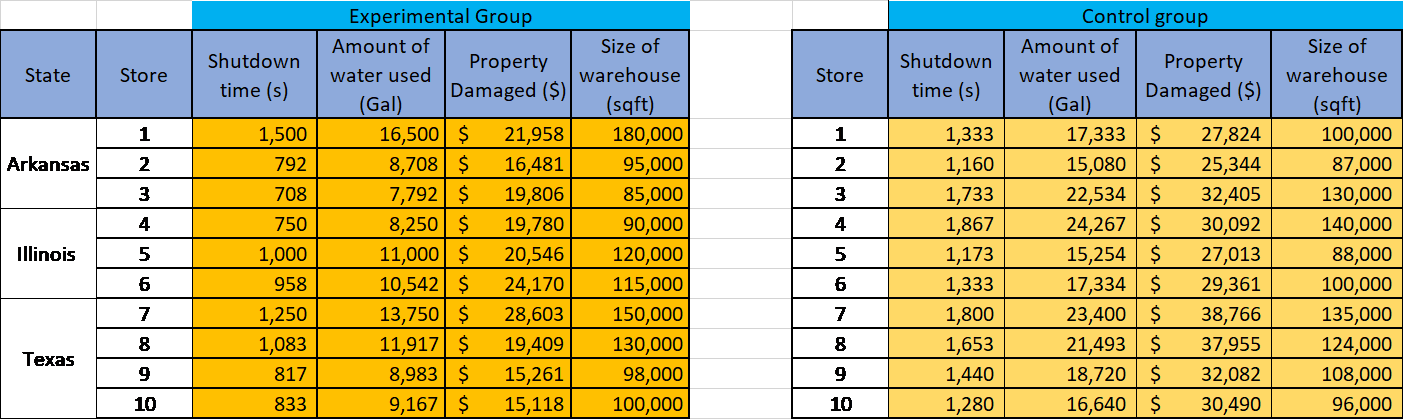
The average shutdown time of the experimental group was 966 seconds or 16.1 minutes, with an average amount of water used being 10,628 gallons. This resulted in an average cost of $20,170 in property damage. The control group however, averaged 1,470 seconds or approximately 24.1 minutes before being shut down. This resulted in an average water usage of 19,110 gallons, and an average cost of $30,723. It was initially anticipated that the doubled water usage would result in a doubling in property damage. This did not prove true as we found that the top- and higher-level shelves absorbed the brunt of the water exposure with the middle- to lower-shelves being less susceptible. The shelves and similar structures also helped to channel the water down the isles versus allowing them to spread freely and more evenly.
Part III B: [Hypothetical] Data Analysis
[This is where the data goes put a summary in the narrative and attach any Excel worksheets, etc.]
Part IIIc: Discussion, Reflection, & Alternatives
[This is the critical review and things that you learn/find out as a result of doing the experiment the way you [hypothetically] did it. In real experiments, it is often surprising what you think of after the fact. This is where those insights go.]
State Store Shutdown time (s) Store Shutdown time (s) 1 1 1,500 792 Arkansas 2 2 3 708 3 Experimental Group Amount of Property water used Damaged ($) (Gal) 16,500 $ 21,958 8,708 $ 16,481 7,792 $ 19,806 8,250 $ 19,780 11,000 $ 20,546 10,542 $ 24,170 13,750 $ 28,603 11,917 $ 19,409 8,983 $ 15,261 9,167 $ 15,118 Control group Amount of Property water used Damaged ($) (Gal) 17,333 $ 27,824 15,080 $ 25,344 22,534 $ 32,405 24,267 $ 30,092 15,254 $ 27,013 17,334 $ 29,361 23,400 $ 38,766 21,493 $ 37,955 18,720 $ 32,082 16,640 $ 30,490 Size of warehouse (sqft) 180,000 95,000 85,000 90,000 120,000 115,000 150,000 130,000 98,000 100,000 4 5 4 Illinois Size of warehouse (sqft) 100,000 87,000 130,000 140,000 88,000 100,000 135,000 124,000 108,000 96,000 1,333 1,160 1,733 1,867 1,173 1,333 1,800 1,653 1,440 1,280 5 750 1,000 958 1,250 1,083 817 6 6 7 7 8 8 Texas 9 9 10 833 10 State Store Shutdown time (s) Store Shutdown time (s) 1 1 1,500 792 Arkansas 2 2 3 708 3 Experimental Group Amount of Property water used Damaged ($) (Gal) 16,500 $ 21,958 8,708 $ 16,481 7,792 $ 19,806 8,250 $ 19,780 11,000 $ 20,546 10,542 $ 24,170 13,750 $ 28,603 11,917 $ 19,409 8,983 $ 15,261 9,167 $ 15,118 Control group Amount of Property water used Damaged ($) (Gal) 17,333 $ 27,824 15,080 $ 25,344 22,534 $ 32,405 24,267 $ 30,092 15,254 $ 27,013 17,334 $ 29,361 23,400 $ 38,766 21,493 $ 37,955 18,720 $ 32,082 16,640 $ 30,490 Size of warehouse (sqft) 180,000 95,000 85,000 90,000 120,000 115,000 150,000 130,000 98,000 100,000 4 5 4 Illinois Size of warehouse (sqft) 100,000 87,000 130,000 140,000 88,000 100,000 135,000 124,000 108,000 96,000 1,333 1,160 1,733 1,867 1,173 1,333 1,800 1,653 1,440 1,280 5 750 1,000 958 1,250 1,083 817 6 6 7 7 8 8 Texas 9 9 10 833 10
Step by Step Solution
There are 3 Steps involved in it

Get step-by-step solutions from verified subject matter experts
 Study Help