





Question: PLEASE Type the code. Please provide correct answer!! Question 1 (25 Marks) In class, we have studied the singly linked list, implemented as follows: #include

PLEASE Type the code.

Please provide correct answer!!
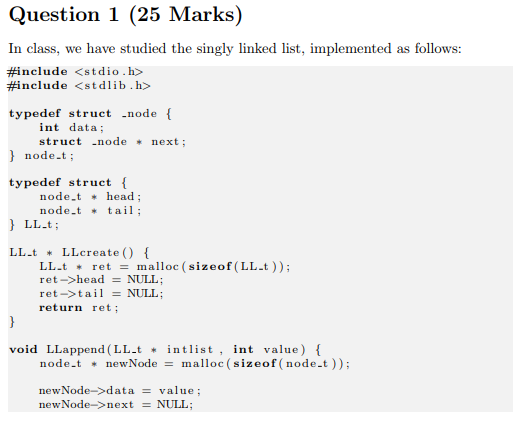
PLEASE Type the code. Please provide correct answer!! Question 1 (25 Marks)In class, we have studied the singly linked list, implemented as follows:
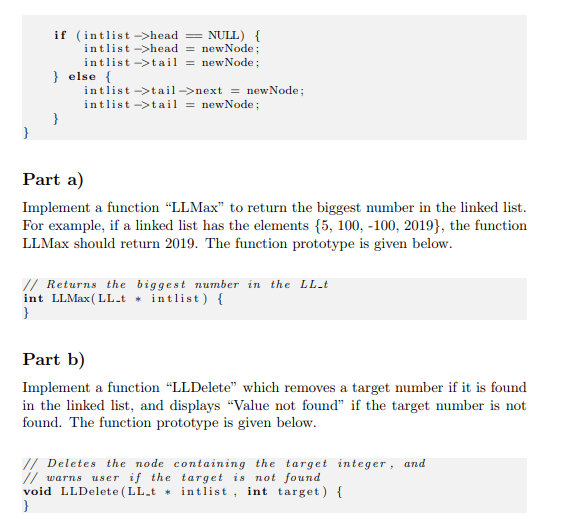
Question 1 (25 Marks) In class, we have studied the singly linked list, implemented as follows: #include #include typedef struct node ( int data struct node next nodet typedef struct { node.t head nodet tail; LLt; LL.t LLcreate) LL-t * ret =malloc ( sizeof(LL-t ) ) ; ret->headNULL ret-> t a i l NUIL return ret; void LLappend (LL.tintlist, int value) node.t newNodemalloc (sizeof (node.t)) newNode->data = value ; newNode-> next = NULL; if (intlist->head :-NULL) { intlist->head - newNode; intlist ->tilnewNode; else intlist-> tail-> next = newNode ; intlist-tailnewNode Part a) Implement a function "LLMax" to return the biggest number in the linked list For example, if a linked list has the elements 5, 100, -100, 2019), the function LLMax should return 2019. The function prototype is given below. Returns the biggest number in the LL.t int LLMax (LL.tintlist) Part b) Implement a function "LLDelete" which removes a target number if it is found in the linked list, and displays "Value not found" if the target number is not found. The function prototype is given below. //Deletes the node containing the target integer, and warns user if the target is not found void LLDelete (LL,t * intlist , int target ) {

Step by Step Solution

There are 3 Steps involved in it

1 Expert Approved Answer
Step: 1 Unlock blur-text-image
Question Has Been Solved by an Expert!

Get step-by-step solutions from verified subject matter experts

Step: 2 Unlock
Step: 3 Unlock

Students Have Also Explored These Related Databases Questions!