





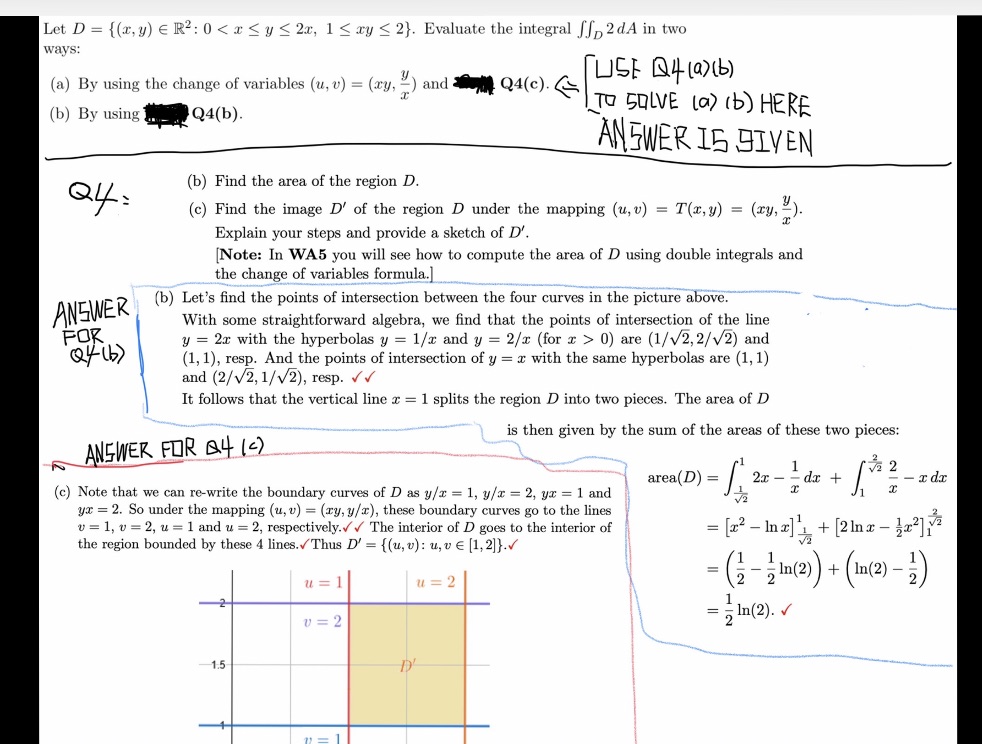
Question: please use answer for q4 (b) (c) to solve the problem (a) (b). Thank you. Let D = {(x, y) ER' : 0 > 0)

please use answer for q4 (b) (c) to solve the problem (a) (b). Thank you.
please use answer for q4 (b) (c) to solve the
Let D = {(x, y) ER' : 0 > 0) are (1/v2,2/v2) and Q4 ( b ) (1, 1), resp. And the points of intersection of y = > with the same hyperbolas are (1, 1) and (2/V/2, 1/V2), resp. v V It follows that the vertical line x = 1 splits the region D into two pieces. The area of D is then given by the sum of the areas of these two pieces: ANSWER FOR B.4 ( C ) area(D) = / (c) Note that we can re-write the boundary curves of D as y/r = 1, y/x = 2, yr = 1 and 2x - - da + yr = 2. So under the mapping (u, v) = (ry, y/x), these boundary curves go to the lines v = 1, v = 2, u = 1 and u = 2, respectively. The interior of D goes to the interior of = [x2 - Inx] 1 + [2lnx - ;x2]%2 the region bounded by these 4 lines. Thus D' = {(u, v): u, ve [1, 2]}. u = 1 u = 2 = (2-710(2) ) + (In(2) - 2) -2- = , In(2). U = 2 1.5

Step by Step Solution

There are 3 Steps involved in it

1 Expert Approved Answer
Step: 1 Unlock blur-text-image

Question Has Been Solved by an Expert!

Get step-by-step solutions from verified subject matter experts

Step: 2 Unlock
Step: 3 Unlock

Students Have Also Explored These Related Mathematics Questions!