







Question: Please use mathlab or python to solve and show all steps with code and solution. 3.For each of the four PRNGs (A-D) defined above, let
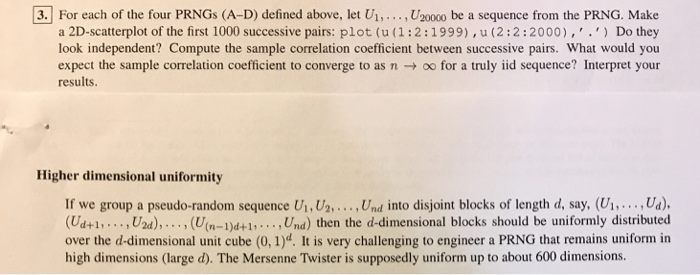
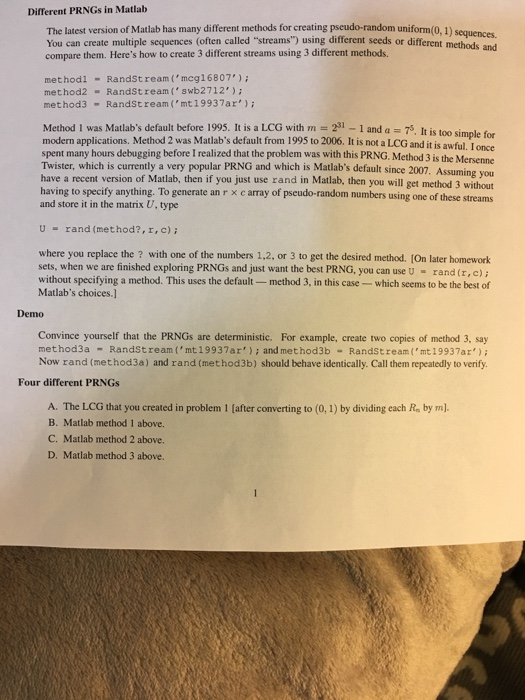
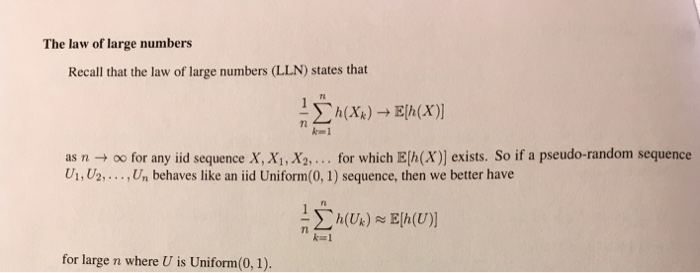
3.For each of the four PRNGs (A-D) defined above, let U.., U2000 be a sequence from the PRNG. Make a 2D-scatterplot of the first 1000 successive pairs: plot (u(1:2:1999),u (2:2:2000),) Do they look independent? Compute the sample correlation coefficient between successive pairs. What would you expect the sample correlation coefficient to converge to as n oo for a truly iid sequence? Interpret your results Higher dimensional uniformity If we group a pseudo-random sequence Ui, U2, . . . , Und into disjoint blocks of length d, say, (u, . . . , U), ,2d)..., (Un- Und) then the d-dimensional blocks should be uniformly distributed over the d-dimensional unit cube (0, 1)d. It is very challenging to engineer a PRNG that remains uniform in high dimensions (large d). The Mersenne Twister is supposedly uniform up to about 600 dimensions. The law of large numbers Recall that the law of large numbers (LLN) states that A-1 as n oo for any iid sequence X, X1,Xy, . . . for which E(h(X) exists. So if a pseudo-random sequence U1,U2,. ,Un behaves like an iid Uniform(0, 1) sequence, then we better have ku1 for large n where U is Uniform (0, 1)
Step by Step Solution
There are 3 Steps involved in it

Get step-by-step solutions from verified subject matter experts
 Study Help