







Question: Please use Python to solve it. Your tasks are listed below. 1. Implement the base case (when the Tree is empty). 2. Implement the case
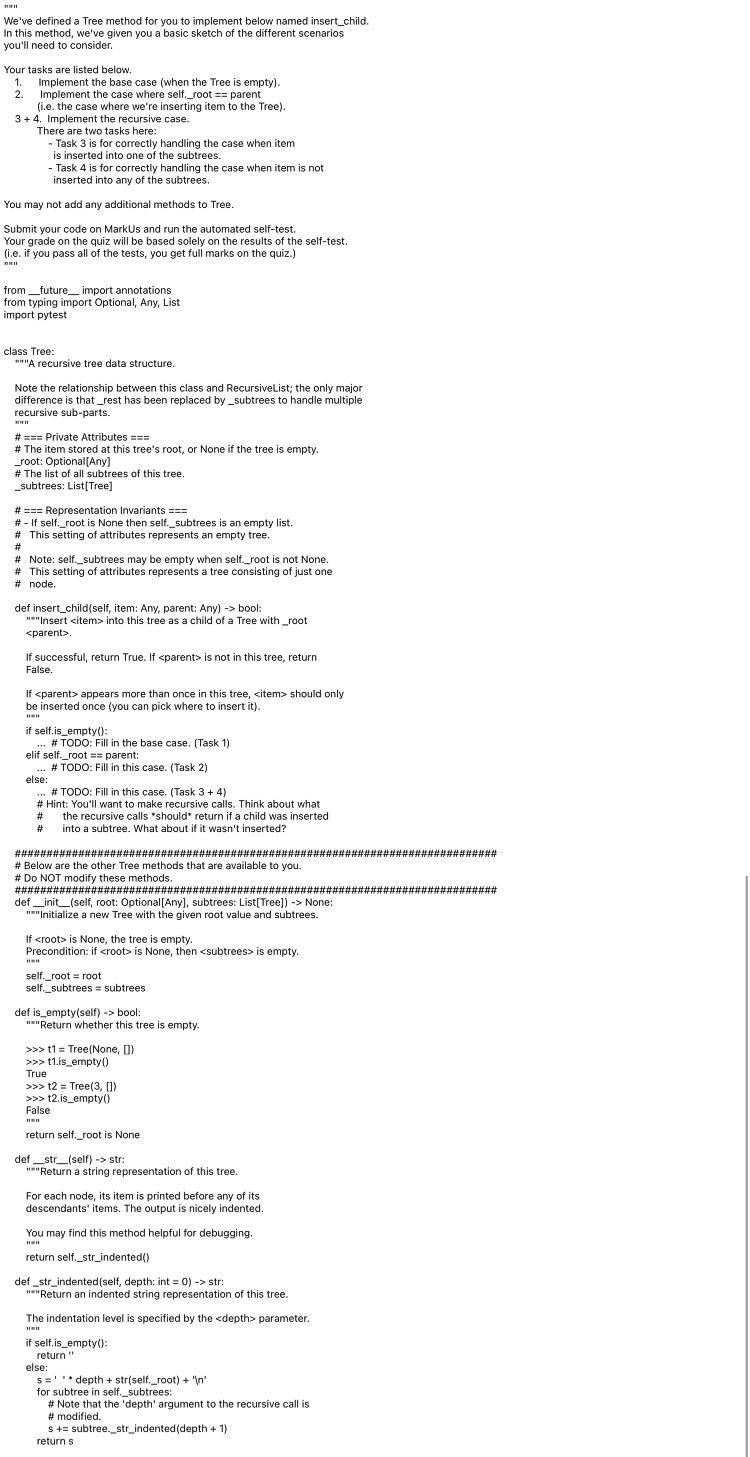
Please use Python to solve it.
Your tasks are listed below. 1. Implement the base case (when the Tree is empty). 2. Implement the case where self._root == parent (i.e. the case where we're inserting item to the Tree). 3 + 4. Implement the recursive case. There are two tasks here: - Task 3 is for correctly handling the case when item is inserted into one of the subtrees. - Task 4 is for correctly handling the case when item is not inserted into any of the subtrees.
You may not add any additional methods to Tree.
Submit your code on MarkUs and run the automated self-test. Your grade on the quiz will be based solely on the results of the self-test. (i.e. if you pass all of the tests, you get full marks on the quiz.) """
from __future__ import annotations from typing import Optional, Any, List import pytest
class Tree: """A recursive tree data structure.
Note the relationship between this class and RecursiveList; the only major difference is that _rest has been replaced by _subtrees to handle multiple recursive sub-parts. """ # === Private Attributes === # The item stored at this tree's root, or None if the tree is empty. _root: Optional[Any] # The list of all subtrees of this tree. _subtrees: List[Tree]
# === Representation Invariants === # - If self._root is None then self._subtrees is an empty list. # This setting of attributes represents an empty tree. # # Note: self._subtrees may be empty when self._root is not None. # This setting of attributes represents a tree consisting of just one # node.
def insert_child(self, item: Any, parent: Any) -> bool: """Insert
If successful, return True. If
If
############################################################################ # Below are the other Tree methods that are available to you. # Do NOT modify these methods. ############################################################################ def __init__(self, root: Optional[Any], subtrees: List[Tree]) -> None: """Initialize a new Tree with the given root value and subtrees.
If is None, the tree is empty. Precondition: if is None, then
def is_empty(self) -> bool: """Return whether this tree is empty.
>>> t1 = Tree(None, []) >>> t1.is_empty() True >>> t2 = Tree(3, []) >>> t2.is_empty() False """ return self._root is None
def __str__(self) -> str: """Return a string representation of this tree.
For each node, its item is printed before any of its descendants' items. The output is nicely indented.
You may find this method helpful for debugging. """ return self._str_indented()
def _str_indented(self, depth: int = 0) -> str: """Return an indented string representation of this tree.
The indentation level is specified by the
We've defined a Tree method for you to implement below named insert_child. In this method, we've given you a basic sketch of the different scenarios you'll need to consider Your tasks are listed below. 1. Implement the base case (when the Tree is empty). 2. Implement the case where self._root == parent (i.e. the case where we're inserting item to the Tree). 3+ 4. Implement the recursive case. There are two tasks here: Task 3 is for correctly handling the case when item is inserted into one of the subtrees. - Task 4 is for correctly handling the case when item is not inserted into any of the subtrees. You may not add any additional methods to Tree. Submit your code on Markus and run the automated self-test. Your grade on the quiz will be based solely on the results of the self-test. (ie. if you pass all of the tests, you get full marks on the quiz.) from_future__ import annotations from typing import Optional, Any, List import pytest class Tree: "A recursive tree data structure. Note the relationship between this class and RecursiveList; the only major difference is that _rest has been replaced by _subtrees to handle multiple recursive sub-parts. # === Private Attributes === # The item stored at this tree's root, or None if the tree is empty. _foot: Optional Any] # The list of all subtrees of this tree. _subtrees: List[Tree] # === Representation Invariants === # - If self._root is None then self._subtrees is an empty list. # This setting of attributes represents an empty tree. # # Note: self._subtrees may be empty when self._root is not None. # This setting of attributes represents a tree consisting of just one # node. def insert_child(self, item: Any, parent: Any) -> bool: Insert citem> into this tree as a child of a Tree with _root
Step by Step Solution
There are 3 Steps involved in it

Get step-by-step solutions from verified subject matter experts
 Study Help