







Question: please use the math lab to solve this question Problem 1 Optimization problem for finding a new tracking portfolio: minZMAX(x) subject to: i=1Ne+(xi)0 i=1N(xi)Ki=1Naixixi0+Ai=1N(xixi0)Ci=1Nxi+i=1Naixixi0+Ai=1N(xixi0)Cxi0,i=1,,I Problem
please use the math lab to solve this question 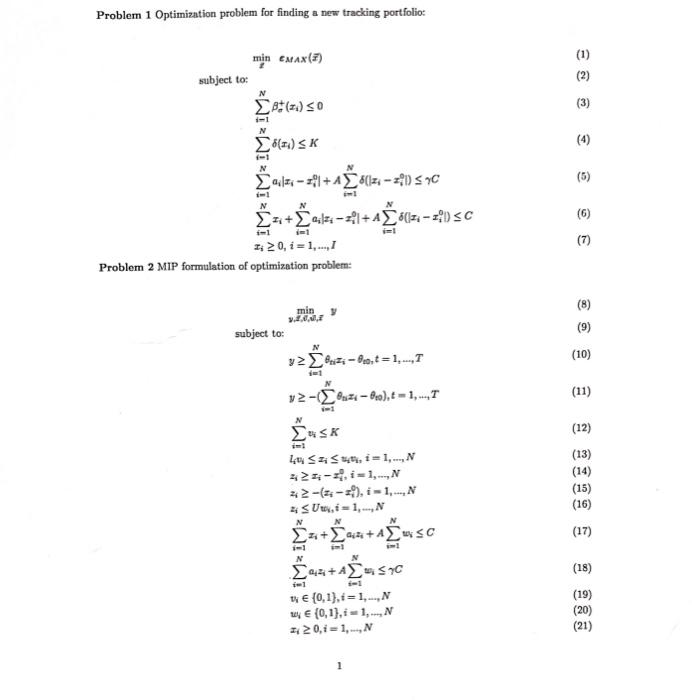
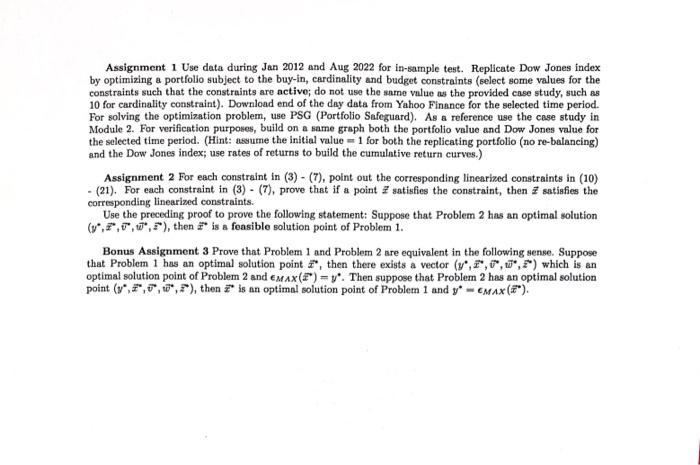
Problem 1 Optimization problem for finding a new tracking portfolio: minZMAX(x) subject to: i=1Ne+(xi)0 i=1N(xi)Ki=1Naixixi0+Ai=1N(xixi0)Ci=1Nxi+i=1Naixixi0+Ai=1N(xixi0)Cxi0,i=1,,I Problem 2 MIP formulation of optimization problem: miny,1,i,u,zy subject to: yi=1Ntixit0,,t=1,,Ty(i=1NNxit0),t=1,,T i=1NiK Livixititi,i=1,,N zixixi0,i=1,,N zi(xixi0),i=1,,N ziUwi,i=1,,N i=1Nxi+i=1Naizi+Ai=1NwiC i=1Naizi+Ai=1NwiC v{0,1},i=1,,N wi{0,1},i=1,,N xi0,i=1,,N Assignment 1 Use deta during Jan 2012 and Aug 2022 for in-sample test. Replicate Dow Jones index by optimizing a portfolio subject to the buy-in, cardinality and budget constraints (select some values for the constraints such that the constraints are active; do not use the anme value as the provided case study, such as 10 for cardinality constraint). Download end of the day data from Yahoo Finance for the selected time period. For solving the optimiation problem, use PSG (Portfolio Safeguard). As a reference use the case study in Module 2. For verification purposes, build on a same graph both the portfolio value and Dow Jones value for the selected time period. (Hint: assume the initial value =1 for both the replicating portfolio (no re-balancing) and the Dow Jones index; use rates of returns to build the cumulative return curves.) Assignment 2 For each constraint in (3) - (7), point out the corresponding linearized constraints in (10) - (21). For each constraint in (3) - 77 , prove thst if a point satisfies the constraint, then x satisfies the corresponding linearized constraints. Use the precoding proof to prove the following statement: Suppose that Problem 2 has an optimal solution (y,x,v,w,z), then x is a feasible solution point of Problem 1. Bonus Assignment 3 Prove that Problem 1 and Problem 2 are equivalent in the following sense. Suppose that Problem 1 has an optimal solution point x, then there exists a vector (y,x,v~,w~,z) which is an optimal solution point of Problem 2 and MAX(z)=y. Then suppose that Problem 2 has an optimal solution point (y,x,v,T,z), then x is an optimal solution point of Problem 1 and y=MAX(x) Step by Step Solution
There are 3 Steps involved in it
1 Expert Approved Answer
Step: 1 Unlock

Question Has Been Solved by an Expert!
Get step-by-step solutions from verified subject matter experts
Step: 2 Unlock
Step: 3 Unlock
 Study Help