







Question: Please use the questions below when analyzing the Alphabet case: Questions: 1. Why does Alphabet own widely different subsidiaries under the same corporate structure? What
Please use the questions below when analyzing the Alphabet case:
Questions:
1. Why does Alphabet own widely different subsidiaries under the same corporate structure? What are the benefits of this choice? And the costs?
2. What is the rationale behind the decentralized structure chosen by Alphabet? What are the benefits of this conglomerate structure? Its drawbacks?
3. Is Alphabets corporate governance (and, in particular the presence of dual class shares) appropriate for the organization? What are the benefits? And the costs?
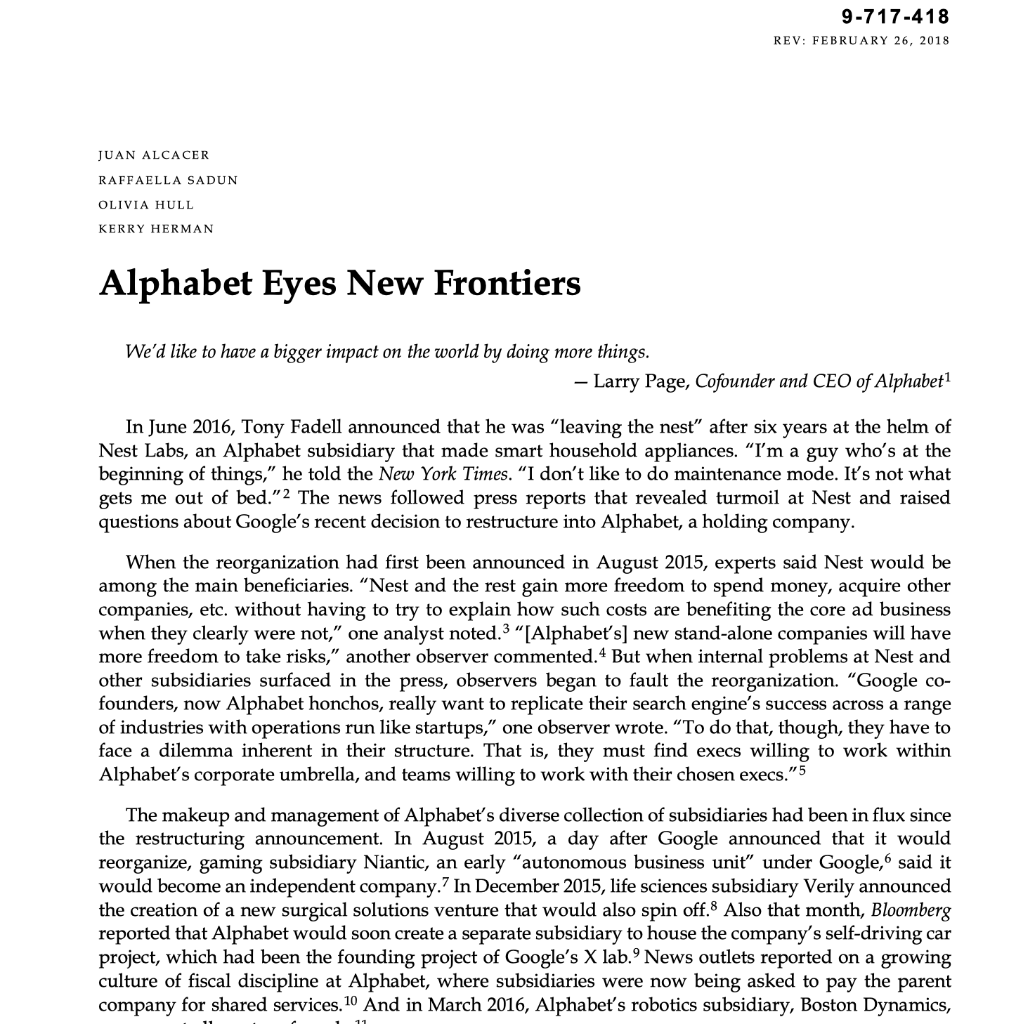
9-717-418 REV: FEBRUARY 26, 2018 JUAN ALCACER RAFFAELLA SADUN OLIVIA HULL KERRY HERMAN Alphabet Eyes New Frontiers We'd like to have a bigger impact on the world by doing more things. Larry Page, Cofounder and CEO of Alphabet1 In June 2016, Tony Fadell announced that he was "leaving the nest after six years at the helm of Nest Labs, an Alphabet subsidiary that made smart household appliances. "I'm a guy who's at the beginning of things, he told the New York Times. I don't like to do maintenance mode. It's not what gets me out of bed.2 The news followed press reports that revealed turmoil at Nest and raised questions about Google's recent decision to restructure into Alphabet, a holding company. When the reorganization had first been announced in August 2015, experts said Nest would be among the main beneficiaries. "Nest and the rest gain more freedom to spend money, acquire other companies, etc. without having to try to explain how such costs are benefiting the core ad business when they clearly were not, one analyst noted.3 [Alphabet's] new stand-alone companies will have more freedom to take risks," another observer commented. But when internal problems at Nest and other subsidiaries surfaced in the press, observers began to fault the reorganization. "Google co- founders, now Alphabet honchos, really want to replicate their search engine's success across a range of industries with operations run like startups," one observer wrote. "To do that, though, they have to face a dilemma inherent in their structure. That is, they must find execs willing to work within Alphabet's corporate umbrella, and teams willing to work with their chosen execs." The makeup and management of Alphabet's diverse collection of subsidiaries had been in flux since the restructuring announcement. In August 2015, a day after Google announced that it would reorganize, gaming subsidiary Niantic, an early autonomous business unit under Google, said it would become an independent company. In December 2015, life sciences subsidiary Verily announced the creation of a new surgical solutions venture that would also spin off. Also that month, Bloomberg reported that Alphabet would soon create a separate subsidiary to house the company's self-driving car project, which had been the founding project of Google's X lab.' News outlets reported on a growing culture of fiscal discipline at Alphabet, where subsidiaries were now being asked to pay the parent company for shared services. 10 And in March 2016, Alphabet's robotics subsidiary, Boston Dynamics, 15
Step by Step Solution
There are 3 Steps involved in it
1 Expert Approved Answer
Step: 1 Unlock

Question Has Been Solved by an Expert!
Get step-by-step solutions from verified subject matter experts
Step: 2 Unlock
Step: 3 Unlock
 Study Help