







Question: Please use Vensim Software and explain the process to make it easier to understand. FIGURE 9-5 Structure of the SIR epidemic model People remain infectious
Please use Vensim Software and explain the process to make it easier to understand. 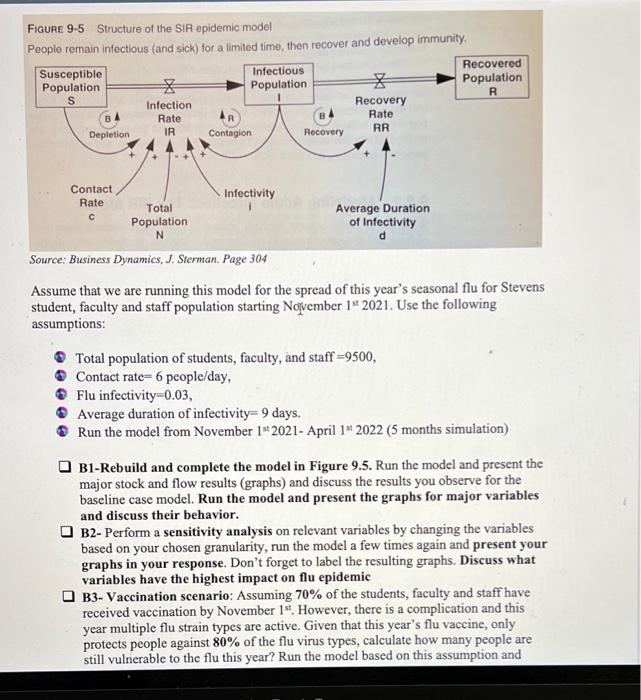
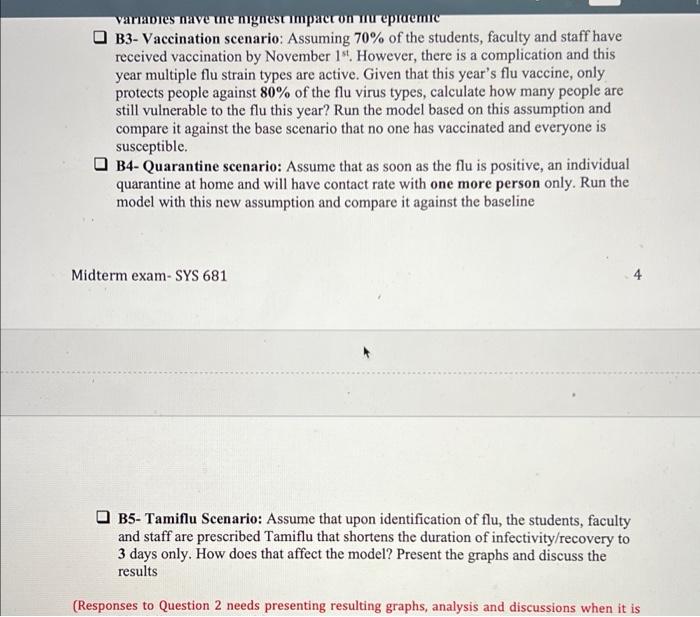
FIGURE 9-5 Structure of the SIR epidemic model People remain infectious (and sick) for a limited time, then recover and develop immunity Susceptible Infectious Recovered Population X Population Population S R Infection Recovery B Rate Rate Depletion IR Contagion Recovery RR Infectivity Contact Rate Total Population N Average Duration of Infectivity d Source: Business Dynamics, J. Sterman. Page 304 Assume that we are running this model for the spread of this year's seasonal flu for Stevens student, faculty and staff population starting November 1* 2021. Use the following assumptions: Total population of students, faculty, and staff =9500, Contact rate=6 people/day, Flu infectivity=0.03, Average duration of infectivity=9 days. Run the model from November 14 2021- April 1* 2022 (5 months simulation) B1-Rebuild and complete the model in Figure 9.5. Run the model and present the major stock and flow results (graphs) and discuss the results you observe for the baseline case model. Run the model and present the graphs for major variables and discuss their behavior. B2- Perform a sensitivity analysis on relevant variables by changing the variables based on your chosen granularity, run the model a few times again and present your graphs in your response. Don't forget to label the resulting graphs. Discuss what variables have the highest impact on flu epidemic B3- Vaccination scenario: Assuming 70% of the students, faculty and staff have received vaccination by November 14. However, there is a complication and this year multiple flu strain types are active. Given that this year's flu vaccine, only protects people against 80% of the flu virus types, calculate how many people are still vulnerable to the flu this year? Run the model based on this assumption and variantes have mighest impact B3- Vaccination scenario: Assuming 70% of the students, faculty and staff have received vaccination by November 1*. However, there is a complication and this year multiple flu strain types are active. Given that this year's flu vaccine, only protects people against 80% of the flu virus types, calculate how many people are still vulnerable to the flu this year? Run the model based on this assumption and compare it against the base scenario that no one has vaccinated and everyone is susceptible. B4- Quarantine scenario: Assume that as soon as the flu is positive, an individual quarantine at home and will have contact rate with one more person only. Run the model with this new assumption and compare it against the baseline Midterm exam-SYS 681 B5- Tamiflu Scenario: Assume that upon identification of flu, the students, faculty and staff are prescribed Tamiflu that shortens the duration of infectivity/recovery to 3 days only. How does that affect the model? Present the graphs and discuss the results (Responses to Question 2 needs presenting resulting graphs, analysis and discussions when it is FIGURE 9-5 Structure of the SIR epidemic model People remain infectious (and sick) for a limited time, then recover and develop immunity Susceptible Infectious Recovered Population X Population Population S R Infection Recovery B Rate Rate Depletion IR Contagion Recovery RR Infectivity Contact Rate Total Population N Average Duration of Infectivity d Source: Business Dynamics, J. Sterman. Page 304 Assume that we are running this model for the spread of this year's seasonal flu for Stevens student, faculty and staff population starting November 1* 2021. Use the following assumptions: Total population of students, faculty, and staff =9500, Contact rate=6 people/day, Flu infectivity=0.03, Average duration of infectivity=9 days. Run the model from November 14 2021- April 1* 2022 (5 months simulation) B1-Rebuild and complete the model in Figure 9.5. Run the model and present the major stock and flow results (graphs) and discuss the results you observe for the baseline case model. Run the model and present the graphs for major variables and discuss their behavior. B2- Perform a sensitivity analysis on relevant variables by changing the variables based on your chosen granularity, run the model a few times again and present your graphs in your response. Don't forget to label the resulting graphs. Discuss what variables have the highest impact on flu epidemic B3- Vaccination scenario: Assuming 70% of the students, faculty and staff have received vaccination by November 14. However, there is a complication and this year multiple flu strain types are active. Given that this year's flu vaccine, only protects people against 80% of the flu virus types, calculate how many people are still vulnerable to the flu this year? Run the model based on this assumption and variantes have mighest impact B3- Vaccination scenario: Assuming 70% of the students, faculty and staff have received vaccination by November 1*. However, there is a complication and this year multiple flu strain types are active. Given that this year's flu vaccine, only protects people against 80% of the flu virus types, calculate how many people are still vulnerable to the flu this year? Run the model based on this assumption and compare it against the base scenario that no one has vaccinated and everyone is susceptible. B4- Quarantine scenario: Assume that as soon as the flu is positive, an individual quarantine at home and will have contact rate with one more person only. Run the model with this new assumption and compare it against the baseline Midterm exam-SYS 681 B5- Tamiflu Scenario: Assume that upon identification of flu, the students, faculty and staff are prescribed Tamiflu that shortens the duration of infectivity/recovery to 3 days only. How does that affect the model? Present the graphs and discuss the results (Responses to Question 2 needs presenting resulting graphs, analysis and discussions when it is
Step by Step Solution
There are 3 Steps involved in it
1 Expert Approved Answer
Step: 1 Unlock

Question Has Been Solved by an Expert!
Get step-by-step solutions from verified subject matter experts
Step: 2 Unlock
Step: 3 Unlock
 Study Help