Question: Please use your own words don't copy and paste DO NOT USE HANDWRITING Lead in Toys and Drinking Water Toys for children are made in
Please use your own words don't copy and paste
DO NOT USE HANDWRITING 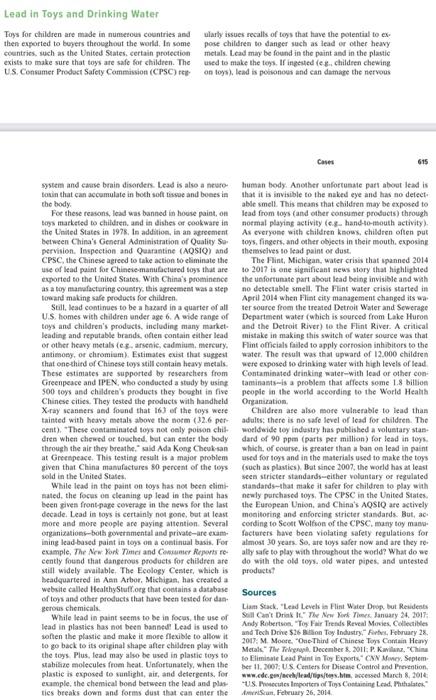
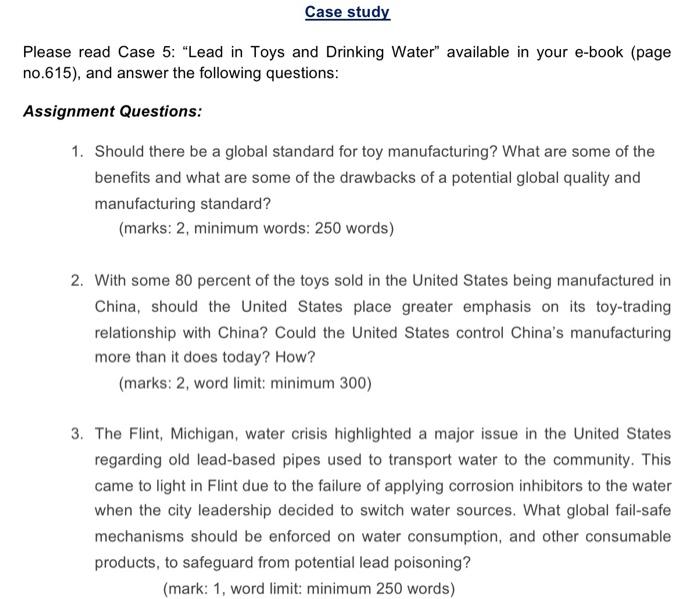
Lead in Toys and Drinking Water Toys for children are made in numerous countries and ularly issues recalls of toys that have the potential to ex then exported to buyers throughout the world. In some pose children to danger such as lead or other heavy countries, such as the United States, certain protection metals. Lead may be found in the paint and in the plastic exists to make sure that toys are safe for children. The used to make the toys. If ingested (es. children chewing U.S. Consumer Product Safety Commission (CPSC) rep on toys), lead is poisonous and can damage the nervous 615 system and cause brain disorders. Lead is also a neuro toxin that can accumulate in both soft tissue and bones in the body. For these reasons, lead was banned in house paint on toy marketed to children, and in dishes or cookware in the United States in 1975. In addition, in an agreement between China's General Administration of Quality So pervision. Inspection and Quarantine (AQSIO) and CPSC, the Chinese agreed to take action to eliminate the use of lead paint for Chinese manufactured toys that are exported to the United States. With China's prominence as a toy manufacturing country this agreement was a step toward making safe products for children Still lead continues to be a hazard in a quarter of all U.S. homes with children under age 6. A wide range of toys and children's products, including many market leading and reputable brands, often contain either lead or other heavy metals (es. arsenic, cadmium, mercury. antimony, or chromium). Estimates exist that suggest that one third of Chinese toys still contain heavy metals These estimates are supported by researchers from Greenpeace and IPEN who conducted a study by using 500 toys and children's products they bought in five Chinese cities. They tested the products with handheld X-ray scanners and found that 163 of the toys were tainted with heavy metals above the norm (32.6 per cent). These contaminated toys not only poison chib dren when chewed or touched, but can enter the body through the air they breathe, waid Ada Kong Cheul-san at Greenpeace. This testing result is a major problem given that China manufactures 80 percent of the toys sold in the United States While lead in the paint on toys has not been clim mated, the focus on cleaning up lead in the paint has been given front page coverage in the news for the last decade. Lead in toys is certainly not gone, but at least more and more people are paying attention. Several organizations-both povernmental and private-are exam. ining lead-based paint in toys on a continual basis. For example, The New York Times and Consumer Rere cently found that dangerous products for children are still widely wailable. The Ecology Center, which is headquartered in Ann Arbor, Michigan, has created a website called Healthy Stuff.org that contains a database of toys and other products that have been tested for dan gerous chemicals While lead in paint seems to be in focus, the use of lead in plasties has not been banned! Lead is used to soften the plastic and make it more flexible to allow it to go back to its original shape after children play with the toys Plus, lead may also be used in plastic toys to stabilize molecules from heat. Unfortunately, when the plastic is exposed to sunlight, air, and detergents, for example, the chemical bond between the lead and plas tics breaks down and forms dust that can enter the human body. Another unfortunate part about lead is that it is invisible to the naked eye and has no detect able smell. This means that children may be exposed to lead from toys (and other consumer products) through normal playing activity (cs hand-to- mouth activity). As everyone with children knows, children often put toys, fingers and other objects in their mouth, exposing themselves to lead paint or dust. The Flint, Michigan, water crisis that spanned 2014 10 2017 is one significant news story that highlighted the unfortunate part about lead being invisible and with no detectable smell. The Flint water crisis started in April 2014 when Flint city management changed its wa ter source from the treated Detroit Water and Sewerage Department water (which is sourced from Lake Huron and the Detroit River) to the Flint River. A critical mistake in making this switch of water source was that Flint officials failed to apply corrosion inhibitors to the water. The result was that upward of 12.000 children were exposed to drinking water with high levels of lead Contaminated drinking water with load or other con taminants-is a problem that affects some 1.8 billion people in the world according to the World Health Organization Children are also more vulnerable to lead than adults, there is no sade level of lead for children. The worldwide toy industry has published a voluntary stan dard of 90 ppm (parts per million) for lead in toys. which, of course, is greater than a ban on lead in paint used for toys and in the materials used to make the toys (such as plasties) But since 2007, the world has at least seen stricter standards-either voluntary or regulated standards that make it safer for children to play with newly purchased toys. The CPSC in the United States. the European Union, and China's AQSIQ are actively monitoring and enforcing stricter standards. But, ac cording to Scott Wolfson of the CPSC. many toy man facturers have been violating safety regulations for almost 30 years. So, are toys safer now and are they re- ally safe to play with throughout the world? What do we do with the old toys. old water pipes, and untested products Sources Liam Stack. "Lead Levels in Flint Water Drop, but Residents Still Can't Drink It The New York Times January 24, 2017: Andy Robertson "Toy Far Trends Reveal Movies Collectibles und Tech Dehe $26 on Toy Industry. Fres, February 28, 2017: M. Moore. "One Third of Chinese Toys Contain Heavy Metals The Telegraph December 2011: P. Kavila. "China to Eliminate Lead Paintin Toy Exports. CN My, Septem ber 11. 2007: US Centers for Disease Control and Prevention, www.edc.gov/vocessed March 2014 "US. Precies Importen af Toys Containing tead, Phthalatok American, February 26, 2014 Case study Please read Case 5: "Lead in Toys and Drinking Water" available in your e-book (page no.615), and answer the following questions: Assignment Questions: 1. Should there be a global standard for toy manufacturing? What are some of the benefits and what are some of the drawbacks of a potential global quality and manufacturing standard? (marks: 2, minimum words: 250 words) 2. With some 80 percent of the toys sold in the United States being manufactured in China, should the United States place greater emphasis on its toy-trading relationship with China? Could the United States control China's manufacturing more than it does today? How? (marks: 2, word limit: minimum 300) 3. The Flint, Michigan, water crisis highlighted a major issue in the United States regarding old lead-based pipes used to transport water to the community. This came to light in Flint due to the failure of applying corrosion inhibitors to the water when the city leadership decided to switch water sources. What global fail-safe mechanisms should be enforced on water consumption, and other consumable products, to safeguard from potential lead poisoning? (mark: 1, word limit: minimum 250 words)









 Study Help