







Question: please with drawing on Graph paper Problem #3 An acetone-water solution containing 25wt% acetone is to be fractionated at a rate of 10000kg/hr at 1
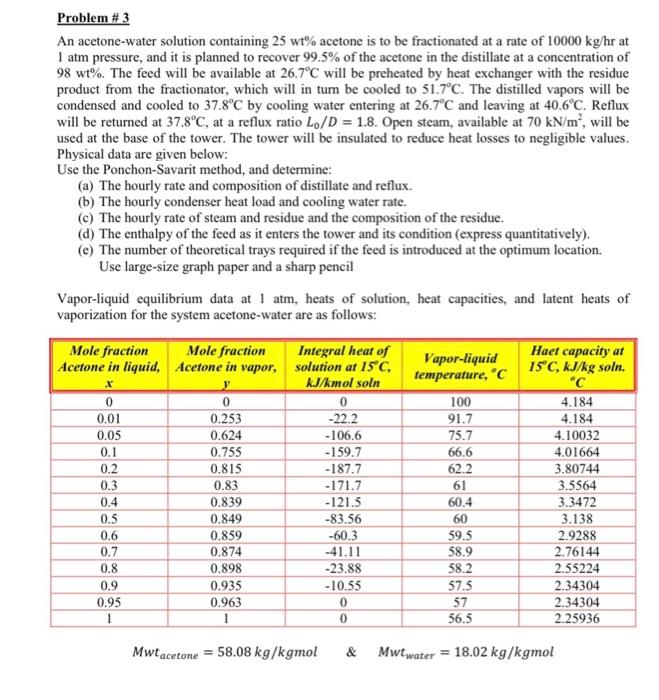
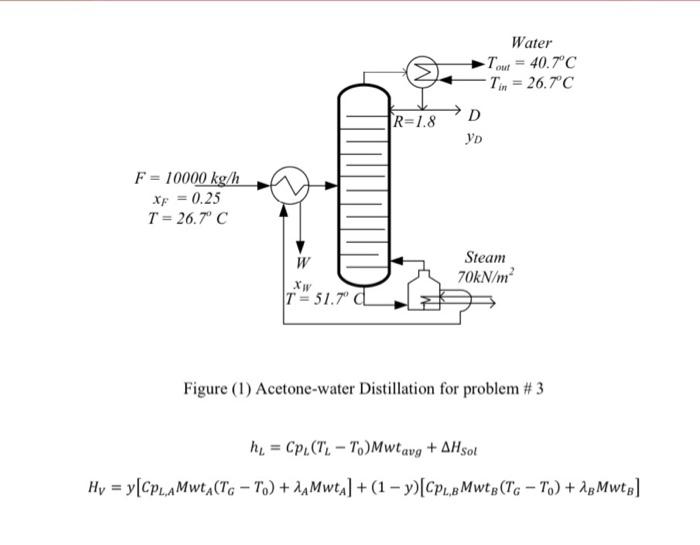
Problem \#3 An acetone-water solution containing 25wt% acetone is to be fractionated at a rate of 10000kg/hr at 1 atm pressure, and it is planned to recover 99.5% of the acetone in the distillate at a concentration of 98wt%. The feed will be available at 26.7C will be preheated by heat exchanger with the residue product from the fractionator, which will in tum be cooled to 51.7C. The distilled vapors will be condensed and cooled to 37.8C by cooling water entering at 26.7C and leaving at 40.6C. Reflux will be returned at 37.8C, at a reflux ratio L0/D=1.8. Open steam, available at 70kN/m2, will be used at the base of the tower. The tower will be insulated to reduce heat losses to negligible values. Physical data are given below: Use the Ponchon-Savarit method, and determine: (a) The hourly rate and composition of distillate and reflux. (b) The hourly condenser heat load and cooling water rate. (c) The hourly rate of steam and residue and the composition of the residue. (d) The enthalpy of the feed as it enters the tower and its condition (express quantitatively). (e) The number of theoretical trays required if the feed is introduced at the optimum location. Use large-size graph paper and a sharp pencil Vapor-liquid equilibrium data at 1atm, heats of solution, heat capacities, and latent heats of vaporization for the system acetone-water are as follows: Mwtacetone=58.08kg/kgmol&Mwtwater=18.02kg/kgmol Figure (1) Acetone-water Distillation for problem \# 3 hL=CpL(TLT0)Mwtavg+HSolHV=y[CpL,AMwtA(TGT0)+AMwtA]+(1y)[CpL,BMwtB(TGT0)+BMwtB]
Step by Step Solution
There are 3 Steps involved in it

Get step-by-step solutions from verified subject matter experts
 Study Help