



Question: Please write 1-2 page answer to the following questions about Zaras core competency. Please read the opening case of Zara in Chapter 3, and use
Please write 1-2 page answer to the following questions about Zaras core competency. Please read the opening case of Zara in Chapter 3, and use value chain analysis to identify Zaras core competency. Please answer the following questions in your analysis:
1. Which value chain activities (marketing, logistics, design, human resource management, etc.) make Zara competitive compared with major rivals in the industry segment?
2. What resources (tangible and intangible) and capabilities does Zara have that are valuable, rare, non-imitable, and non-substitutable?
3. How sustainable is Zaras core competency? Or, how long/how easy does it take for Zaras competitors to duplicate or substitute Zaras resources and capabilities? (Hint: intangible resources are harder to duplicate than tangible resources such as factories.)
Also, pay attention that strength and weakness are defined as "relative to competitors". So try to compare Zara with its major competitors for each value chain activity.
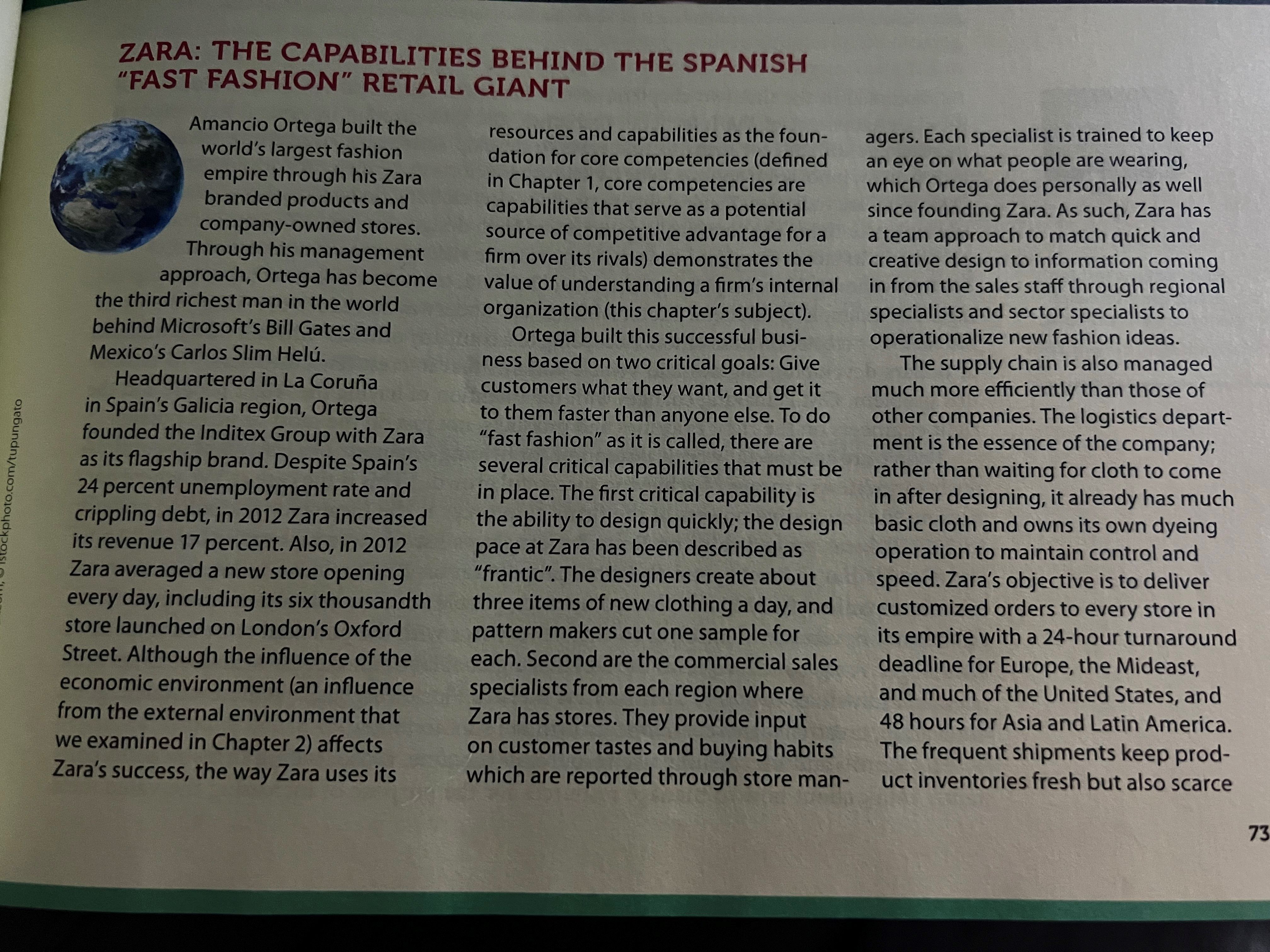
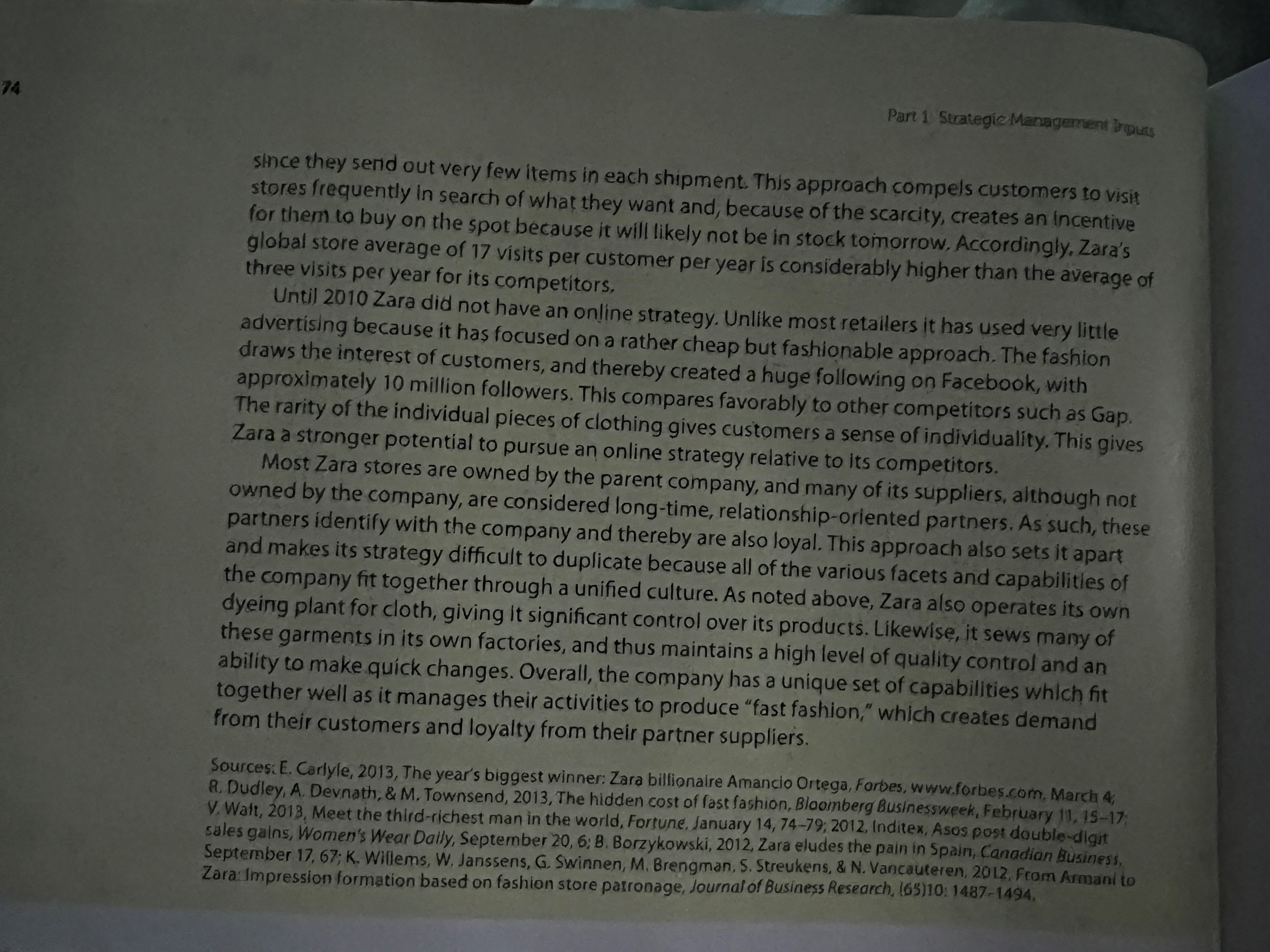
ZARA: THE CAPABILITIES BEHIND THE SPANISH "FAST FASHION" RETAIL GIANT Amancio Ortega built the world's largest fashion empire through his Zara branded products and company-owned stores. Through his management approach, Ortega has become he third richest man in the world ehind Microsoft's Bill Gates and lexico's Carlos Slim Hel. Headquartered in La Corua Spain's Galicia region, Ortega unded the Inditex Group with Zara its flagship brand. Despite Spain's percent unemployment rate and pling debt, in 2012 Zara increased evenue 17 percent. Also, in 2012 averaged a new store opening y day, including its six thousandth e launched on London's Oxford et. Although the influence of the omic environment (an influence the external environment that ramined in Chapter 2) affects success, the way Zara uses its resources and capabilities as the foundation for core competencies (defined in Chapter 1 , core competencies are capabilities that serve as a potential source of competitive advantage for a firm over its rivals) demonstrates the value of understanding a firm's internal organization (this chapter's subject). Ortega built this successful business based on two critical goals: Give customers what they want, and get it to them faster than anyone else. To do "fast fashion" as it is called, there are several critical capabilities that must be in place. The first critical capability is the ability to design quickly; the design pace at Zara has been described as "frantic". The designers create about three items of new clothing a day, and pattern makers cut one sample for each. Second are the commercial sales specialists from each region where Zara has stores. They provide input on customer tastes and buying habits which are reported through store man- agers. Each specialist is trained to kee an eye on what people are wearing, which Ortega does personally as wel since founding Zara. As such, Zara ha a team approach to match quick ano creative design to information comi in from the sales staff through regio specialists and sector specialists to operationalize new fashion ideas. The supply chain is also manage much more efficiently than those o other companies. The logistics dep ment is the essence of the compan rather than waiting for cloth to cor in after designing, it already has m basic cloth and owns its own dyeir operation to maintain control and speed. Zara's objective is to delive customized orders to every store its empire with a 24-hour turnaro deadline for Europe, the Mideast, and much of the United States, a 48 hours for Asia and Latin Amer The frequent shipments keep pr uct inventories fresh but also sca Part 1 Strategie Maragement Ir ours Since they send out very few items in each shipment. This approach compels customers to visit stores frequently in search of what they want and, because of the scarcity, creates an incentive for them to buy on the spot because it will likely not be in stock tomorrow. Accordingly. Zara's global store average of 17 visits per customer per year is considerably higher than the average of three visits per year for its competitors, Until 2010 Zara did not have an online strategy. Unlike most retailers it has used very little advertising because it has focused on a rather cheap but fashionable approach. The fashion draws the interest of customers, and thereby created a huge following on Facebook, with approximately 10 million followers. This compares favorably to other competitors such as Gap. The rarity of the individual pieces of clothing gives customers a sense of individuality. This gives Zara a stronger potential to pursue an online strategy relative to its competitors. Most Zara stores are owned by the parent company, and many of its suppliers, although not owned by the company, are considered long-time, relationship-oriented partners. As such, these partners identify with the company and thereby are also loyal. This approach also sets it apart and makes its strategy difficult to duplicate because all of the various facets and capabilities of the company fit together through a unified culture. As noted above, Zara also operates its own dyeing plant for cloth, giving it significant control over its products. Likewise, it sews many of these garments in its own factories, and thus maintains a high level of quality control and an ability to make quick changes. Overall, the company has a unique set of capabilities which fit together well as it manages their activities to produce "fast fashion," which creates demand from thejr customers and loyalty from their partner suppliers. Sourcesi E. Corlyle, 2013, The year's biggest winner: Zara billionaire Amancio Ortega, Farbes, www forbes.com, March 4; R. Dudley, A. Devnath, \& M. Townsend, 2013, The hidden cost of fast fashion, Bloomberg Businessweek, February 11, 15-17 V. Watt, 2013, Meet the third-richest man in the world, Forsune, January 14, 74-79; 2012. Inditex, Asos post double-digit sales gains, Women's Wear Dally, September 20, 6: B. Borzykowski, 2012, Zara eludes the pain in Spain, Canadian Business, September 17, 67; K. Willems, W. Janssens, G. Swinnen, M. Brengman, S. Streukens, &N. Vancauteren, 2012, From Armanl to Zara Impression formation based on fashion store parronage, Journal of Business Research, (63)10:1487-1494
Step by Step Solution
There are 3 Steps involved in it

Get step-by-step solutions from verified subject matter experts