







Question: Please write a C code to answer the question. Commenting code is encouraged! There is a different answer on Chegg that does not compile (I
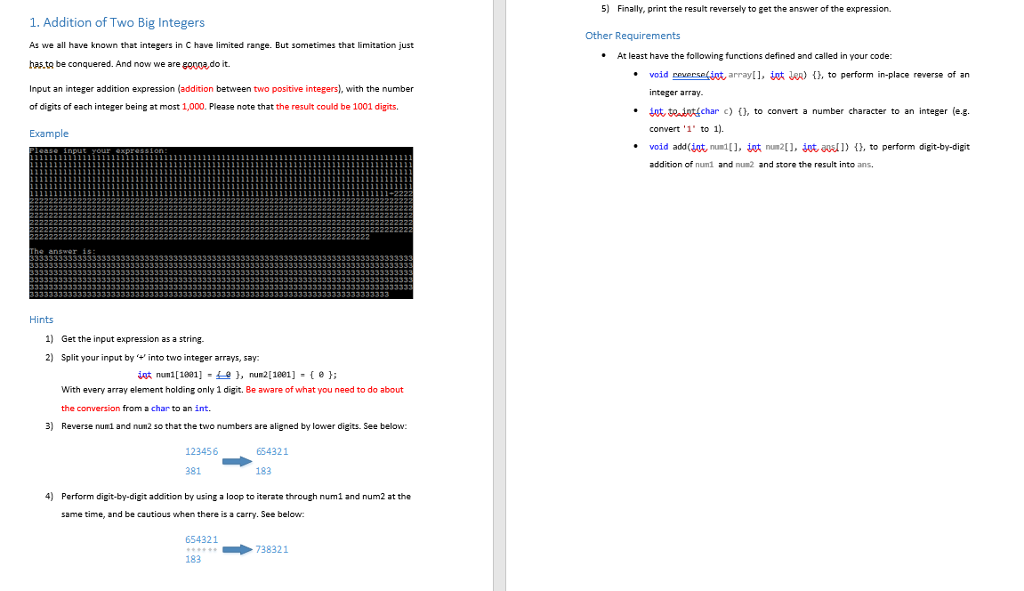 Please write a C code to answer the question. Commenting code is encouraged! There is a different answer on Chegg that does not compile (I think it might be C++) so please do not reference that.
5) Finally, print the result reversely to get the answer of the expression, 1. Addition of Two Big Integers As we all have known that integers in C have limited range. But sometimes that limitation just has.ta be conquered. And now we are gepnedo it. Input an integer addition expression (addition between two positive integers), with the number of digits of each integer being at most 1,000. Please note that the result could be 1001 digits. Example Other Requirements eAt least have the following functions defined and called in your code: void reverse(dot, array[], 40JRA) {}, to perform in-place reverse of an integer array 40t, gate 4car c) {), to convert a number character to an integer (e.g. convert '1" to 1) * void addfint, numi], at num2],nt as1) ), to perform digit-by-digit addition of nuni and num2 and store the result into ans. 1211112IE11212212222122122222212221222212121 he answer is Hints 1 Get the input expressio 2) Split your input by into two integer arrays, say n as a string. With every array element holding only 1 digit. Be aware of what you need to do about the conversion from a char to an int. Reverse numi and nun2 so that the two numbers are aligned by lower digits. See below: 3) 123456 654321 381 183 4) Perform digit-by-digit addition by using a loop to iterate through num1 and num2 at the same time, and be cautious when there is a carry. See below 654321 738321 183
Step by Step Solution
There are 3 Steps involved in it

Get step-by-step solutions from verified subject matter experts
 Study Help