







Question: Please write the C++ code. Follow all instructions when writing the code. Please answer question at the end as well PART 2: ROUND-OFF ERROR You
Please write the C++ code. Follow all instructions when writing the code. Please answer question at the end as well
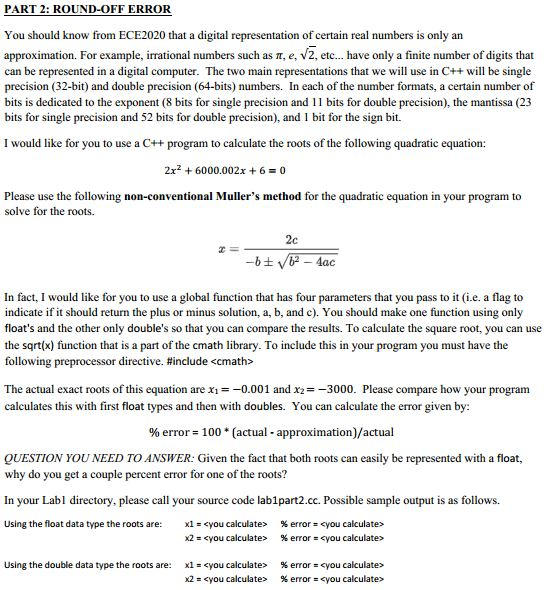
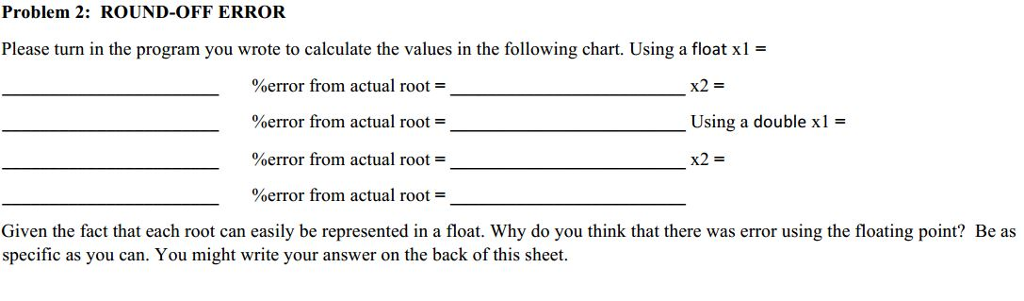
PART 2: ROUND-OFF ERROR You should know from ECE2020 that a digital representation of certain real numbers is only an approximation. For example, irrational numbers such as T, e, V2, etc...have only a finite number of digits that can be represented in a digital computer. The two main representations that we will use in C++ will be single precision (32-bit) and double precision (64-bits) numbers. In each of the number formats, a certain number of bits is dedicated to the exponent (8 bits for single precision and 11 bits for double precision), the mantissa (23 bits for single precision and 52 bits for double precision), and I bit for the sign bit. I would like for you to use a C++ program to calculate the roots of the following quadratic equation: 2x2 6000.002x + 60 Please use the following non-conventional Muller's method for the quadratic equation in your program to solve for the roots 2c In fact, I would like for you to use a global function that has four parameters that you pass to it (i.e. a flag to indicate if it should return the plus or minus solution, a, b, and c). You should make one function using only float's and the other only double's so that you can compare the results. To calculate the square root, you can use the sqrt(x) function that is a part of the cmath library. To include this in your program you must have the follow ing preprocessor directive. # include
Step by Step Solution
There are 3 Steps involved in it

Get step-by-step solutions from verified subject matter experts
 Study Help