







Question: Please write a code in C++ that satisfies the problem. Write code in C++ that satisfies problem. Problem 1. For a traveling object, the air
Please write a code in C++ that satisfies the problem.
Write code in C++ that satisfies problem.
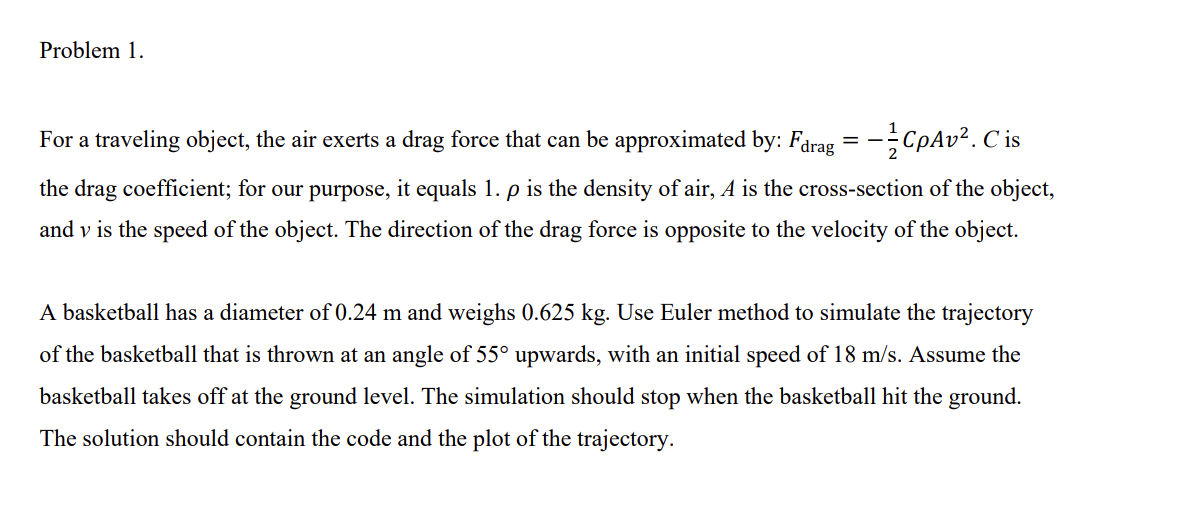
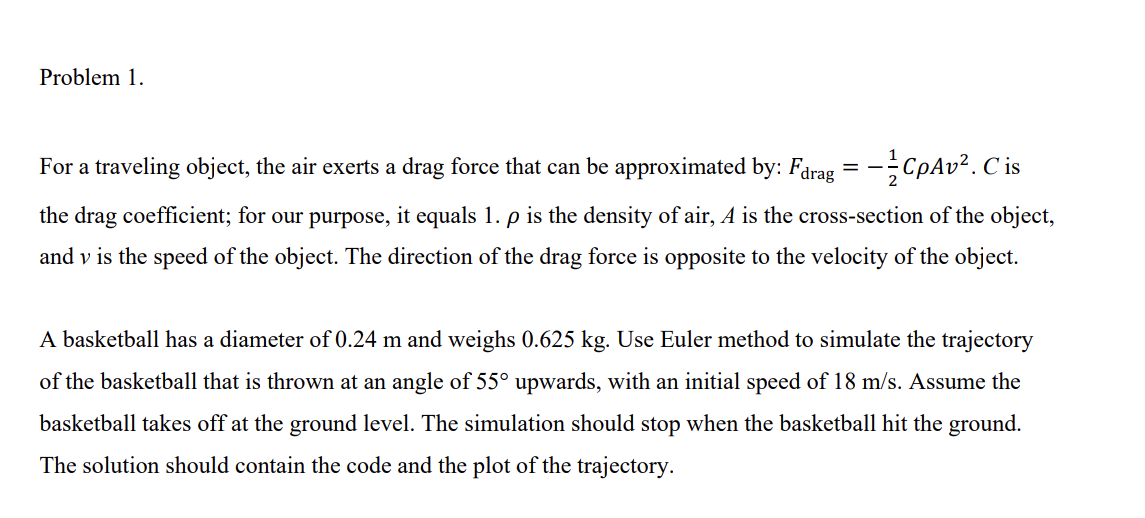
Problem 1. For a traveling object, the air exerts a drag force that can be approximated by: Fdrag = - CpAv?. Cis the drag coefficient; for our purpose, it equals 1. p is the density of air, A is the cross-section of the object, and v is the speed of the object. The direction of the drag force is opposite to the velocity of the object. A basketball has a diameter of 0.24 m and weighs 0.625 kg. Use Euler method to simulate the trajectory of the basketball that is thrown at an angle of 55 upwards, with an initial speed of 18 m/s. Assume the basketball takes off at the ground level. The simulation should stop when the basketball hit the ground. The solution should contain the code and the plot of the trajectory. Problem 1. For a traveling object, the air exerts a drag force that can be approximated by: Farag = - CpAv?. Cis the drag coefficient; for our purpose, it equals 1. p is the density of air, A is the cross-section of the object, and v is the speed of the object. The direction of the drag force is opposite to the velocity of the object. A basketball has a diameter of 0.24 m and weighs 0.625 kg. Use Euler method to simulate the trajectory of the basketball that is thrown at an angle of 55 upwards, with an initial speed of 18 m/s. Assume the basketball takes off at the ground level. The simulation should stop when the basketball hit the ground. The solution should contain the code and the plot of the trajectory. Problem 1. For a traveling object, the air exerts a drag force that can be approximated by: Fdrag = - CpAv?. Cis the drag coefficient; for our purpose, it equals 1. p is the density of air, A is the cross-section of the object, and v is the speed of the object. The direction of the drag force is opposite to the velocity of the object. A basketball has a diameter of 0.24 m and weighs 0.625 kg. Use Euler method to simulate the trajectory of the basketball that is thrown at an angle of 55 upwards, with an initial speed of 18 m/s. Assume the basketball takes off at the ground level. The simulation should stop when the basketball hit the ground. The solution should contain the code and the plot of the trajectory. Problem 1. For a traveling object, the air exerts a drag force that can be approximated by: Farag = - CpAv?. Cis the drag coefficient; for our purpose, it equals 1. p is the density of air, A is the cross-section of the object, and v is the speed of the object. The direction of the drag force is opposite to the velocity of the object. A basketball has a diameter of 0.24 m and weighs 0.625 kg. Use Euler method to simulate the trajectory of the basketball that is thrown at an angle of 55 upwards, with an initial speed of 18 m/s. Assume the basketball takes off at the ground level. The simulation should stop when the basketball hit the ground. The solution should contain the code and the plot of the trajectory
Step by Step Solution
There are 3 Steps involved in it

Get step-by-step solutions from verified subject matter experts
 Study Help