







Question: Please write a full answer. Do not answer if you do not know it! Assignment 5 Consider a function scheduler that realises a scheduler of

Please write a full answer. Do not answer if you do not know it!
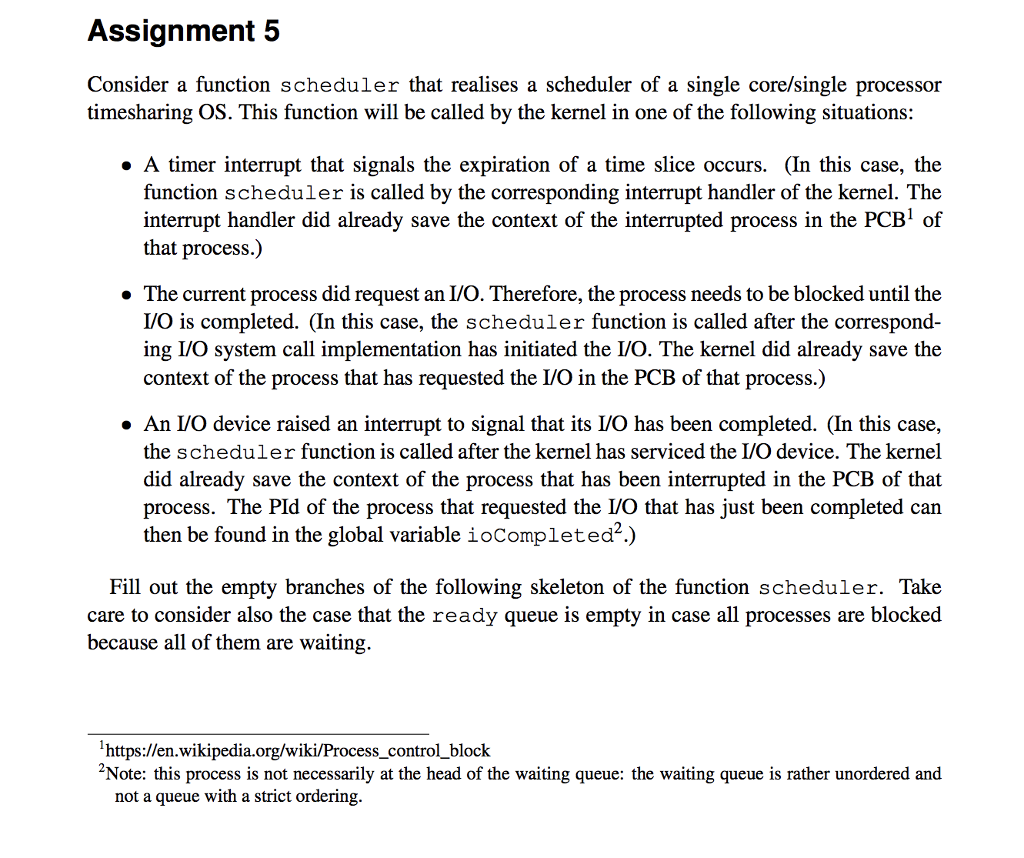
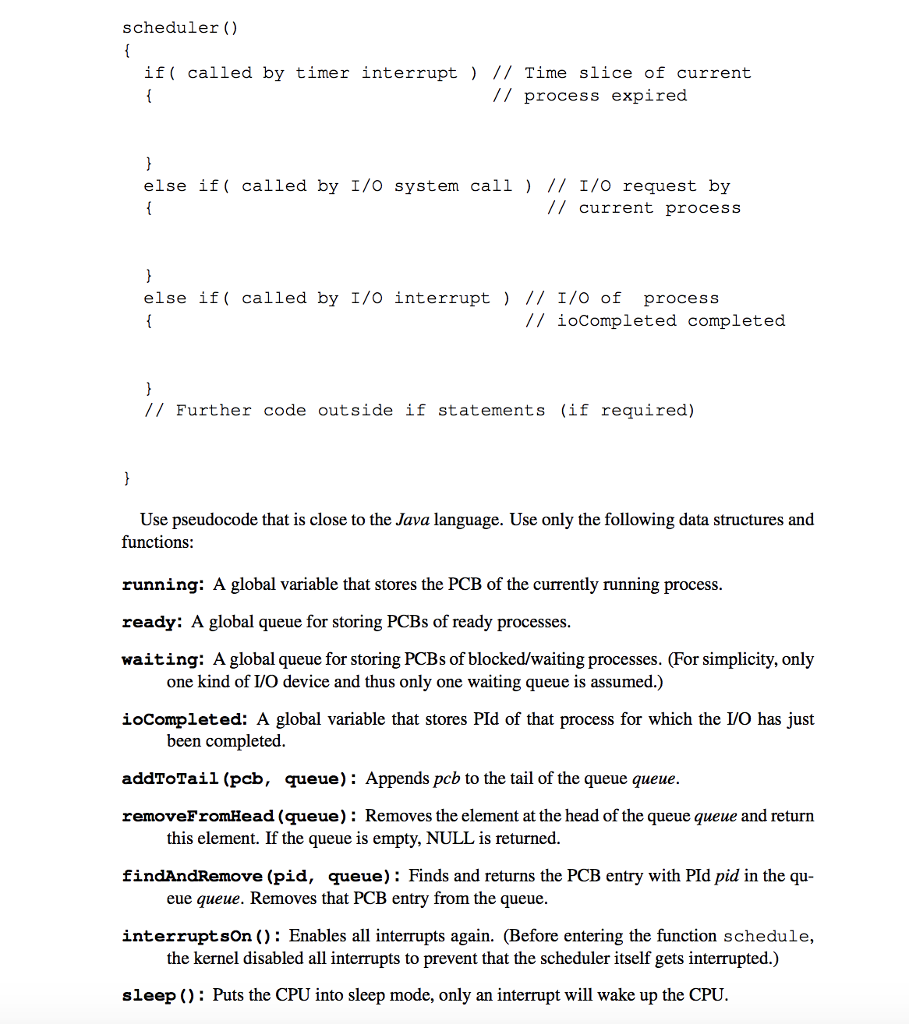
Assignment 5 Consider a function scheduler that realises a scheduler of a single core/single processor timesharing OS. This function will be called by the kernel in one of the following situations: A timer interrupt that signals the expiration of a time slice occurs. (In this case, the function scheduler is called by the corresponding interrupt handler of the kernel. The interrupt handler did already save the context of the interrupted process in the PCB1 of that process.) The current process did request an IO. Therefore, the process needs to be blocked until the I/O is completed. (In this case, the scheduler function is called after the correspond- ing I/O system call implementation has initiated the I/O. The kernel did already save the context of the process that has requested the I/O in the PCB of that process.) An VO device raised an interrupt to signal that its 10 has been completed. (In this case, the scheduler function is called after the kernel has serviced the I/O device. The kernel did already save the context of the process that has been interrupted in the PCB of that process. The PId of the process that requested the IO that has just been completed can then be found in the global variable ioCompleted2.) Fill out the empty branches of the following skeleton of the function scheduler. Take care to consider also the case that the ready queue is empty in case all processes are blocked because all of them are waiting. https://en.wikipedia.org/wiki/Process_control_block 'Note: this process is not necessarily at the head of the waiting queue: the waiting queue is rather unordered and not a queue with a strict ordering. Assignment 5 Consider a function scheduler that realises a scheduler of a single core/single processor timesharing OS. This function will be called by the kernel in one of the following situations: A timer interrupt that signals the expiration of a time slice occurs. (In this case, the function scheduler is called by the corresponding interrupt handler of the kernel. The interrupt handler did already save the context of the interrupted process in the PCB1 of that process.) The current process did request an IO. Therefore, the process needs to be blocked until the I/O is completed. (In this case, the scheduler function is called after the correspond- ing I/O system call implementation has initiated the I/O. The kernel did already save the context of the process that has requested the I/O in the PCB of that process.) An VO device raised an interrupt to signal that its 10 has been completed. (In this case, the scheduler function is called after the kernel has serviced the I/O device. The kernel did already save the context of the process that has been interrupted in the PCB of that process. The PId of the process that requested the IO that has just been completed can then be found in the global variable ioCompleted2.) Fill out the empty branches of the following skeleton of the function scheduler. Take care to consider also the case that the ready queue is empty in case all processes are blocked because all of them are waiting. https://en.wikipedia.org/wiki/Process_control_block 'Note: this process is not necessarily at the head of the waiting queue: the waiting queue is rather unordered and not a queue with a strict ordering
Step by Step Solution
There are 3 Steps involved in it

Get step-by-step solutions from verified subject matter experts
 Study Help