







Question: Please write a one page reflective summary on the included article: Technology Strategy & Management: G 1. What is the main point(s) of the article?
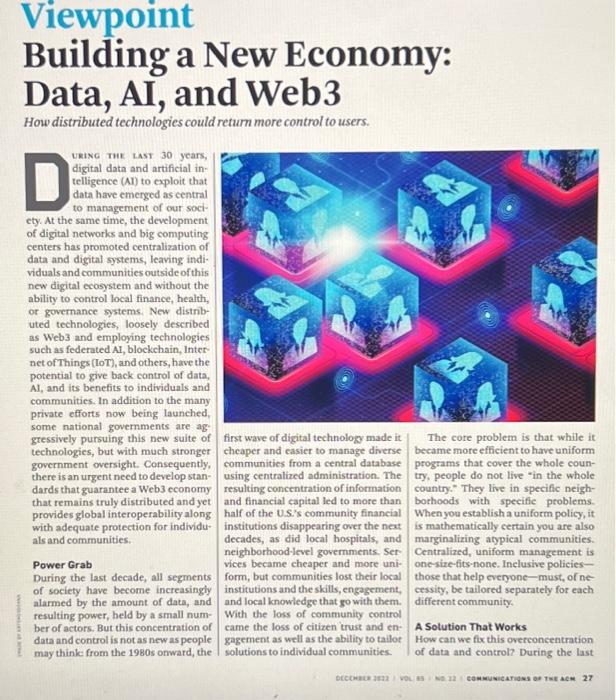

Please write a one page reflective summary on the included article: Technology Strategy \& Management: G 1. What is the main point(s) of the article? 2. What ideas stood our to you and why? 3. What do your know about the topic and where does this existing knowledge come from? 4. Does this text reinforce and/or challenge any existing ideas or assumptions? 5. Did this text assist you in the understanding of the topic? If so, how? Viewpoint Building a New Economy: Data, AI, and Web3 more traditionally democratic fabric, with communities of clitens seting the rales for legal transactiohs and able to audit ruxpicious behavier? Teding there are ne generally accepted standards for monitoring of audieine these Eow of information, money, material, emironmental er medical data, despite the obvious riok these peoblems pose to individuals, corpo-rations, and kovernments. As a consequence, pethaps the most important element of Web3 gov ermance is control of data, bechuse A. blockchain transactions, and lot are all mosty mechanloms to create and use data. When Web 1.0 and Web 2.0 wrie firt developed, they were touted as decentralired systems that would empower marginalied communitics. Unfortunately, these hopes faded as bis commercial playen developedplat-forms and interfaces that centralised data and Al. It is promising that the decentral. iation of data ownenhip and distrib uted Al prevides way to ensafe decth tralization of Web3, soencthing that was not possible when Web 1.0 and 20 were depleyed. The kry is to place control of data in the hands of intrinsh-cally distributed communities ruch as physical neighborhoods the way we do with voeing and govermment, of legally defined conmunities such as doe-ton or civil enginecrs. Having control of data collection and data use lecally anchored in community organizations such as member-owned data coopera. tives, where coenmunity members vote fot the policies tho want and the to. operative assutes that data use follows thote pulicies, means it is much mare diffcult to centralise control. Such demoxratic gowemance of Wrbs requires the voluntary collabora: tive pooling by individuals of their per-sonal data for the benefit of the mem. benhip of the group or commsinity, an arrangement I call a date cooperafive. The motivation for individuals to get together and pool their data is driven by the need to khare commen insights across data that would be otherwise siloed or inaccesible. These intights prowide the cooperative members is a whole with a betier undersanding of thrif current economic, health, and social conditions and can allow much betser management of cantmunity ief. vices without endangering privacy, It is technically straightforward to have a third party such as a coopera-the hold copies of their members' data in order to help theen afeguard their rights, to represent them in nepoti-ating how their data is used, to alert them to how they are being surveliled, and to audit the large companies and gowemment institutions using their members' data. Nor does the crication of such data cooperatives require new laws; many communicy organizations (such as credit unions) are alresd, chartered to manage nember's pet sohal information for them. in fact. ey reserch group and 1 are currenth. working with entitics like Consumers Union and similar conmunity oftz-nizations to do ceactly this, uning the sofware architectures developed in our book. Building a New Ecenemy: Dafa ar Capiaf(MTr Wreas). Many countries ate actively devel. oping their own veriona of data co-operatives, in Rorea, the goverament is licensing data folucinries based on their new data protection law (known as P1PN). In india NCOs like ispirit are working with the government to bulld the "India Suck" and already have hum-dreds of mallions of users. In the U.S. my reirareh group is helping to deploy APlo that automate the privacy rights provided by Califomia privacy law (see the U.K., there are active efforts within 10 Downing sureet to empower focal nelghbarhood Councils to be data A -duciaries for their residenis. Next Steps The ability to balance the world's flews of data, money, roods, and intel lectual property depends on ereating a balance of atakeholders. Hy leverar ing cooperative worker and eitizen organirations we can change the cur rent situation and create a sustainable diptal economy that serves the many and not just the few. If the 100mil lion US. consumers who are currendy members of local credit unions and coops could also control their data, they would be a force to be reckoned with. The same potential for commu. nity ofganizations to balance today's data monoliths exists in most coun. tries around the world. The key challenge for such a trans formation is to ensure safety and ownerahlp rigbts while still encur-ing global interoperability. Data is a new primary means of produetion, like capital, labor, or land, but it is so now that there are no institutions to guarantee that everone benefita from data use. There are efforts be-ginning in many nations to regulate crypto ("Web 3.0) but these efforts do not address the larger problems of global interoperability, safety, and inclusiveness. This surgests that a new "Digital Bretton Woods" stan: dards effort is requited, in otder to forge standards and governance of Web3 platforms covering both pri-vate efforts-like Etherium of Libra and national platforms such as these developed by China, singapore, and 5witartand. Unlike the World War II Bretton Woods effort, weh coop-dination must not only be eentered around banking and finance but must be focused on developing digh tal technical standards for all corts of transactions, including commu-nications, trade, finance, and gow ernment, and must also kupport sus-tainability and other soclal factors. Creacien and maintesance of woch a standards body need not be expen sive or large, as iflustrated by the rom ernance eversight platforms devel-oped for the Internet and the World wide Web. 4 Sesterinaporyoias
Step by Step Solution
There are 3 Steps involved in it

Get step-by-step solutions from verified subject matter experts
 Study Help