Question: (Please write all your answers on the answer sheet) 1. Choose proper terms to fill in the blanks (20%, 1% each blank) supply chain (Nam
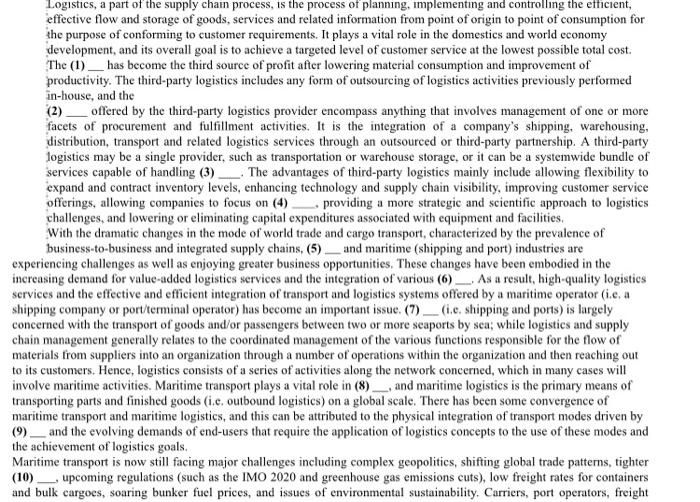
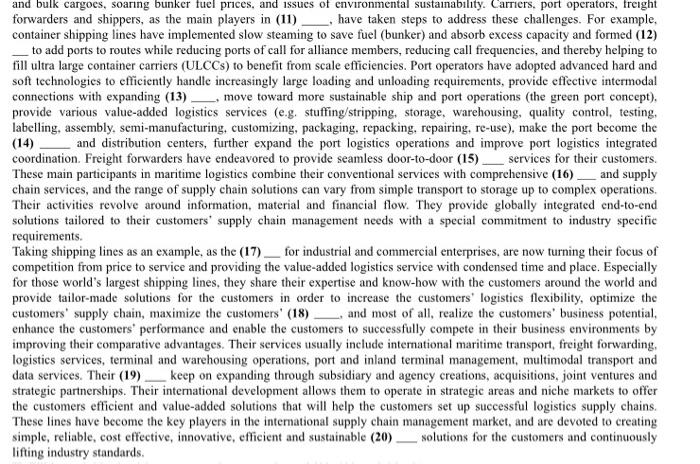
(Please write all your answers on the answer sheet) 1. Choose proper terms to fill in the blanks (20%, 1% each blank) supply chain (Nam maritime transport supply chain management liner alliances core competencies value-added logistics services e) port hinterland logistics centers outsourced logistics services containerization ship financing third-party logistics maritime logistics global supply chain multinational network transport modes intermodal transport distribution networks modern logistics international logistics - Logistics, a part of the supply chain process, is the process of planning, implementing and controlling the efficient, effective flow and storage of goods, services and related information from point of origin to point of consumption for the purpose of conforming to customer requirements. It plays a vital role in the domestics and world economy development, and its overall goal is to achieve a targeted level of customer service at the lowest possible total cost. The (1) _ has become the third source of profit after lowering material consumption and improvement of productivity. The third-party logistics includes any form of outsourcing of logistics activities previously performed in-house, and the (2) offered by the third-party logistics provider encompass anything that involves management of one or more facets of procurement and fulfillment activities. It is the integration of a company's shipping, warehousing, distribution, transport and related logistics services through an outsourced or third-party partnership. A third-party logistics may be a single provider, such as transportation or warehouse storage, or it can be a systemwide bundle of services capable of handling (3) ___. The advantages of third-party logistics mainly include allowing flexibility to expand and contract inventory levels, enhancing technology and supply chain visibility, improving customer service offerings, allowing companies to focus on (4) providing a more strategic and scientific approach to logistics challenges, and lowering or eliminating capital expenditures associated with equipment and facilities. With the dramatic changes in the mode of world trade and cargo transport, characterized by the prevalence of business-to-business and integrated supply chains, (5) and maritime (shipping and port) industries are experiencing challenges as well as enjoying greater business opportunities. These changes have been embodied in the increasing demand for value-added logistics services and the integration of various (6)_As a result, high-quality logistics services and the effective and efficient integration of transport and logistics systems offered by a maritime operator (i.ca shipping company or port/terminal operator) has become an important issue. (7) _ (.e. shipping and ports) is largely concerned with the transport of goods and/or passengers between two or more seaports by sea; while logistics and supply chain management generally relates to the coordinated management of the various functions responsible for the flow of materials from suppliers into an organization through a number of operations within the organization and then reaching out to its customers. Hence, logistics consists of a series of activities along the network concerned, which in many cases will involve maritime activities. Maritime transport plays a vital role in (8), and maritime logistics is the primary means of transporting parts and finished goods (i.c. outbound logistics) on a global scale. There has been some convergence of maritime transport and maritime logistics, and this can be attributed to the physical integration of transport modes driven by (9)_ and the evolving demands of end-users that require the application of logistics concepts to the use of these modes and the achievement of logistics goals. Maritime transport is now still facing major challenges including complex geopolitics, shifting global trade patterns, tighter (10)_, upcoming regulations (such as the IMO 2020 and greenhouse gas emissions cuts), low freight rates for containers and bulk cargoes, soaring bunker fuel prices, and issues of environmental sustainability. Carriers, port operators, freight and bulk cargoes, soaring bunker fuel prices, and issues of environmental sustainability. Carriers. port operators, freight forwarders and shippers, as the main players in (11), have taken steps to address these challenges. For example, container shipping lines have implemented slow steaming to save fuel (bunker) and absorb excess capacity and formed (12) to add ports to routes while reducing ports of call for alliance members, reducing call frequencies, and thereby helping to fill ultra large container carriers (ULCCS) to benefit from scale efficiencies. Port operators have adopted advanced hard and soft technologies to efficiently handle increasingly large loading and unloading requirements, provide effective intermodal connections with expanding (13) move toward more sustainable ship and port operations (the green port concept), provide various value-added logistics services (e.g. stuffing/stripping, storage, warehousing, quality control, testing, labelling, assembly, semi-manufacturing, customizing, packaging, repacking, repairing, re-use), make the port become the (14) and distribution centers, further expand the port logistics operations and improve port logistics integrated coordination. Freight forwarders have endeavored to provide seamless door-to-door (15) services for their customers. These main participants in maritime logistics combine their conventional services with comprehensive (16) and supply chain services, and the range of supply chain solutions can vary from simple transport to storage up to complex operations. Their activities revolve around information, material and financial flow. They provide globally integrated end-to-end solutions tailored to their customers' supply chain management needs with a special commitment to industry specific requirements. Taking shipping lines as an example, as the (17)_ for industrial and commercial enterprises, are now turning their focus of competition from price to service and providing the value-added logistics service with condensed time and place. Especially for those world's largest shipping lines, they share their expertise and know-how with the customers around the world and provide tailor-made solutions for the customers in order to increase the customers' logistics flexibility, optimize the customers' supply chain, maximize the customers' (18)__ and most of all, realize the customers' business potential, enhance the customers' performance and enable the customers to successfully compete in their business environments by improving their comparative advantages. Their services usually include international maritime transport, freight forwarding, logistics services, terminal and warehousing operations, port and inland terminal management, multimodal transport and data services. Their (19) _ keep on expanding through subsidiary and agency creations, acquisitions, joint ventures and strategic partnerships. Their international development allows them to operate in strategic areas and niche markets to offer the customers efficient and value-added solutions that will help the customers set up successful logistics supply chains. These lines have become the key players in the international supply chain management market, and are devoted to creating simple, reliable, cost effective, innovative, efficient and sustainable (20) solutions for the customers and continuously lifting industry standards










 Study Help