Question: Please write in JAVA make sure the code can pass the test, will give up the vote. Thanks Some examples discussed during the lectures featured
Please write in JAVA
make sure the code can pass the test, will give up the vote. Thanks
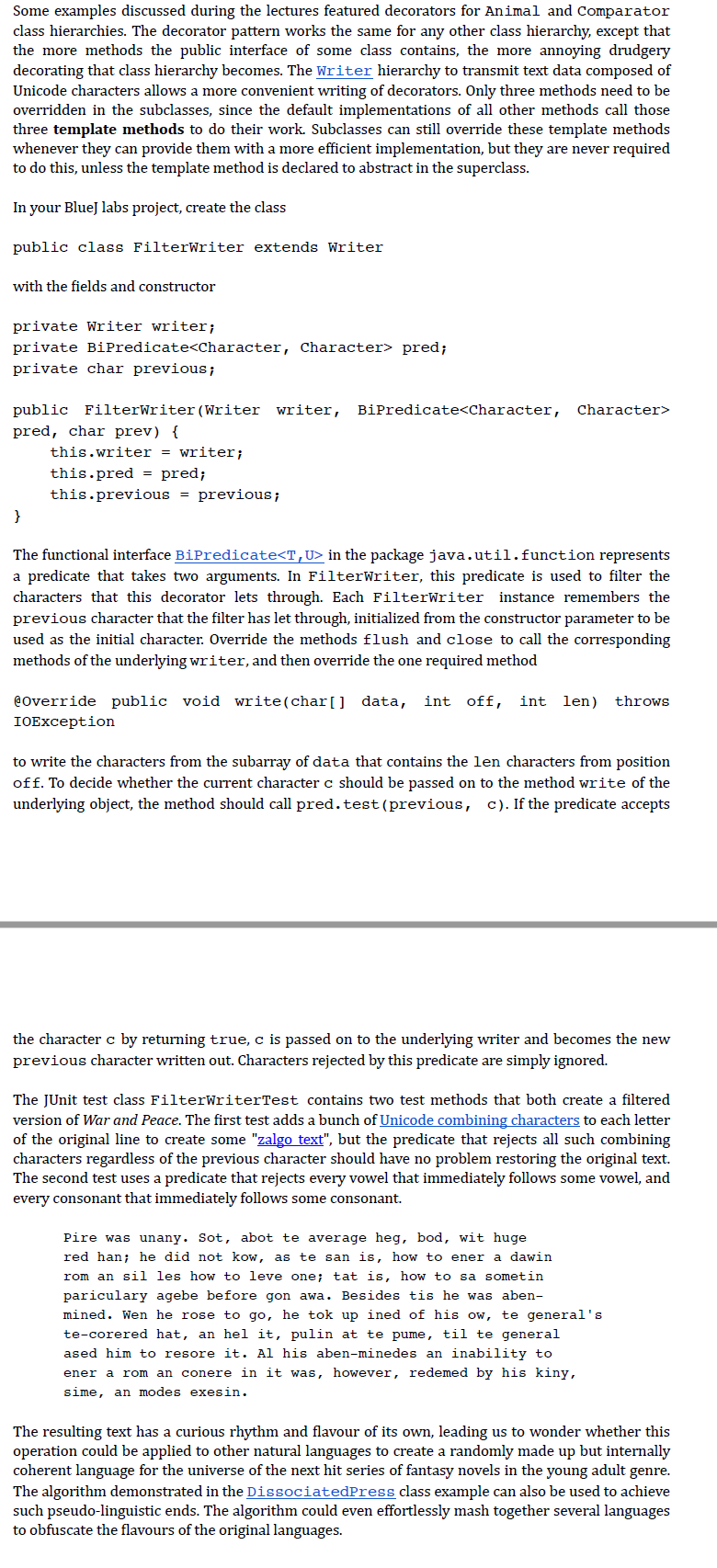
Some examples discussed during the lectures featured decorators for Animal and Comparator class hierarchies. The decorator pattern works the same for any other class hierarchy, except that the more methods the public interface of some class contains, the more annoying drudgery decorating that class hierarchy becomes. The Writer hierarchy to transmit text data composed of Unicode characters allows a more convenient writing of decorators. Only three methods need to be overridden in the subclasses, since the default implementations of all other methods call those three template methods to do their work. Subclasses can still override these template methods whenever they can provide them with a more efficient implementation, but they are never required to do this, unless the template method is declared to abstract in the superclass. In your Blue) labs project, create the class public class FilterWriter extends Writer with the fields and constructor private Writer writer; private BiPredicate pred; private char previous; Character> public FilterWriter (Writer writer, BiPredicate in the package java.util.function represents a predicate that takes two arguments. In FilterWriter, this predicate is used to filter the characters that this decorator lets through. Each FilterWriter instance remembers the previous character that the filter has let through, initialized from the constructor parameter to be used as the initial character. Override the methods flush and close to call the corresponding methods of the underlying writer, and then override the one required method @Override public void write(char[] data, IOException int off, int len) throws to write the characters from the subarray of data that contains the len characters from position off. To decide whether the current character c should be passed on to the method write of the underlying object, the method should call pred.test(previous, C). If the predicate accepts the character c by returning true, c is passed on to the underlying writer and becomes the new previous character written out. Characters rejected by this predicate are simply ignored. The JUnit test class FilterWriterTest contains two test methods that both create a filtered version of War and Peace. The first test adds a bunch of Unicode combining characters to each letter of the original line to create some "zalgo text", but the predicate that rejects all such combining characters regardless of the previous character should have no problem restoring the original text. The second test uses a predicate that rejects every vowel that immediately follows some vowel, and every consonant that immediately follows some consonant. Pire was unany. Sot, abot te average heg, bod, wit huge red han; he did not kow, as te san is, how to ener a dawin rom an sil les how to leve one; tat is, how to sa sometin pariculary agebe before gon awa. Besides tis he was aben- mined. Wen he rose to go, he tok up ined of his ow, te general's te-corered hat, an hel it, pulin at te pume, til te general ased him to resore it. Al his aben-minedes an inability to ener a rom an conere in it was, however, redemed by his kiny, sime, an modes exesin. The resulting text has a curious rhythm and flavour of its own, leading us to wonder whether this operation could be applied to other natural languages to create a randomly made up but internally coherent language for the universe of the next hit series of fantasy novels in the young adult genre. The algorithm demonstrated in the DissociatedPress class example can also be used to achieve such pseudo-linguistic ends. The algorithm could even effortlessly mash together several languages to obfuscate the flavours of the original languages. Some examples discussed during the lectures featured decorators for Animal and Comparator class hierarchies. The decorator pattern works the same for any other class hierarchy, except that the more methods the public interface of some class contains, the more annoying drudgery decorating that class hierarchy becomes. The Writer hierarchy to transmit text data composed of Unicode characters allows a more convenient writing of decorators. Only three methods need to be overridden in the subclasses, since the default implementations of all other methods call those three template methods to do their work. Subclasses can still override these template methods whenever they can provide them with a more efficient implementation, but they are never required to do this, unless the template method is declared to abstract in the superclass. In your Blue) labs project, create the class public class FilterWriter extends Writer with the fields and constructor private Writer writer; private BiPredicate pred; private char previous; Character> public FilterWriter (Writer writer, BiPredicate in the package java.util.function represents a predicate that takes two arguments. In FilterWriter, this predicate is used to filter the characters that this decorator lets through. Each FilterWriter instance remembers the previous character that the filter has let through, initialized from the constructor parameter to be used as the initial character. Override the methods flush and close to call the corresponding methods of the underlying writer, and then override the one required method @Override public void write(char[] data, IOException int off, int len) throws to write the characters from the subarray of data that contains the len characters from position off. To decide whether the current character c should be passed on to the method write of the underlying object, the method should call pred.test(previous, C). If the predicate accepts the character c by returning true, c is passed on to the underlying writer and becomes the new previous character written out. Characters rejected by this predicate are simply ignored. The JUnit test class FilterWriterTest contains two test methods that both create a filtered version of War and Peace. The first test adds a bunch of Unicode combining characters to each letter of the original line to create some "zalgo text", but the predicate that rejects all such combining characters regardless of the previous character should have no problem restoring the original text. The second test uses a predicate that rejects every vowel that immediately follows some vowel, and every consonant that immediately follows some consonant. Pire was unany. Sot, abot te average heg, bod, wit huge red han; he did not kow, as te san is, how to ener a dawin rom an sil les how to leve one; tat is, how to sa sometin pariculary agebe before gon awa. Besides tis he was aben- mined. Wen he rose to go, he tok up ined of his ow, te general's te-corered hat, an hel it, pulin at te pume, til te general ased him to resore it. Al his aben-minedes an inability to ener a rom an conere in it was, however, redemed by his kiny, sime, an modes exesin. The resulting text has a curious rhythm and flavour of its own, leading us to wonder whether this operation could be applied to other natural languages to create a randomly made up but internally coherent language for the universe of the next hit series of fantasy novels in the young adult genre. The algorithm demonstrated in the DissociatedPress class example can also be used to achieve such pseudo-linguistic ends. The algorithm could even effortlessly mash together several languages to obfuscate the flavours of the original languages









 Study Help