







Question: Please write in Python and note the restrictions etc thank you. Allowed Things: - The, ( + + = ) , * ,
Please write in Python and note the restrictions etc thank you.
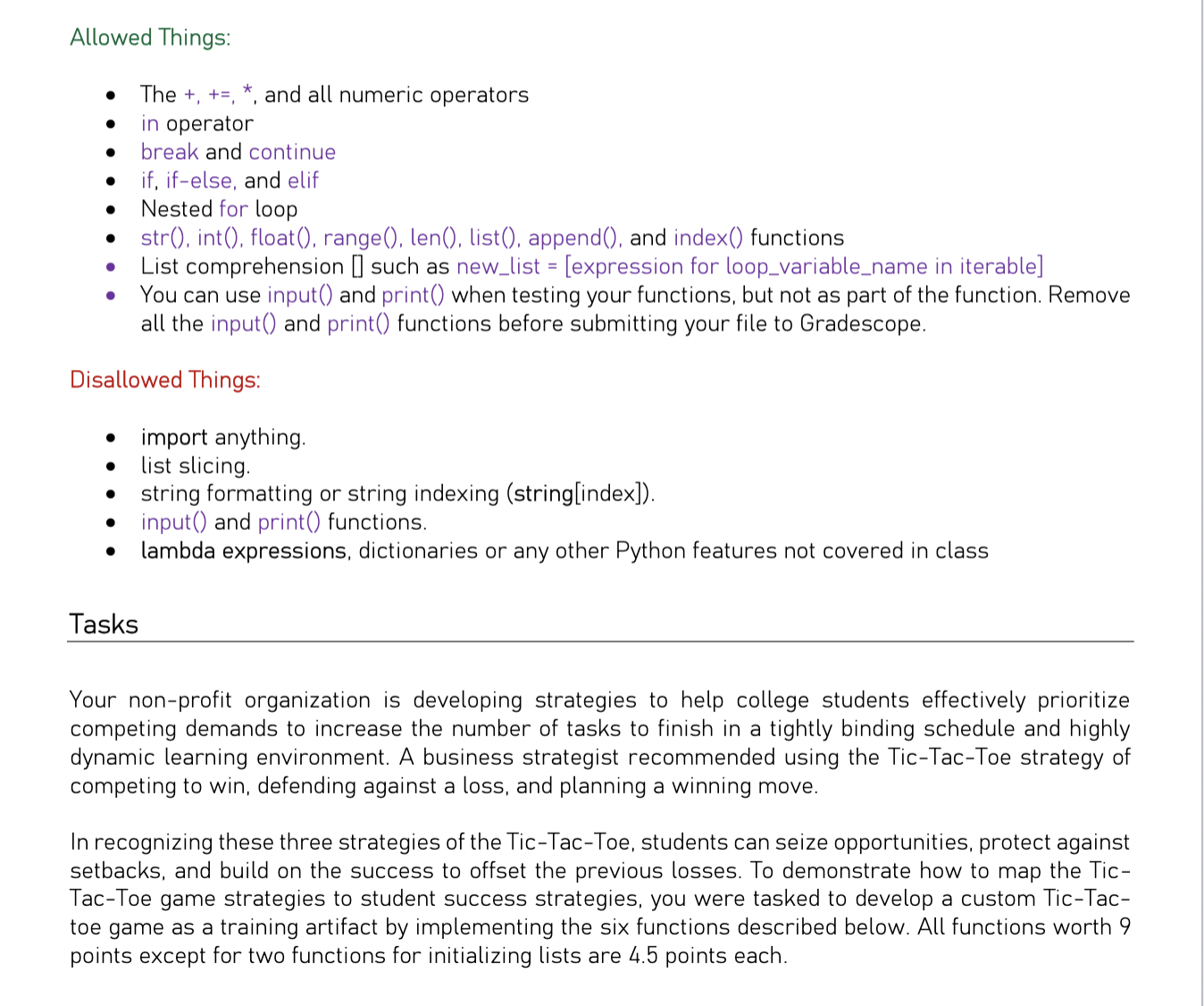
Allowed Things:
The, and all numeric operators
in operator
break and continue
if ifelse, and elif
Nested for loop
operatornamestr int float range len list append and index functions
List comprehension such as newlist expression for loopvariablename in iterable
You can use input and print when testing your functions, but not as part of the function. Remove all the input and print functions before submitting your file to Gradescope.
Disallowed Things:
import anything.
list slicing.
string formatting or string indexing stringindex
input and print functions.
lambda expressions, dictionaries or any other Python features not covered in class
Tasks
Your nonprofit organization is developing strategies to help college students effectively prioritize competing demands to increase the number of tasks to finish in a tightly binding schedule and highly dynamic learning environment. A business strategist recommended using the TicTacToe strategy of competing to win, defending against a loss, and planning a winning move.
In recognizing these three strategies of the TicTacToe, students can seize opportunities, protect against setbacks, and build on the success to offset the previous losses. To demonstrate how to map the TicTacToe game strategies to student success strategies, you were tasked to develop a custom TicTactoe game as a training artifact by implementing the six functions described below. All functions worth points except for two functions for initializing lists are points each.
def definesymbolssymbolslist:
Description: This function takes a predefined onedimensional D list of six different symbols, for example, @#XO and builds a twodimensional D list consisting of three nested lists, for example, @#X each containing two symbols from the ID list in the order they appear in the D see the below examples on the resulting D list
Parameters:
symbolslist a D list of strings: This parameter reflects six predefined symbols.
Assumptions: None
Return value: The D list of game symbols Type: list
Examples:
The row no cannot be greater than and the column no cannot be greater than
Symbolslist @#X
definesymbolssymbolslist@#X
symbolslist :$
definesymbolssymbolslist:$
symbolslist &QU
definesymbolssymbolslist&QU
Step by Step Solution
There are 3 Steps involved in it
1 Expert Approved Answer
Step: 1 Unlock

Question Has Been Solved by an Expert!
Get step-by-step solutions from verified subject matter experts
Step: 2 Unlock
Step: 3 Unlock
 Study Help