







Question: Please write in python and please do steps 1 and 2. Thank you! Step 1 Write a Python function to sort numbers in decreasing order,
Please write in python and please do steps 1 and 2. Thank you!
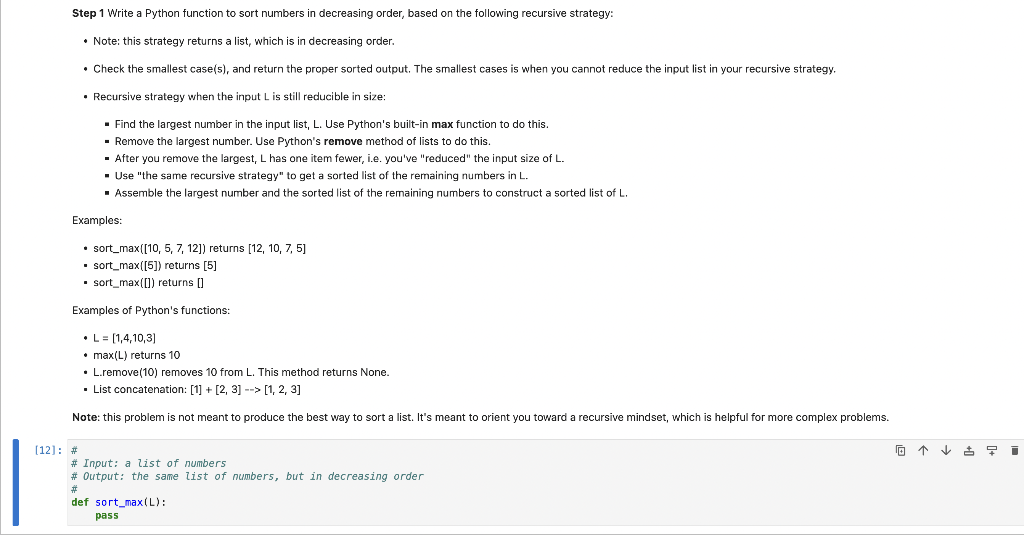
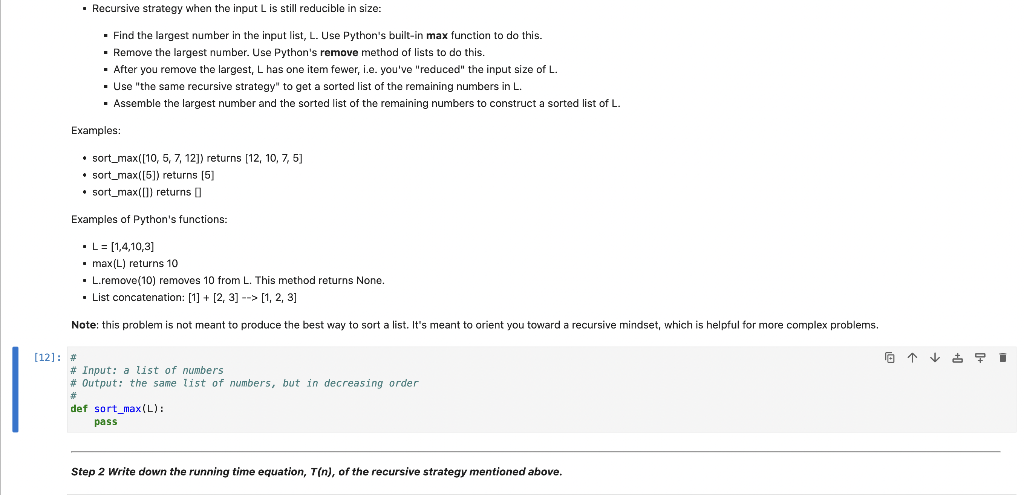
Step 1 Write a Python function to sort numbers in decreasing order, based on the following recursive strategy: - Note: this strategy returns a list, which is in decreasing order. - Check the smallest case(s), and return the proper sorted output. The smallest cases is when you cannot reduce the input list in your recursive strategy. - Recursive strategy when the input L is still reducible in size: - Find the largest number in the input list, L. Use Python's built-in max function to do this. - Remove the largest number. Use Python's remove method of lists to do this. - After you remove the largest, L has one item fewer, i.e. you've "reduced" the input size of L. - Use "the same recursive strategy" to get a sorted list of the remaining numbers in L. - Assemble the largest number and the sorted list of the remaining numbers to construct a sorted list of L. Examples: - sort_max ([10,5,7,12]) returns [12,10,7,5] - sort_max([5]) returns [5] - sort_max([]) returns [] Examples of Python's functions: - L=[1,4,10,3] - max(L) returns 10 - L.remove(10) removes 10 from L. This method returns None. - List concatenation: [1]+[2,3]>[1,2,3] Note: this problem is not meant to produce the best way to sort a list. It's meant to orient you toward a recursive mindset, which is helpful for more complex problems. \# Input: a list of numbers \# Output: the same list of numbers, but in decreasing order \# def sort_max(L): pass - Recursive strategy when the input L is still reducible in size: - Find the largest number in the input list, L. Use Python's built-in max function to do this. - Remove the largest number. Use Python's remove method of lists to do this. - After you remove the largest, L has one item fewer, i.e. you've "reduced" the input size of L. - Use "the same recursive strategy" to get a sorted list of the remaining numbers in L. - Assemble the largest number and the sorted list of the remaining numbers to construct a sorted list of L. Examples: - sort_max ([10,5,7,12]) returns [12,10,7,5] - sort_max([5]) returns [5] - sort_max([]] returns [] Examples of Python's functions: - L=[1,4,10,3] - max(L) returns 10 - L.remove(10) removes 10 from L. This method returns None. - List concatenation: [1]+[2,3][1,2,3] Note: this problem is not meant to produce the best way to sort a list. It's meant to orient you toward a recursive mindset, which is helpful for more complex problems. \# Input: a list of numbers \# Output: the same list of numbers, but in decreasing order def sort_max(L): pass
Step by Step Solution
There are 3 Steps involved in it

Get step-by-step solutions from verified subject matter experts
 Study Help