







Question: please write in word Assignment: Find two newspaperews magazine articles (one must be from a course you are taking or must deal with a sustainability
please write in word
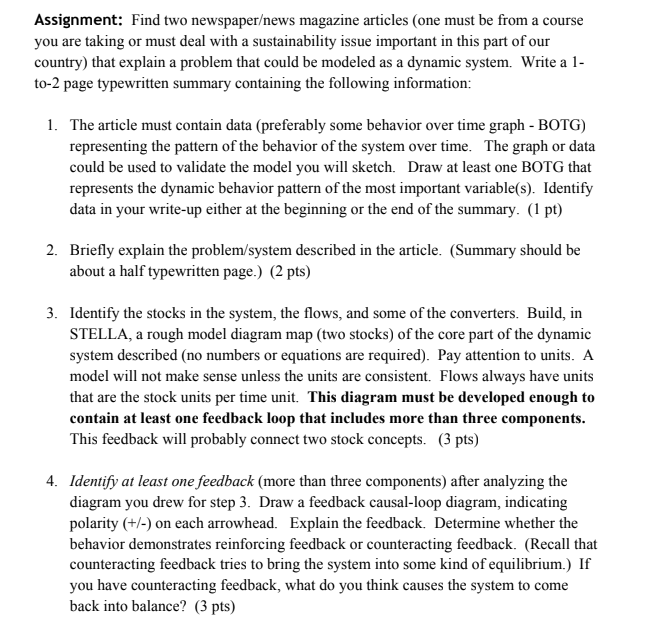
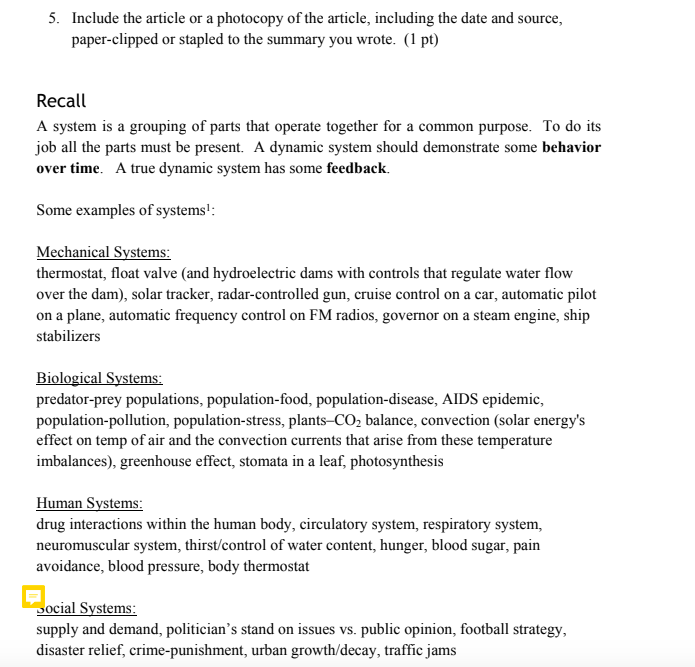
Assignment: Find two newspaperews magazine articles (one must be from a course you are taking or must deal with a sustainability issue important in this part of our country) that explain a problem that could be modeled as a dynamic system. Write a 1- to-2 page typewritten summary containing the following information: 1. The article must contain data (preferably some behavior over time graph - BOTG) representing the pattern of the behavior of the system over time. The graph or data could be used to validate the model you will sketch. Draw at least one BOTG that represents the dynamic behavior pattern of the most important variable(s). Identify data in your write-up either at the beginning or the end of the summary. (1 pt) 2. Briefly explain the problem/system described in the article. (Summary should be about a half typewritten page.) (2 pts) 3. Identify the stocks in the system, the flows, and some of the converters. Build, in STELLA, a rough model diagram map (two stocks) of the core part of the dynamic system described (no numbers or equations are required). Pay attention to units. A model will not make sense unless the units are consistent. Flows always have units that are the stock units per time unit. This diagram must be developed enough to contain at least one feedback loop that includes more than three components. This feedback will probably connect two stock concepts. (3 pts) 4. Identify at least one feedback (more than three components) after analyzing the diagram you drew for step 3. Draw a feedback causal-loop diagram, indicating polarity (+/-) on each arrowhead. Explain the feedback. Determine whether the behavior demonstrates reinforcing feedback or counteracting feedback. (Recall that counteracting feedback tries to bring the system into some kind of equilibrium.) If you have counteracting feedback, what do you think causes the system to come back into balance? (3 pts) 5. Include the article or a photocopy of the article, including the date and source, paper-clipped or stapled to the summary you wrote. (1 pt) Recall A system is a grouping of parts that operate together for a common purpose. To do its job all the parts must be present. A dynamic system should demonstrate some behavior over time. A true dynamic system has some feedback. Some examples of systems!: Mechanical Systems: thermostat, float valve (and hydroelectric dams with controls that regulate water flow over the dam), solar tracker, radar-controlled gun, cruise control on a car, automatic pilot on a plane, automatic frequency control on FM radios, governor on a steam engine, ship stabilizers Biological Systems: predator-prey populations, population-food, population-disease, AIDS epidemic, population-pollution, population-stress, plants-CO2 balance, convection (solar energy's effect on temp of air and the convection currents that arise from these temperature imbalances), greenhouse effect, stomata in a leaf, photosynthesis Human Systems: drug interactions within the human body, circulatory system, respiratory system, neuromuscular system, thirst/control of water content, hunger, blood sugar, pain avoidance, blood pressure, body thermostat Social Systems: supply and demand, politician's stand on issues vs. public opinion, football strategy, disaster relief, crime-punishment, urban growth/decay, traffic jams Assignment: Find two newspaperews magazine articles (one must be from a course you are taking or must deal with a sustainability issue important in this part of our country) that explain a problem that could be modeled as a dynamic system. Write a 1- to-2 page typewritten summary containing the following information: 1. The article must contain data (preferably some behavior over time graph - BOTG) representing the pattern of the behavior of the system over time. The graph or data could be used to validate the model you will sketch. Draw at least one BOTG that represents the dynamic behavior pattern of the most important variable(s). Identify data in your write-up either at the beginning or the end of the summary. (1 pt) 2. Briefly explain the problem/system described in the article. (Summary should be about a half typewritten page.) (2 pts) 3. Identify the stocks in the system, the flows, and some of the converters. Build, in STELLA, a rough model diagram map (two stocks) of the core part of the dynamic system described (no numbers or equations are required). Pay attention to units. A model will not make sense unless the units are consistent. Flows always have units that are the stock units per time unit. This diagram must be developed enough to contain at least one feedback loop that includes more than three components. This feedback will probably connect two stock concepts. (3 pts) 4. Identify at least one feedback (more than three components) after analyzing the diagram you drew for step 3. Draw a feedback causal-loop diagram, indicating polarity (+/-) on each arrowhead. Explain the feedback. Determine whether the behavior demonstrates reinforcing feedback or counteracting feedback. (Recall that counteracting feedback tries to bring the system into some kind of equilibrium.) If you have counteracting feedback, what do you think causes the system to come back into balance? (3 pts) 5. Include the article or a photocopy of the article, including the date and source, paper-clipped or stapled to the summary you wrote. (1 pt) Recall A system is a grouping of parts that operate together for a common purpose. To do its job all the parts must be present. A dynamic system should demonstrate some behavior over time. A true dynamic system has some feedback. Some examples of systems!: Mechanical Systems: thermostat, float valve (and hydroelectric dams with controls that regulate water flow over the dam), solar tracker, radar-controlled gun, cruise control on a car, automatic pilot on a plane, automatic frequency control on FM radios, governor on a steam engine, ship stabilizers Biological Systems: predator-prey populations, population-food, population-disease, AIDS epidemic, population-pollution, population-stress, plants-CO2 balance, convection (solar energy's effect on temp of air and the convection currents that arise from these temperature imbalances), greenhouse effect, stomata in a leaf, photosynthesis Human Systems: drug interactions within the human body, circulatory system, respiratory system, neuromuscular system, thirst/control of water content, hunger, blood sugar, pain avoidance, blood pressure, body thermostat Social Systems: supply and demand, politician's stand on issues vs. public opinion, football strategy, disaster relief, crime-punishment, urban growth/decay, traffic jamsStep by Step Solution
There are 3 Steps involved in it
1 Expert Approved Answer
Step: 1 Unlock

Question Has Been Solved by an Expert!
Get step-by-step solutions from verified subject matter experts
Step: 2 Unlock
Step: 3 Unlock
 Study Help