







Question: please write neatly and clearly and answer all learned in this course in communications is the amplitude modulation technique (see the block diagram below) cost)
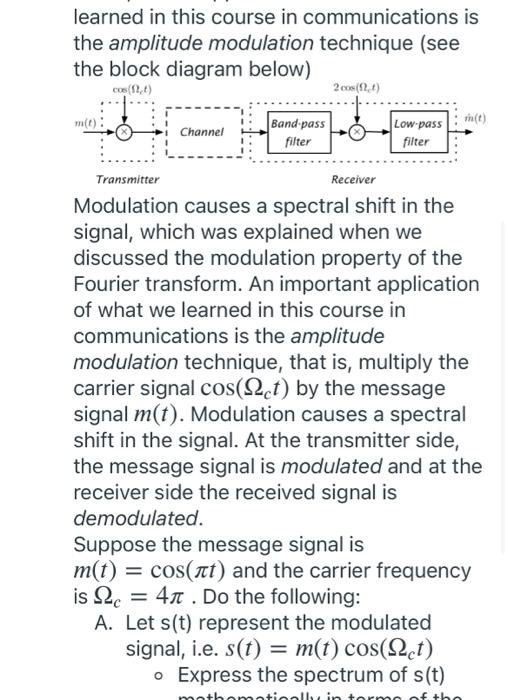
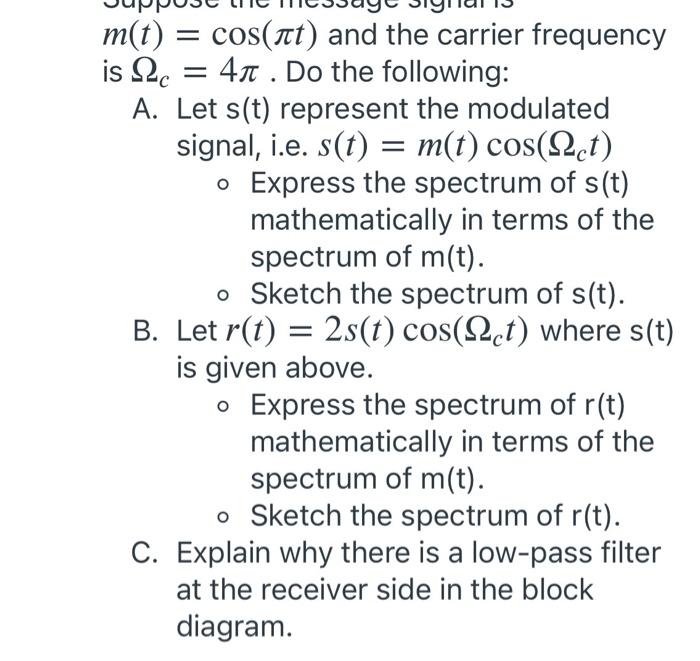
learned in this course in communications is the amplitude modulation technique (see the block diagram below) cost) 2008 (12) m(t): (t) Channel Band pass filter Low-pass filter Transmitter Receiver Modulation causes a spectral shift in the signal, which was explained when we discussed the modulation property of the Fourier transform. An important application of what we learned in this course in communications is the amplitude modulation technique, that is, multiply the carrier signal cos(12ct) by the message signal m(t). Modulation causes a spectral shift in the signal. At the transmitter side, the message signal is modulated and at the receiver side the received signal is demodulated. Suppose the message signal is m(t) = cos(at) and the carrier frequency is 92c = 41. Do the following: A. Let s(t) represent the modulated signal, i.e. s(t) = m(t) cos(92ct) o Express the spectrum of s(t) = atbonaatiollistarmanfube m(t) = cos(at) and the carrier frequency is . = 41. Do the following: A. Let s(t) represent the modulated signal, i.e. s(t) = m(t) cos(32ct) o Express the spectrum of s(t) mathematically in terms of the spectrum of m(t). o Sketch the spectrum of s(t). B. Let r(t) = 2s(t) cos(92ct) where s(t) is given above. o Express the spectrum of r(t) mathematically in terms of the spectrum of m(t). o Sketch the spectrum of r(t). C. Explain why there is a low-pass filter at the receiver side in the block diagram
Step by Step Solution
There are 3 Steps involved in it

Get step-by-step solutions from verified subject matter experts
 Study Help