







Question: Please write notes briefly of this page If any problems (or) derivations also explain briefly (a) (b) (c) a a a a b 1 Densio
Please write notes briefly of this page
If any problems (or) derivations also explain briefly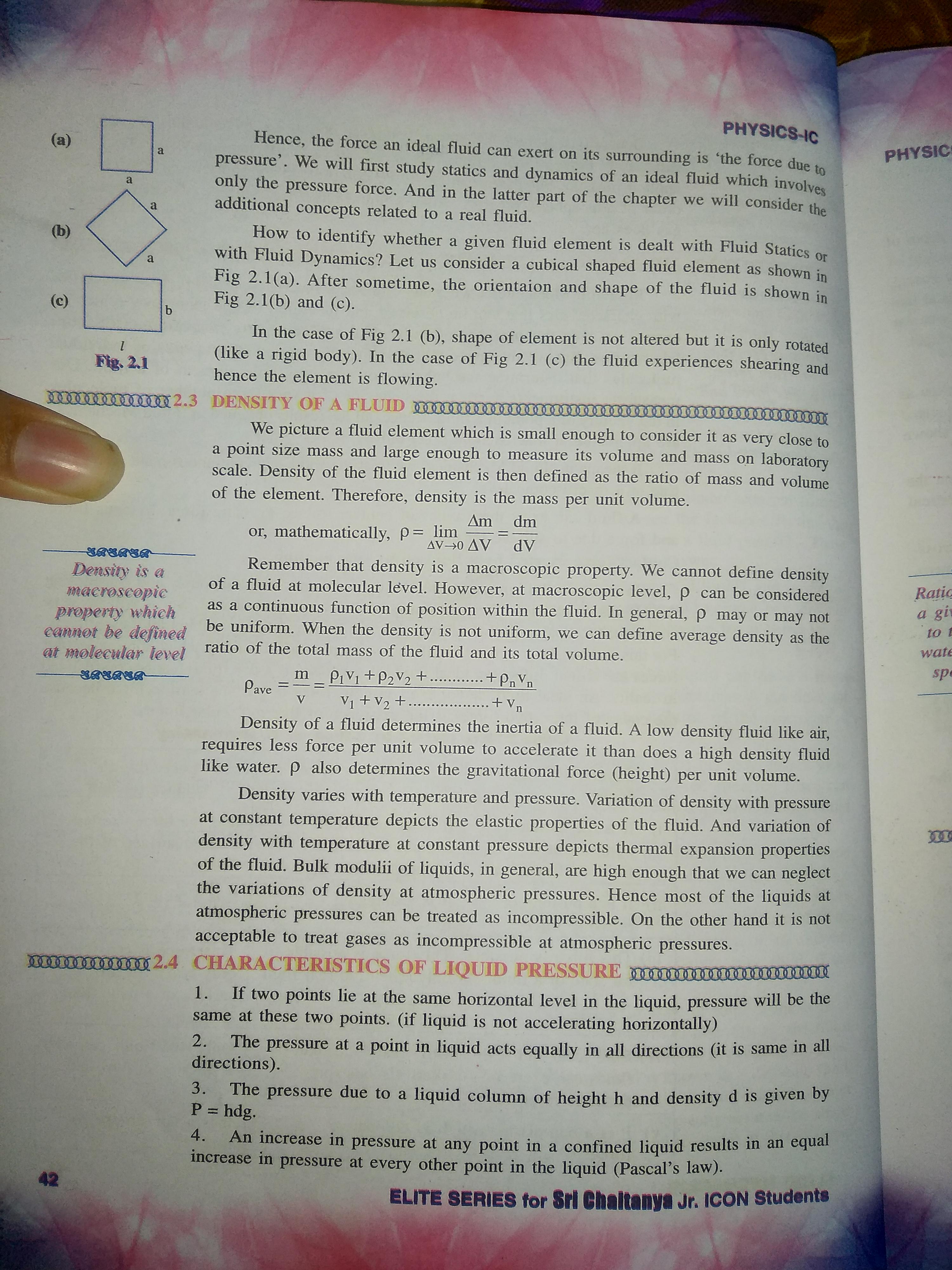
(a) (b) (c) a a a a b 1 Densio is a pmperty which cannot be defined at molecular level PHYSICS-IC Hence, the force an ideal fluid can exert on its surrounding is 'the force due pressure'. We will first study statics and dynamics of an ideal fluid which involves only the pressure force. And in the latter part of the chapter we will consider the additional concepts related to a real fluid. How to identify whether a given fluid element is dealt with Fluid Statics or with Fluid Dynamics? Let us consider a cubical shaped fluid element as shown in Fig 2.1 (a). After sometime, the orientaion and shape of the fluid is shown in Fig 2.1(b) and (c). In the case of Fig 2.1 (b), shape of element is not altered but it is only rotated (like a rigid body). In the case of Fig 2.1 (c) the fluid experiences shearing and hence the element is flowing. DENSITY OF A FLUID We picture a fluid element which is small enough to consider it as very close to a point size mass and large enough to measure its volume and mass on laboratory scale. Density of the fluid element is then defined as the ratio of mass and volume of the element. Therefore, density is the mass per unit volume. Am dm or, mathematically, p = lim Remember that density is a macroscopic property. We cannot define density of a fluid at molecular level. However, at macroscopic level, p can be considered as a continuous function of position within the fluid. In general, p may or may not be uniform. When the density is not uniform, we can define average density as the ratio of the total mass of the fluid and its total volume. m + P2V2 + pave VI + V2 + Density of a fluid determines the inertia of a fluid. A low density fluid like air, requires less force per unit volume to accelerate it than does a high density fluid like water. p also determines the gravitational force (height) per unit volume. Density varies with temperature and pressure. Variation of density with pressure at constant temperature depicts the elastic properties of the fluid. And variation of density with temperature at constant pressure depicts thermal expansion properties of the fluid. Bulk modulii of liquids, in general, are high enough that we can neglect the variations of density at atmospheric pressures. Hence most of the liquids at atmospheric pressures can be treated as incompressible. On the other hand it is not acceptable to treat gases as incompressible at atmospheric pressures. CHARACTERISTICS OF LIQUID PRESSURE 1. If two points lie at the same horizontal level in the liquid, pressure will be the same at these two points. (if liquid is not accelerating horizontally) 2. The pressure at a point in liquid acts equally in all directions (it is same in all directions). 3. The pressure due to a liquid column of height h and density d is given by P = hdg. 4. An increase in pressure at any point in a confined liquid results in an equal increase in pressure at every other point in the liquid (Pascal's law). ELITE SERIES for Sr1 Choltanya Jr. ICON Students PHYSIC Ra!ic a gil to t watt
Step by Step Solution
3.37 Rating (156 Votes )
There are 3 Steps involved in it
Topic Density of a fluidnotes in brief 1Density of fluid element definitionit is defined as ratio of ... View full answer

Get step-by-step solutions from verified subject matter experts
 Study Help