







Question: Please write the code for all the requirements. Objective of the project: Convert a recording of touch tones' from a real telephone into the corresponding
 Please write the code for all the requirements.
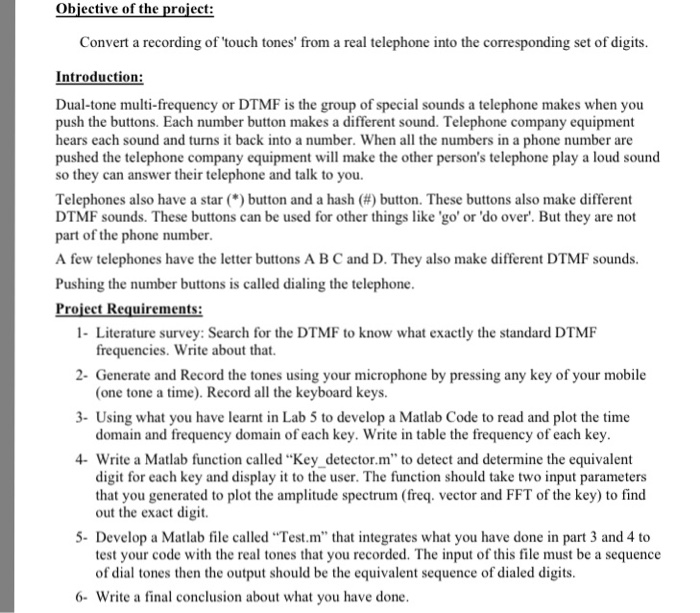
 Objective of the project: Convert a recording of touch tones' from a real telephone into the corresponding set of digits. Introduction: Dual-tone multi-frequency or DTMF is the group of special sounds a telephone makes when you push the buttons. Each number button makes a different sound. Telephone company equipment hears each sound and turns it back into a number. When all the numbers in a phone number are pushed the telephone company equipment will make the other person's telephone play a loud sound so they can answer their telephone and talk to you Telephones also have a star (*) button and a hash (#) button. These buttons also make different DTMF sounds. These buttons can be used for other things like 'go' or'do over. But they are not part of the phone number A few telephones have the letter buttons A B C and D. They also make different DTMF sounds. Pushing the number buttons is called dialing the telephone. Project Requirements: - Literature survey: Search for the DTMF to know what exactly the standard DTMF 2- Generate and Record the tones using your microphone by pressing any key of your mobile 3- Using what you have learnt in Lab 5 to develop a Matlab Code to read and plot the time frequencies. Write about that. (one tone a time). Record all the keyboard keys. domain and frequency domain of each key. Write in table the frequency of each key Write a Matlab function called "Key detector.m" to detect and determine the equivalent digit for each key and display it to the user. The function should take two input parameters that you generated to plot the amplitude spectrum (freq. vector and FFT of the key) to find out the exact digit. 5- Develop a Matlab file called Test.m" that integrates what you have done in part 3 and 4 to test your code with the real tones that you recorded. The input of this file must be a sequence of dial tones then the output should be the equivalent sequence of dialed digits. 6- Write a final conclusion about what you have done. Objective of the project: Convert a recording of touch tones' from a real telephone into the corresponding set of digits. Introduction: Dual-tone multi-frequency or DTMF is the group of special sounds a telephone makes when you push the buttons. Each number button makes a different sound. Telephone company equipment hears each sound and turns it back into a number. When all the numbers in a phone number are pushed the telephone company equipment will make the other person's telephone play a loud sound so they can answer their telephone and talk to you Telephones also have a star (*) button and a hash (#) button. These buttons also make different DTMF sounds. These buttons can be used for other things like 'go' or'do over. But they are not part of the phone number A few telephones have the letter buttons A B C and D. They also make different DTMF sounds. Pushing the number buttons is called dialing the telephone. Project Requirements: - Literature survey: Search for the DTMF to know what exactly the standard DTMF 2- Generate and Record the tones using your microphone by pressing any key of your mobile 3- Using what you have learnt in Lab 5 to develop a Matlab Code to read and plot the time frequencies. Write about that. (one tone a time). Record all the keyboard keys. domain and frequency domain of each key. Write in table the frequency of each key Write a Matlab function called "Key detector.m" to detect and determine the equivalent digit for each key and display it to the user. The function should take two input parameters that you generated to plot the amplitude spectrum (freq. vector and FFT of the key) to find out the exact digit. 5- Develop a Matlab file called Test.m" that integrates what you have done in part 3 and 4 to test your code with the real tones that you recorded. The input of this file must be a sequence of dial tones then the output should be the equivalent sequence of dialed digits. 6- Write a final conclusion about what you have done
Step by Step Solution
There are 3 Steps involved in it

Get step-by-step solutions from verified subject matter experts
 Study Help