Question: please write the internal downward communication 81 81 DO: Week 2: Activity Discussion // Four Types of Business Communications // Submit here There are 4
 please write the internal downward communication
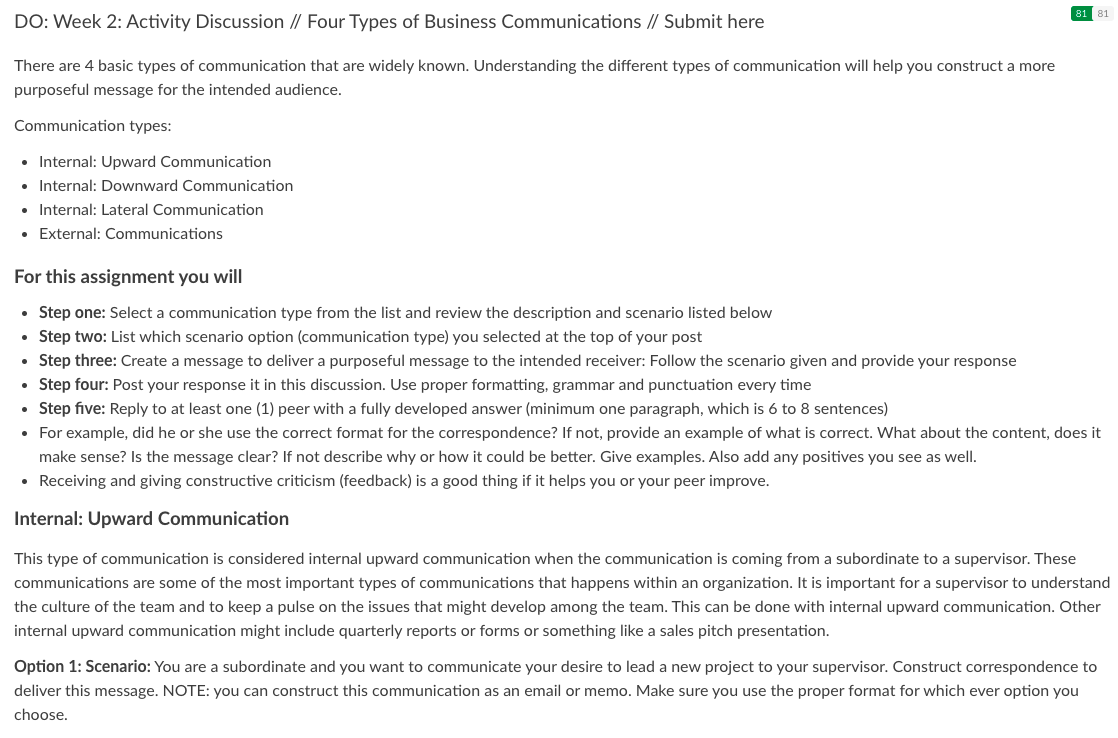
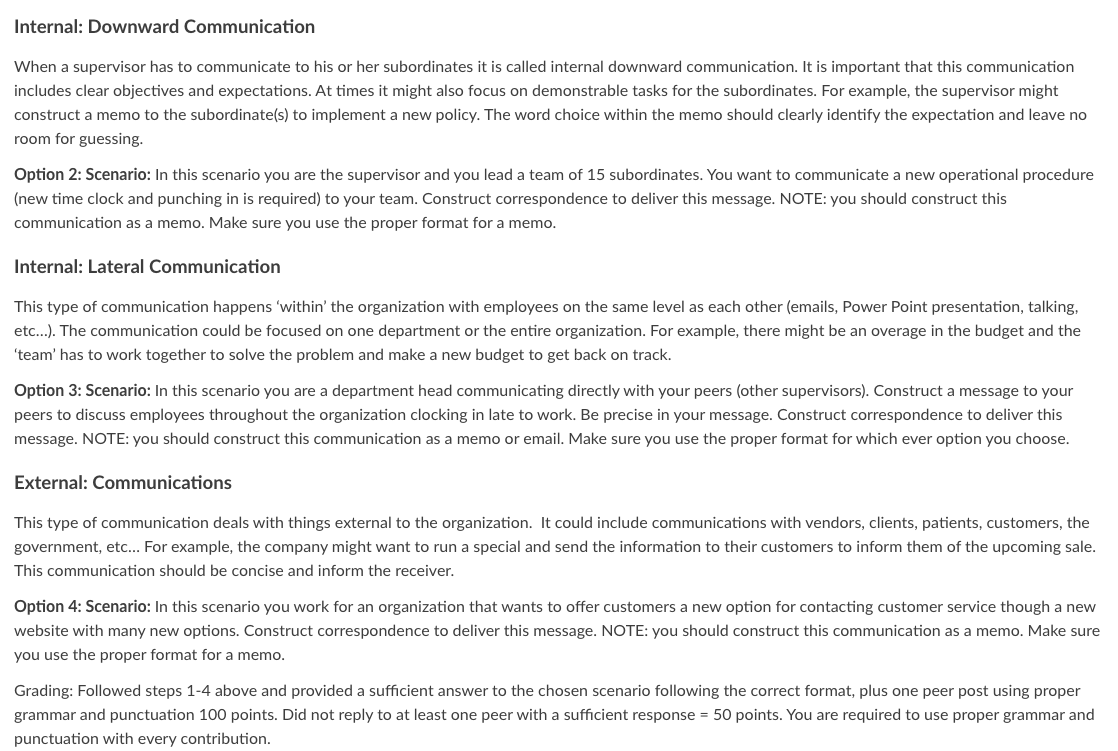
81 81 DO: Week 2: Activity Discussion // Four Types of Business Communications // Submit here There are 4 basic types of communication that are widely known. Understanding the different types of communication will help you construct a more purposeful message for the intended audience. Communication types: Internal: Upward Communication Internal: Downward Communication Internal: Lateral Communication External: Communications For this assignment you will Step one: Select a communication type from the list and review the description and scenario listed below Step two: List which scenario option (communication type) you selected at the top of your post Step three: Create a message to deliver a purposeful message to the intended receiver: Follow the scenario given and provide your response Step four: Post your response it in this discussion. Use proper formatting, grammar and punctuation every time Step five: Reply to at least one (1) peer with a fully developed answer (minimum one paragraph, which is 6 to 8 sentences) For example, did he or she use the correct format for the correspondence? If not, provide an example of what is correct. What about the content, does it make sense? Is the message clear? If not describe why or how it could be better. Give examples. Also add any positives you see as well. Receiving and giving constructive criticism (feedback) is a good thing if it helps you or your peer improve. Internal: Upward Communication This type of communication is considered internal upward communication when the communication is coming from a subordinate to a supervisor. These communications are some of the most important types of communications that happens within an organization. It is important for a supervisor to understand the culture of the team and to keep a pulse on the issues that might develop among the team. This can be done with internal upward communication. Other internal upward communication might include quarterly reports or forms or something like a sales pitch presentation. Option 1: Scenario: You are a subordinate and you want to communicate your desire to lead a new project to your supervisor. Construct correspondence to deliver this message. NOTE: you can construct this communication as an email or memo. Make sure you use the proper format for which ever option you choose. Internal: Downward Communication When a supervisor has to communicate to his or her subordinates it is called internal downward communication. It is important that this communication includes clear objectives and expectations. At times it might also focus on demonstrable tasks for the subordinates. For example, the supervisor might construct a memo to the subordinate(s) to implement a new policy. The word choice within the memo should clearly identify the expectation and leave no room for guessing. Option 2: Scenario: In this scenario you are the supervisor and you lead a team of 15 subordinates. You want to communicate a new operational procedure (new time clock and punching in is required) to your team. Construct correspondence to deliver this message. NOTE: you should construct this communication as a memo. Make sure you use the proper format for a memo. Internal: Lateral Communication This type of communication happens 'within' the organization with employees on the same level as each other (emails, Power Point presentation, talking, etc...). The communication could be focused on one department or the entire organization. For example, there might be an overage in the budget and the 'team' has to work together to solve the problem and make a new budget to get back on track. Option 3: Scenario: In this scenario you are a department head communicating directly with your peers (other supervisors). Construct a message to your peers to discuss employees throughout the organization clocking in late to work. Be precise in your message. Construct correspondence to deliver this message. NOTE: you should construct this communication as a memo or email. Make sure you use the proper format for which ever option you choose. External: Communications This type of communication deals with things external to the organization. It could include communications with vendors, clients, patients, customers, the government, etc... For example, the company might want to run a special and send the information to their customers to inform them of the upcoming sale. This communication should be concise and inform the receiver. Option 4: Scenario: In this scenario you work for an organization that wants to offer customers a new option for contacting customer service though a new website with many new options. Construct correspondence to deliver this message. NOTE: you should construct this communication as a memo. Make sure you use the proper format for a memo. Grading: Followed steps 1-4 above and provided a sufficient answer to the chosen scenario following the correct format, plus one peer post using proper grammar and punctuation 100 points. Did not reply to at least one peer with a sufficient response = 50 points. You are required to use proper grammar and punctuation with every contribution. 81 81 DO: Week 2: Activity Discussion // Four Types of Business Communications // Submit here There are 4 basic types of communication that are widely known. Understanding the different types of communication will help you construct a more purposeful message for the intended audience. Communication types: Internal: Upward Communication Internal: Downward Communication Internal: Lateral Communication External: Communications For this assignment you will Step one: Select a communication type from the list and review the description and scenario listed below Step two: List which scenario option (communication type) you selected at the top of your post Step three: Create a message to deliver a purposeful message to the intended receiver: Follow the scenario given and provide your response Step four: Post your response it in this discussion. Use proper formatting, grammar and punctuation every time Step five: Reply to at least one (1) peer with a fully developed answer (minimum one paragraph, which is 6 to 8 sentences) For example, did he or she use the correct format for the correspondence? If not, provide an example of what is correct. What about the content, does it make sense? Is the message clear? If not describe why or how it could be better. Give examples. Also add any positives you see as well. Receiving and giving constructive criticism (feedback) is a good thing if it helps you or your peer improve. Internal: Upward Communication This type of communication is considered internal upward communication when the communication is coming from a subordinate to a supervisor. These communications are some of the most important types of communications that happens within an organization. It is important for a supervisor to understand the culture of the team and to keep a pulse on the issues that might develop among the team. This can be done with internal upward communication. Other internal upward communication might include quarterly reports or forms or something like a sales pitch presentation. Option 1: Scenario: You are a subordinate and you want to communicate your desire to lead a new project to your supervisor. Construct correspondence to deliver this message. NOTE: you can construct this communication as an email or memo. Make sure you use the proper format for which ever option you choose. Internal: Downward Communication When a supervisor has to communicate to his or her subordinates it is called internal downward communication. It is important that this communication includes clear objectives and expectations. At times it might also focus on demonstrable tasks for the subordinates. For example, the supervisor might construct a memo to the subordinate(s) to implement a new policy. The word choice within the memo should clearly identify the expectation and leave no room for guessing. Option 2: Scenario: In this scenario you are the supervisor and you lead a team of 15 subordinates. You want to communicate a new operational procedure (new time clock and punching in is required) to your team. Construct correspondence to deliver this message. NOTE: you should construct this communication as a memo. Make sure you use the proper format for a memo. Internal: Lateral Communication This type of communication happens 'within' the organization with employees on the same level as each other (emails, Power Point presentation, talking, etc...). The communication could be focused on one department or the entire organization. For example, there might be an overage in the budget and the 'team' has to work together to solve the problem and make a new budget to get back on track. Option 3: Scenario: In this scenario you are a department head communicating directly with your peers (other supervisors). Construct a message to your peers to discuss employees throughout the organization clocking in late to work. Be precise in your message. Construct correspondence to deliver this message. NOTE: you should construct this communication as a memo or email. Make sure you use the proper format for which ever option you choose. External: Communications This type of communication deals with things external to the organization. It could include communications with vendors, clients, patients, customers, the government, etc... For example, the company might want to run a special and send the information to their customers to inform them of the upcoming sale. This communication should be concise and inform the receiver. Option 4: Scenario: In this scenario you work for an organization that wants to offer customers a new option for contacting customer service though a new website with many new options. Construct correspondence to deliver this message. NOTE: you should construct this communication as a memo. Make sure you use the proper format for a memo. Grading: Followed steps 1-4 above and provided a sufficient answer to the chosen scenario following the correct format, plus one peer post using proper grammar and punctuation 100 points. Did not reply to at least one peer with a sufficient response = 50 points. You are required to use proper grammar and punctuation with every contribution









 Study Help