







Question: pleaseeeee help please write a summary what did you learn from the article? Hampson: The Case of the Forgotten Production Concepts The Toyota Production System:
pleaseeeee help please write a summary 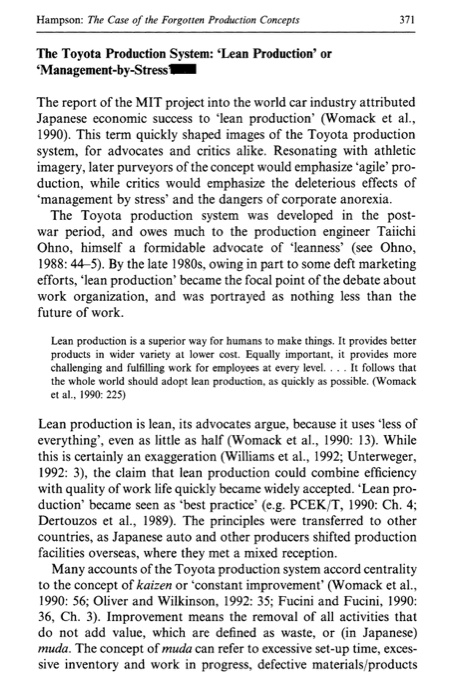
what did you learn from the article?
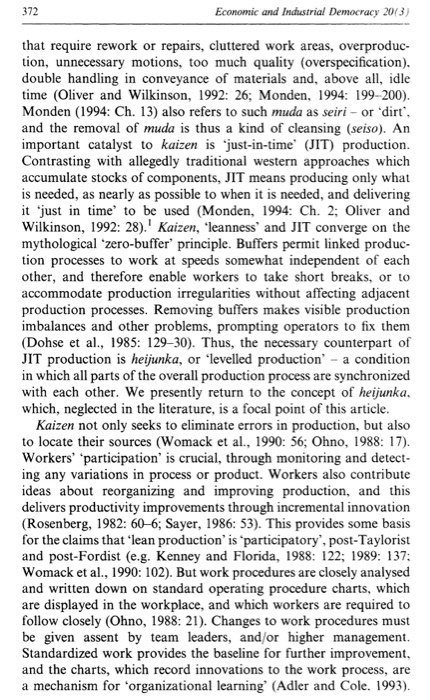
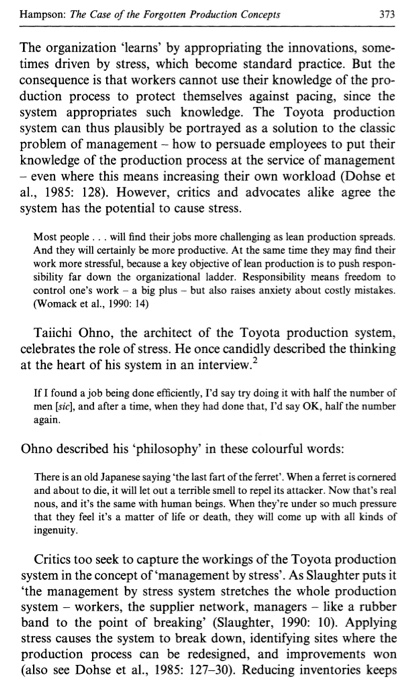
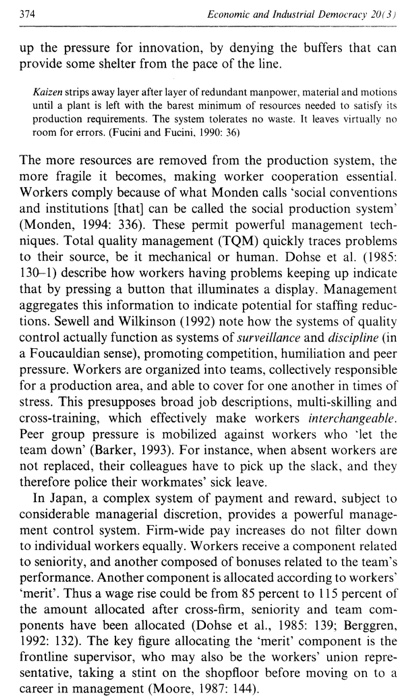
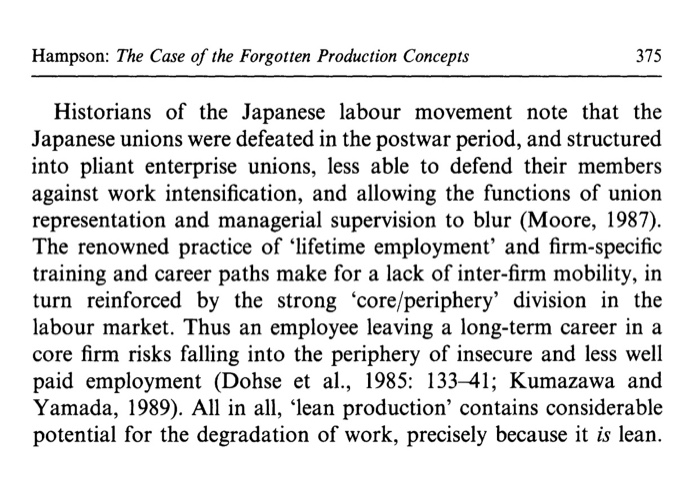
Hampson: The Case of the Forgotten Production Concepts The Toyota Production System: 'Lean Production or 'Management-by-Stress The report of the MIT project into the world car industry attributed Japanese economic success to 'lean production' (Womack et al., 1990). This term quickly shaped images of the Toyota production system, for advocates and critics alike. Resonating with athletic imagery, later purveyors of the concept would emphasize 'agile' pro- duction, while critics would emphasize the deleterious effects of 'management by stress and the dangers of corporate anorexia. The Toyota production system was developed in the post- war period, and owes much to the production engineer Taiichi Ohno, himself a formidable advocate of 'leanness' (see Ohno, 1988: 44-5). By the late 1980s, owing in part to some deft marketing efforts, "lean production' became the focal point of the debate about work organization, and was portrayed as nothing less than the future of work. Lean production is a superior way for humans to make things. It provides better products in wider variety at lower cost. Equally important, it provides more challenging and fulfilling work for employees at every level.... It follows that the whole world should adopt lean production, as quickly as possible. (Womack et al., 1990: 225) Lean production is lean, its advocates argue, because it uses 'less of everything', even as little as half (Womack et al., 1990: 13). While this is certainly an exaggeration (Williams et al., 1992; Unterweger, 1992: 3), the claim that lean production could combine efficiency with quality of work life quickly became widely accepted. 'Lean pro- duction became seen as 'best practice' (e.g. PCEKT, 1990: Ch. 4; Dertouzos et al., 1989). The principles were transferred to other countries, as Japanese auto and other producers shifted production facilities overseas, where they met a mixed reception. Many accounts of the Toyota production system accord centrality to the concept of kaizen or constant improvement' (Womack et al., 1990: 56; Oliver and Wilkinson, 1992: 35; Fucini and Fucini, 1990: 36, Ch. 3). Improvement means the removal of all activities that do not add value, which are defined as waste, or in Japanese) muda. The concept of muda can refer to excessive set-up time, exces- sive inventory and work in progress, defective materials/products 372 Economic and Industrial Democracy 2013) that require rework or repairs, cluttered work areas, overproduc tion, unnecessary motions, too much quality (overspecification). double handling in conveyance of materials and, above all, idle time (Oliver and Wilkinson, 1992: 26; Monden, 1994: 199-200). Monden (1994: Ch. 13) also refers to such muda as seiri - or dirt, and the removal of muda is thus a kind of cleansing (seiso). An important catalyst to kaizen is 'just-in-time (JIT) production. Contrasting with allegedly traditional western approaches which accumulate stocks of components, JIT means producing only what is needed, as nearly as possible to when it is needed, and delivering it 'just in time to be used (Monden, 1994: Ch. 2; Oliver and Wilkinson, 1992: 28).' Kaizen, 'leanness' and JIT converge on the mythological "zero-buffer' principle. Buffers permit linked produc- tion processes to work at speeds somewhat independent of each other, and therefore enable workers to take short breaks, or to accommodate production irregularities without affecting adjacent production processes. Removing buffers makes visible production imbalances and other problems, prompting operators to fix them (Dohse et al., 1985: 129-30). Thus, the necessary counterpart of JIT production is heijunka, or 'levelled production - a condition in which all parts of the overall production process are synchronized with each other. We presently return to the concept of heijunka, which, neglected in the literature, is a focal point of this article. Kaizen not only seeks to eliminate errors in production, but also to locate their sources (Womack et al., 1990: 56; Ohno, 1988: 17). Workers' participation is crucial, through monitoring and detect ing any variations in process or product. Workers also contribute ideas about reorganizing and improving production, and this delivers productivity improvements through incremental innovation (Rosenberg, 1982: 60-6; Sayer, 1986: 53). This provides some basis for the claims that 'lean production' is participatory.post-Taylorist and post-Fordist (e.g. Kenney and Florida, 1988: 122; 1989: 137: Womack et al., 1990: 102). But work procedures are closely analysed and written down on standard operating procedure charts, which are displayed in the workplace, and which workers are required to follow closely (Ohno, 1988: 21). Changes to work procedures must be given assent by team leaders, and/or higher management. Standardized work provides the baseline for further improvement, and the charts, which record innovations to the work process, are a mechanism for organizational learning (Adler and Cole. 1993). Hampson: The Case of the Forgotten Production Concepts 373 The organization 'learns' by appropriating the innovations, some- times driven by stress, which become standard practice. But the consequence is that workers cannot use their knowledge of the pro- duction process to protect themselves against pacing, since the system appropriates such knowledge. The Toyota production system can thus plausibly be portrayed as a solution to the classic problem of management - how to persuade employees to put their knowledge of the production process at the service of management - even where this means increasing their own workload (Dohse et al., 1985: 128). However, critics and advocates alike agree the system has the potential to cause stress. Most people... will find their jobs more challenging as lean production spreads. And they will certainly be more productive. At the same time they may find their work more stressful, because a key objective of lean production is to push respon sibility far down the organizational ladder. Responsibility means freedom to control one's work - a big plus - but also raises anxiety about costly mistakes. (Womack et al., 1990:14) Taiichi Ohno, the architect of the Toyota production system, celebrates the role of stress. He once candidly described the thinking at the heart of his system in an interview." If I found a job being done efficiently, I'd say try doing it with half the number of men (sic), and after a time, when they had done that, I'd say OK, half the number again. Ohno described his philosophy' in these colourful words: There is an old Japanese saying the last fart of the ferret'. When a ferret is cornered and about to die, it will let out a terrible smell to repel its attacker. Now that's real nous, and it's the same with human beings. When they're under so much pressure that they feel it's a matter of life or death, they will come up with all kinds of ingenuity Critics too seek to capture the workings of the Toyota production system in the concept of management by stress'. As Slaughter puts it 'the management by stress system stretches the whole production system - workers, the supplier network, managers - like a rubber band to the point of breaking (Slaughter, 1990: 10). Applying stress causes the system to break down, identifying sites where the production process can be redesigned, and improvements won (also see Dohse et al., 1985: 127-30). Reducing inventories keeps 374 Economic and Industrial Democracy 2013) up the pressure for innovation, by denying the buffers that can provide some shelter from the pace of the line. Kaizen strips away layer after layer of redundant manpower, material and motions until a plant is left with the barest minimum of resources needed to satisfy its production requirements. The system tolerates no waste. It leaves virtually no room for errors. (Fucini and Fucini, 1990: 36) The more resources are removed from the production system, the more fragile it becomes, making worker cooperation essential Workers comply because of what Monden calls 'social conventions and institutions (that) can be called the social production system (Monden, 1994: 336). These permit powerful management tech- niques. Total quality management (TOM) quickly traces problems to their source, be it mechanical or human. Dohse et al. (1985: 130-1) describe how workers having problems keeping up indicate that by pressing a button that illuminates a display. Management aggregates this information to indicate potential for staffing reduc. tions. Sewell and Wilkinson (1992) note how the systems of quality control actually function as systems of surveillance and discipline (in a Foucauldian sense), promoting competition, humiliation and peer pressure. Workers are organized into teams, collectively responsible for a production area, and able to cover for one another in times of stress. This presupposes broad job descriptions, multi-skilling and cross-training, which effectively make workers interchangeable. Peer group pressure is mobilized against workers who 'let the team down' (Barker, 1993). For instance, when absent workers are not replaced, their colleagues have to pick up the slack, and they therefore police their workmates' sick leave. In Japan, a complex system of payment and reward, subject to considerable managerial discretion, provides a powerful manage- ment control system. Firm-wide pay increases do not filter down to individual workers equally. Workers receive a component related to seniority, and another composed of bonuses related to the team's performance. Another component is allocated according to workers 'merit'. Thus a wage rise could be from 85 percent to 115 percent of the amount allocated after cross-firm, seniority and team com- ponents have been allocated (Dohse et al., 1985: 139Berggren, 1992: 132). The key figure allocating the 'merit' component is the frontline supervisor, who may also be the workers' union repre- sentative, taking a stint on the shopfloor before moving on to a career in management (Moore, 1987: 144). Hampson: The Case of the Forgotten Production Concepts 375 Historians of the Japanese labour movement note that the Japanese unions were defeated in the postwar period, and structured into pliant enterprise unions, less able to defend their members against work intensification, and allowing the functions of union representation and managerial supervision to blur (Moore, 1987). The renowned practice of 'lifetime employment and firm-specific training and career paths make for a lack of inter-firm mobility, in turn reinforced by the strong 'core/periphery' division in the labour market. Thus an employee leaving a long-term career in a core firm risks falling into the periphery of insecure and less well paid employment (Dohse et al., 1985: 13341; Kumazawa and Yamada, 1989). All in all, lean production contains considerable potential for the degradation of work, precisely because it is lean
Step by Step Solution
There are 3 Steps involved in it
1 Expert Approved Answer
Step: 1 Unlock

Question Has Been Solved by an Expert!
Get step-by-step solutions from verified subject matter experts
Step: 2 Unlock
Step: 3 Unlock
 Study Help