Question: Please,I just want a problem statement (formulation, interpretation) of this case of B1 Winston. All typed. CASE 8 Emergency Vehicle Location in Springfield You are
Please,I just want a problem statement (formulation, interpretation) of this case of B1 Winston. All typed.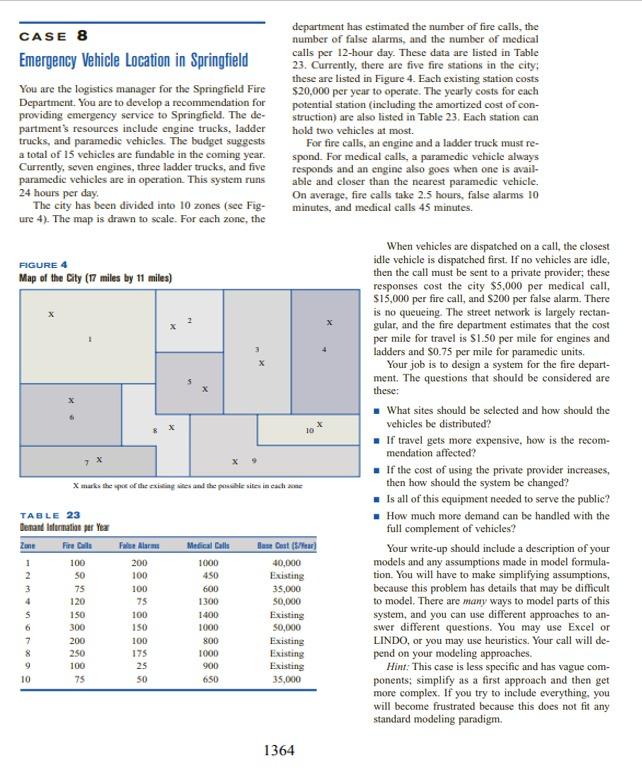
CASE 8 Emergency Vehicle Location in Springfield You are the logistics manager for the Springfield Fire Department. You are to develop a recommendation for providing emergency service to Springfield. The de- partment's resources include engine trucks, ladder trucks, and paramedic vehicles. The budget suggests a total of 15 vehicles are fundable in the coming year. Currently, seven engines, three ladder trucks, and five paramedic vehicles are in operation. This system runs 24 hours per day. The city has been divided into 10 zones (see Fig- ure 4). The map is drawn to scale. For each zone, the FIGURE 4 Map of the City (17 miles by 11 miles) 3 X x X marks the spot of the existing sites and the possible sites in each one False Alarm Base Cost (S/Year) Medical Calls 1000 200 100 450 40,000 Existing 35,000 100 600 75 1300 50,000 100 1400 150 1000 Existing 50,000 Existing 100 175 Existing 25 Existing 35,000 50 TABLE 23 Demand Information per Year Zone Fire Calls 1 100 2 50 3 75 4 120 5 150 6 300 7 200 8 250 9 100 10 75 X 800 department has estimated the number of fire calls, the number of false alarms, and the number of medical calls per 12-hour day. These data are listed in Table 23. Currently, there are five fire stations in the city: these are listed in Figure 4. Each existing station costs $20,000 per year to operate. The yearly costs for each potential station (including the amortized cost of con- struction) are also listed in Table 23. Each station can hold two vehicles at most. For fire calls, an engine and a ladder truck must re- spond. For medical calls, a paramedic vehicle always responds and an engine also goes when one is avail- able and closer than the nearest paramedic vehicle. On average, fire calls take 2.5 hours, false alarms 10 minutes, and medical calls 45 minutes. 1000 900 650 1364 When vehicles are dispatched on a call, the closest idle vehicle is dispatched first. If no vehicles are idle, then the call must be sent to a private provider; these responses cost the city $5,000 per medical call, $15,000 per fire call, and $200 per false alarm. There is no queueing. The street network is largely rectan- gular, and the fire department estimates that the cost per mile for travel is $1.50 per mile for engines and ladders and $0.75 per mile for paramedic units. Your job is to design a system for the fire depart- ment. The questions that should be considered are these: What sites should be selected and how should the vehicles be distributed? If travel gets more expensive, how is the recom- mendation affected? If the cost of using the private provider increases, then how should the system be changed? Is all of this equipment needed to serve the public? How much more demand can be handled with the full complement of vehicles? Your write-up should include a description of your models and any assumptions made in model formula- tion. You will have to make simplifying assumptions, because this problem has details that may be difficult to model. There are many ways to model parts of this system, and you can use different approaches to an- swer different questions. You may use Excel or LINDO, or you may use heuristics. Your call will de- pend on your modeling approaches. Hint: This case is less specific and has vague com- ponents; simplify as a first approach and then get more complex. If you try to include everything, you will become frustrated because this does not fit any standard modeling paradigm









 Study Help