







Question: pls answer Discussion question and case question DISCUSSION QUESTIONS ash str ture Which types of teams have you worked? Were these teams consistent with the
pls answer Discussion question and case question
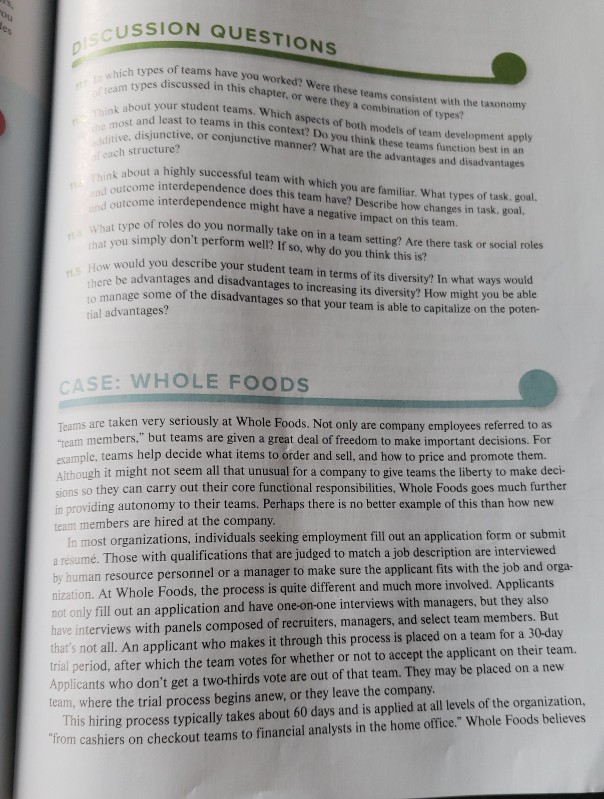
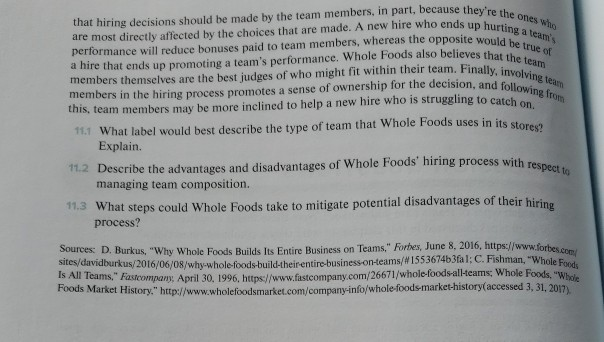
DISCUSSION QUESTIONS ash str ture Which types of teams have you worked? Were these teams consistent with the taxonomy cam types discussed in this chapter, or were they a combination of types? ink about your student teams. Which aspects of both models of team development apply most and least to teams in this context? Do you think these teams function best in an ditive, disjunctive, or conjunctive manner? What are the advantages and disadvantages hink about a highly successful team with which you are familiar. What types of task, goal. nd outcome interdependence does this team have? Describe how changes in task, goal, doutcome interdependence might have a negative impact on this team. What type of roles do you normally take on in a team setting? Are there task or social roles that you simply don't perform well? If so, why do you think this is? How would you describe your student team in terms of its diversity? In what ways would there be advantages and disadvantages to increasing its diversity? How might you be able to manage some of the disadvantages so that your team is able to capitalize on the poten- tial advantages? CASE: WHOLE FOODS Teams are taken very seriously at Whole Foods. Not only are company employees referred to as "team members," but teams are given a great deal of freedom to make important decisions. For example, teams help decide what items to order and sell, and how to price and promote them. Although it might not seem all that unusual for a company to give teams the liberty to make deci- sions so they can carry out their core functional responsibilities, Whole Foods goes much further in providing autonomy to their teams. Perhaps there is no better example of this than how new team members are hired at the company. In most organizations, individuals seeking employment fill out an application form or submit a resume. Those with qualifications that are judged to match a job description are interviewed by human resource personnel or a manager to make sure the applicant fits with the job and orga- nization. At Whole Foods, the process is quite different and much more involved. Applicants not only fill out an application and have one-on-one interviews with managers, but they also have interviews with panels composed of recruiters, managers, and select team members. But that's not all. An applicant who makes it through this process is placed on a team for a 30-day trial period, after which the team votes for whether or not to accept the applicant on their team. Applicants who don't get a two-thirds vote are out of that team. They may be placed on a new team, where the trial process begins anew, or they leave the company. This hiring process typically takes about 60 days and is applied at all levels of the organization, "from cashiers on checkout teams to financial analysts in the home office." Whole Foods believes that hiring decisions should be made by the team members, in part, because they're the ones who performance will reduce bonuses paid to team members, whereas the opposite would be true of are most directly affected by the choices that are made. A new hire who ends up hurting a teams a hire that ends up promoting a team's performance. Whole Foods also believes that the team members themselves are the best judges of who might fit within their team. Finally, involving team members in the hiring process promotes a sense of ownership for the decision, and following from this team members may be more inclined to help a new hire who is struggling to catch on 11.1 What label would best describe the type of team that Whole Foods uses in its stores Explain. 11.2 Describe the advantages and disadvantages of Whole Foods' hiring process with respect to managing team composition. 11.3 What steps could Whole Foods take to mitigate potential disadvantages of their hiring process? Sources: D. Burkus, "Why Whole Foods Builds Its Entire Business on Teams," Forbes, June 8, 2016, https://www.forbes.com/ sites/davidburkus/2016/06/08/why-whole foods-build-theirentire business on-teams/#1553674b3fal: C. Fishman, "Whole Fonds Is All Teams." Fastcompany, April 30, 1996, https://www.fastcompany.com/26671/whole-foods-all-teams; Whole Foods, "Whole Foods Market History." http://www.wholefoodsmarket.com/company.info/whole foods-market-history(accessed 3, 31, 2017)Step by Step Solution
There are 3 Steps involved in it
1 Expert Approved Answer
Step: 1 Unlock

Question Has Been Solved by an Expert!
Get step-by-step solutions from verified subject matter experts
Step: 2 Unlock
Step: 3 Unlock
 Study Help