







Question: Pls do question for thumbs up ;) Assume that you are a prospective business partner of Target Corporation (TGT), a retailer of everyday essentials and
 Pls do question for thumbs up ;)
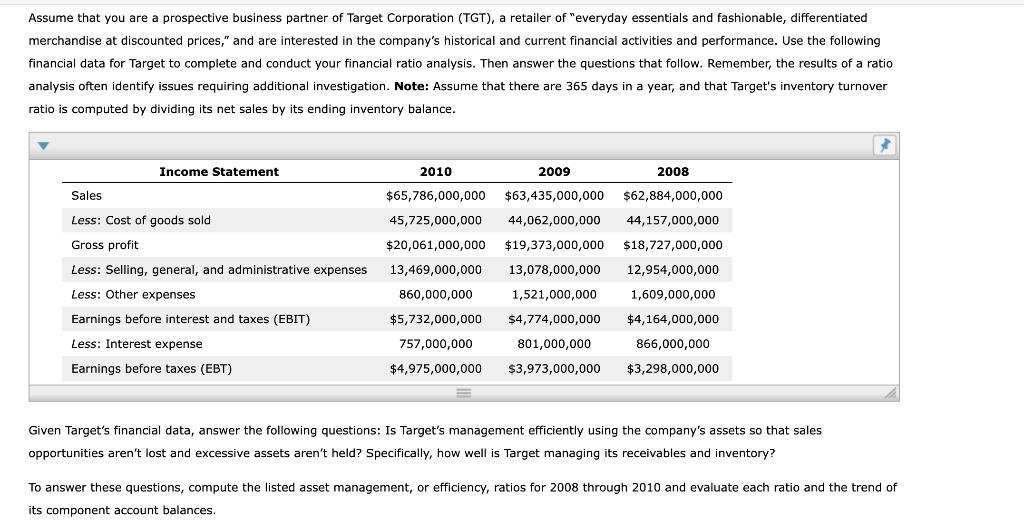
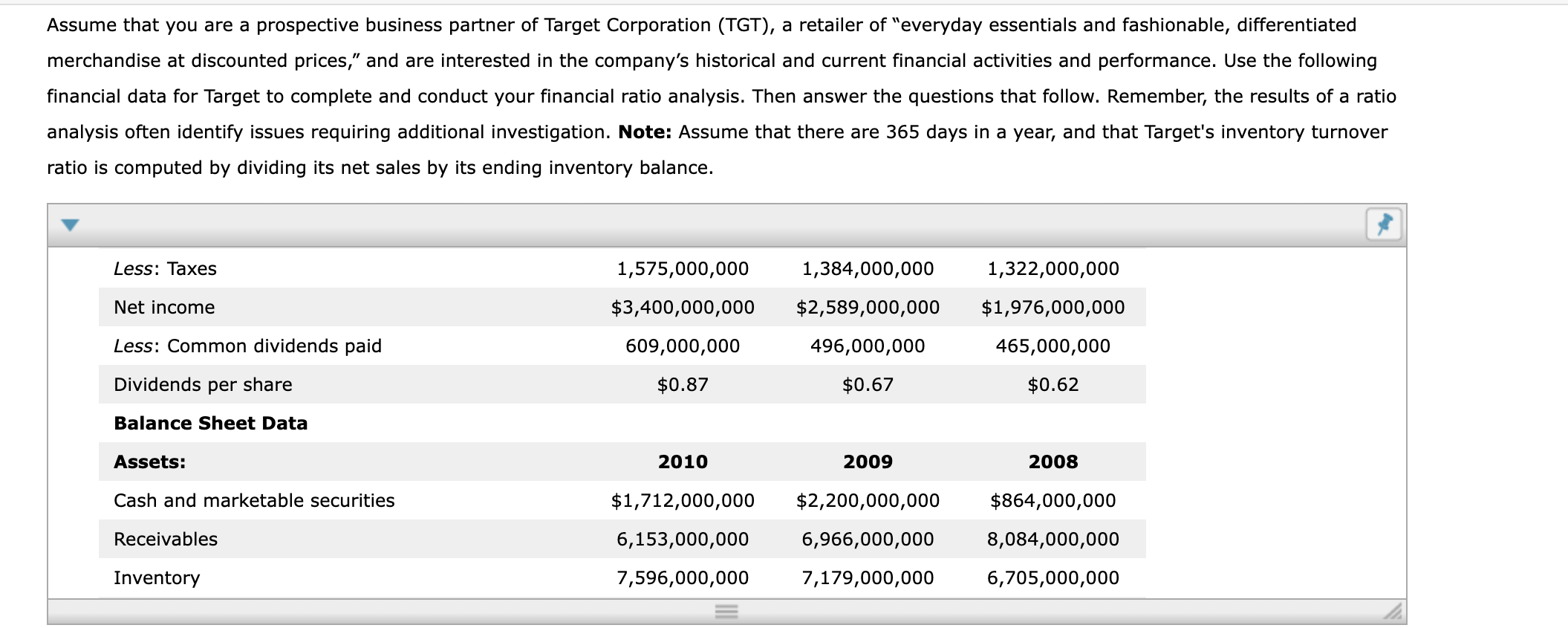
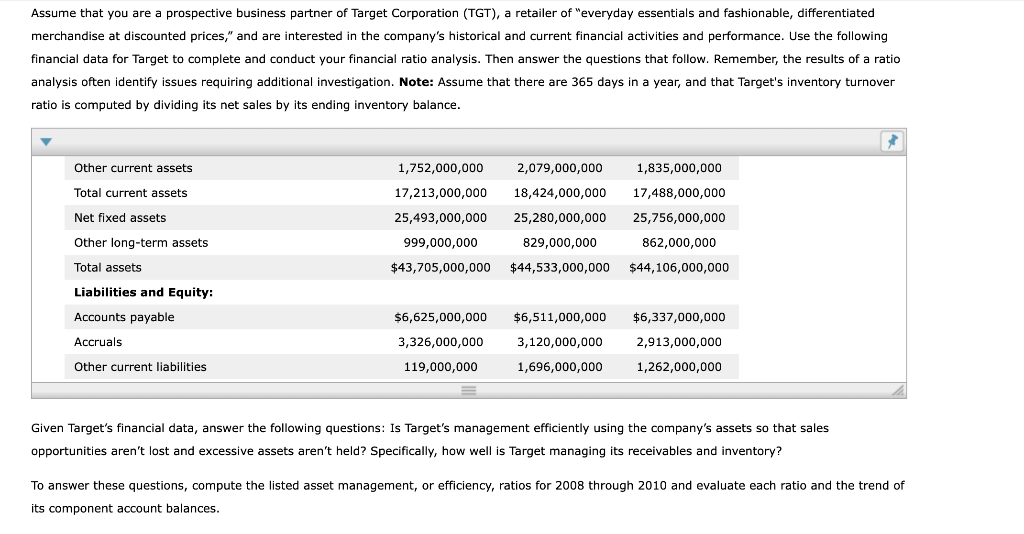
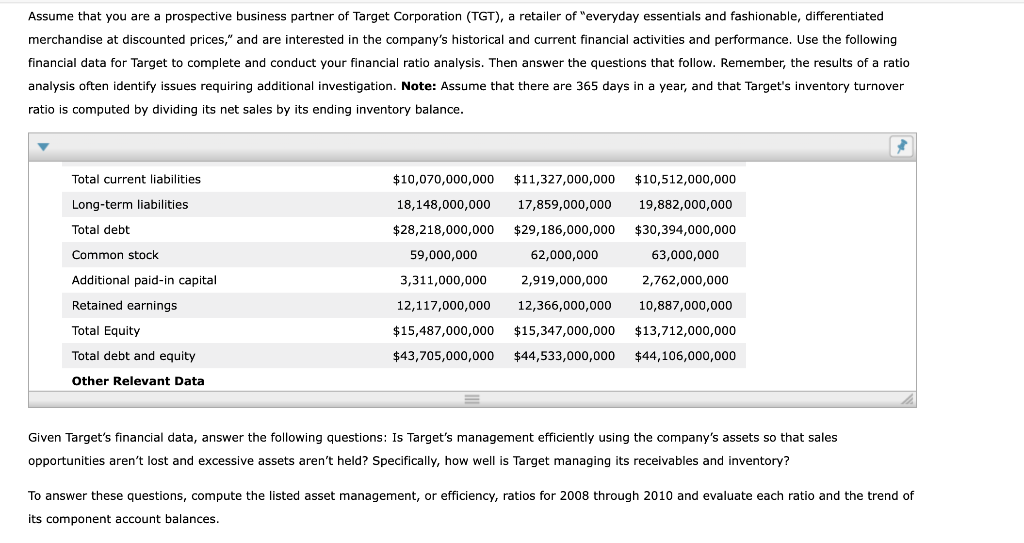
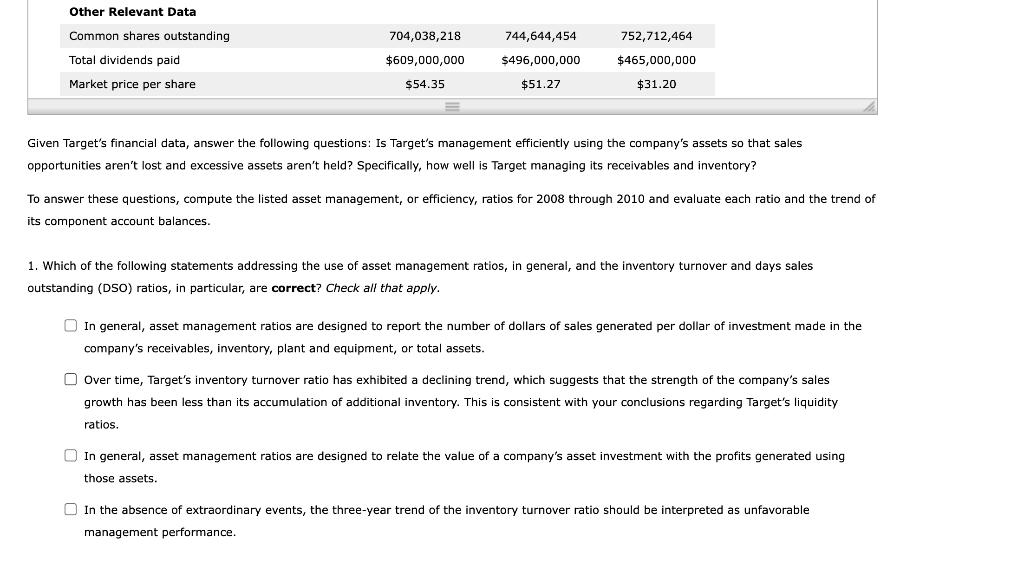
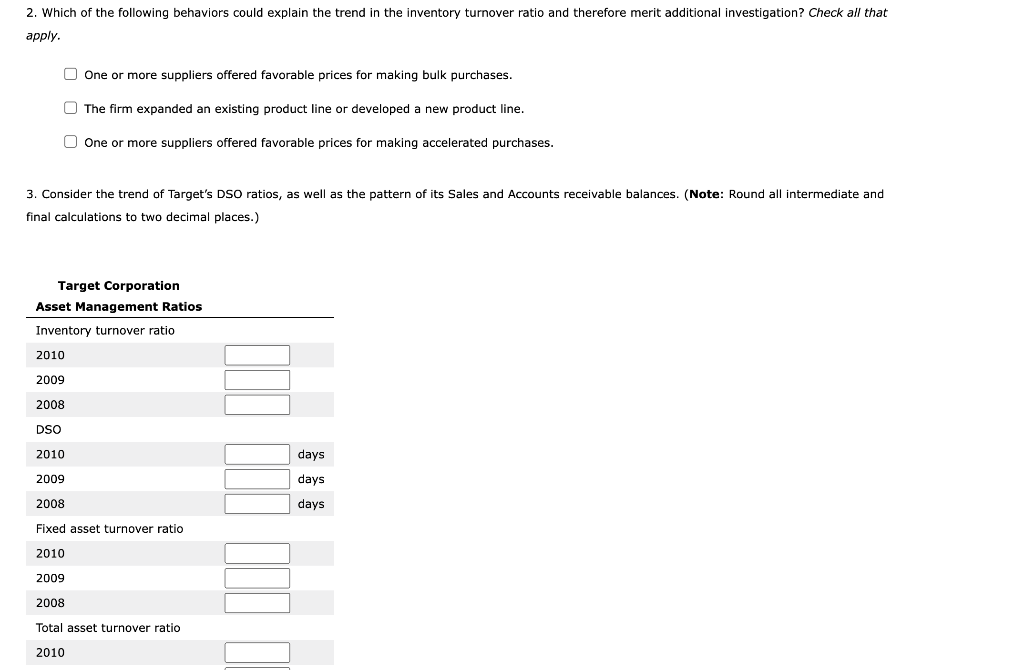
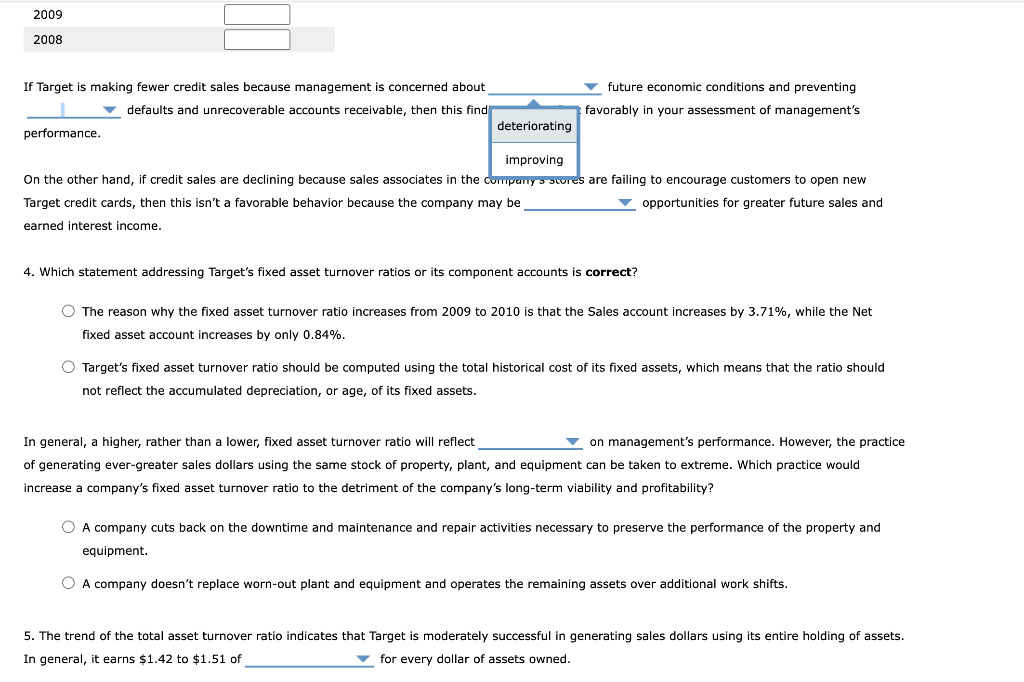
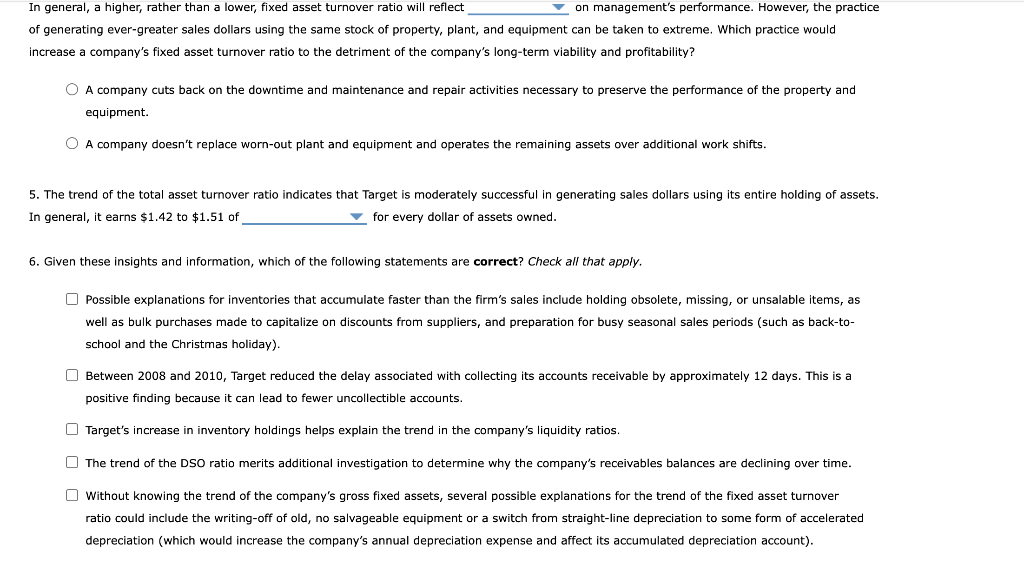
Assume that you are a prospective business partner of Target Corporation (TGT), a retailer of "everyday essentials and fashionable, differentiated merchandise at discounted prices," and are interested in the company's historical and current financial activities and performance. Use the following financial data for Target to complete and conduct your financial ratio analysis. Then answer the questions that follow. Remember, the results of a ratio analysis often identify issues requiring additional investigation. Note: Assume that there are 365 days in a year, and that Target's inventory turnover ratio is computed by dividing its net sales by its ending inventory balance. Given Target's financial data, answer the following questions: Is Target's management efficiently using the company's assets so that sales opportunities aren't lost and excessive assets aren't held? Specifically, how well is Target managing its receivables and inventory? To answer these questions, compute the listed asset management, or efficiency, ratios for 2008 through 2010 and evaluate each ratio and the trend of its component account balances. Assume that you are a prospective business partner of Target Corporation (TGT), a retailer of "everyday essentials and fashionable, differentiated merchandise at discounted prices," and are interested in the company's historical and current financial activities and performance. Use the following analysis often identify issues requiring additional investigation. Note: Assume that there are 365 days in a year, and that ratio is computed by dividing its net sales by its ending inventory balance. Assume that you are a prospective business partner of Target Corporation (TGT), a retailer of "everyday essentials and fashionable, differentiated merchandise at discounted prices," and are interested in the company's historical and current financial activities and performance. Use the following analysis often identify issues requiring additional investigation. Note: Assume that there are 365 days in a year, and that Target's inventory turnover ratio is computed by dividing its net sales by its ending inventory balance. Given Target's financial data, answer the following questions: Is Target's management efficiently using the company's assets so that sales opportunities aren't lost and excessive assets aren't held? Specifically, how well is Target managing its receivables and inventory? To answer these questions, compute the listed asset management, or efficiency, ratios for 2008 through 2010 and evaluate each ratio and the trend its component account balances. Assume that you are a prospective business partner of Target Corporation (TGT), a retailer of "everyday essentials and fashionable, differentiated merchandise at discounted prices," and are interested in the company's historical and current financial activities and performance. Use the following analysis often identify issues requiring additional investigation. Note: Assume that there are 365 days in a year, and that ratio is computed by dividing its net sales by its ending inventory balance. Given Target's financial data, answer the following questions: Is Target's management efficiently using the company's assets so that sales opportunities aren't lost and excessive assets aren't held? Specifically, how well is Target managing its receivables and inventory? To answer these questions, compute the listed asset management, or efficiency, ratios for 2008 through 2010 and evaluate each ratio and the trend of its component account balances. Given Target's financial data, answer the following questions: Is Target's management efficiently using the company's assets so that sales opportunities aren't lost and excessive assets aren't held? Specifically, how well is Target managing its receivables and inventory? To answer these questions, compute the listed asset management, or efficiency, ratios for 2008 through 2010 and evaluate each ratio and the trend of its component account balances. 1. Which of the following statements addressing the use of asset management ratios, in general, and the inventory turnover and days sales outstanding (DSO) ratios, in particular, are correct? Check all that apply. In general, asset management ratios are designed to report the number of dollars of sales generated per dollar investment made in the company's receivables, inventory, plant and equipment, or total assets. Over time, Target's inventory turnover ratio has exhibited a declining trend, which suggests that the strength of the company's sales growth has been less than its accumulation of additional inventory. This is consistent with your conclusions regarding Target's liquidity ratios. In general, asset management ratios are designed to relate the value of a company's asset investment with the profits generated using those assets. In the absence of extraordinary events, the three-year trend of the inventory turnover ratio should be interpreted as unfavorable management performance. 2. Which of the following behaviors could explain the trend in the inventory turnover ratio and therefore merit additional investigation? Check all that apply. One or more suppliers offered favorable prices for mas The firm expanded an existing product line or developed a new product One or more suppliers offered favorable prices for making accelerated 3. Consider the trend of Target's DSO ratios, as well as the pattern of its Sales and Accounts receivable balances. (Note: Round all intermediate and final calculations to two decimal places.) If Target is making fewer credit sales because management is concerned about defaults and unrecoverable accounts receivable, then this find performance. Target credit cards, then this isn't a favorable behavior because the company may be opportunities for greater future sales and earned interest income. 4. Which statement addressing Target's fixed asset turnover ratios or its component accounts is correct? The reason why the fixed asset turnover ratio increases from 2009 to 2010 is that the Sales account increases by 3.71%, while the Net fixed asset account increases by only 0.84%. Target's fixed asset turnover ratio should be computed using the total historical cost of its fixed assets, which means that the ratio should not reflect the accumulated depreciation, or age, of its fixed assets. In general, a higher, rather than a lower, fixed asset turnover ratio will reflect on management's performance. However, the practice of generating ever-greater sales dollars using the same stock of property, plant, and equipment can be taken to extreme. Which practice would increase a company's fixed asset turnover ratio to the detriment of the company's long-term viability and profitability? A company cuts back on the downtime and maintenance and repair activities necessary to preserve the performance of the property and equipment. A company doesn't replace worn-out plant and equipment and operates the remaining assets over additional work shifts. 5. The trend of the total asset turnover ratio indicates that Target is moderately successful in generating sales dollars using its entire holding of assets. In general, it earns $1.42 to $1.51 of for every dollar of assets owned. In general, a higher, rather than a lower, fixed asset turnover ratio will reflect on management's performance. However, the practice of generating ever-greater sales dollars using the same stock of property, plant, and equipment can be taken to extreme. Which practice would increase a company's fixed asset turnover ratio to the detriment of the company's long-term viability and profitability? A company cuts back on the downtime and maintenance and repair activities necessary to preserve the performance of the property and equipment. A company doesn't replace worn-out plant and equipment and operates the remaining assets over additional work shifts. 5. The trend of the total asset turnover ratio indicates that Target is moderately successful in generating sales dollars using its entire holding of assets. In general, it earns $1.42 to $1.51 of for every dollar of assets owned. 6. Given these insights and information, which of the following statements are correct? Check all that apply. Possible explanations for inventories that accumulate faster than the firm's sales include holding obsolete, missing, or unsalable items, as school and the Christmas holiday). Between 2008 and 2010, Target reduced the delay associated with collecting its accounts receivable by approximately 12 days. This is a positive finding because it can lead to fewer uncollectible accounts. Target's increase in inventory holdings helps explain the trend in the company's liquidity ratios. The trend of the DSO ratio merits additional investigation to determine why the company's receivables balances are declining over time. Without knowing the trend of the company's gross fixed assets, several possible explanations for the trend of the fixed asset turnover ratio could include the writing-off of old, no salvageable equipment or a switch from straight-line depreciation to some form of accelerated depreciation (which would increase the company's annual depreciation expense and affect its accumulated depreciation account). Assume that you are a prospective business partner of Target Corporation (TGT), a retailer of "everyday essentials and fashionable, differentiated merchandise at discounted prices," and are interested in the company's historical and current financial activities and performance. Use the following financial data for Target to complete and conduct your financial ratio analysis. Then answer the questions that follow. Remember, the results of a ratio analysis often identify issues requiring additional investigation. Note: Assume that there are 365 days in a year, and that Target's inventory turnover ratio is computed by dividing its net sales by its ending inventory balance. Given Target's financial data, answer the following questions: Is Target's management efficiently using the company's assets so that sales opportunities aren't lost and excessive assets aren't held? Specifically, how well is Target managing its receivables and inventory? To answer these questions, compute the listed asset management, or efficiency, ratios for 2008 through 2010 and evaluate each ratio and the trend of its component account balances. Assume that you are a prospective business partner of Target Corporation (TGT), a retailer of "everyday essentials and fashionable, differentiated merchandise at discounted prices," and are interested in the company's historical and current financial activities and performance. Use the following analysis often identify issues requiring additional investigation. Note: Assume that there are 365 days in a year, and that ratio is computed by dividing its net sales by its ending inventory balance. Assume that you are a prospective business partner of Target Corporation (TGT), a retailer of "everyday essentials and fashionable, differentiated merchandise at discounted prices," and are interested in the company's historical and current financial activities and performance. Use the following analysis often identify issues requiring additional investigation. Note: Assume that there are 365 days in a year, and that Target's inventory turnover ratio is computed by dividing its net sales by its ending inventory balance. Given Target's financial data, answer the following questions: Is Target's management efficiently using the company's assets so that sales opportunities aren't lost and excessive assets aren't held? Specifically, how well is Target managing its receivables and inventory? To answer these questions, compute the listed asset management, or efficiency, ratios for 2008 through 2010 and evaluate each ratio and the trend its component account balances. Assume that you are a prospective business partner of Target Corporation (TGT), a retailer of "everyday essentials and fashionable, differentiated merchandise at discounted prices," and are interested in the company's historical and current financial activities and performance. Use the following analysis often identify issues requiring additional investigation. Note: Assume that there are 365 days in a year, and that ratio is computed by dividing its net sales by its ending inventory balance. Given Target's financial data, answer the following questions: Is Target's management efficiently using the company's assets so that sales opportunities aren't lost and excessive assets aren't held? Specifically, how well is Target managing its receivables and inventory? To answer these questions, compute the listed asset management, or efficiency, ratios for 2008 through 2010 and evaluate each ratio and the trend of its component account balances. Given Target's financial data, answer the following questions: Is Target's management efficiently using the company's assets so that sales opportunities aren't lost and excessive assets aren't held? Specifically, how well is Target managing its receivables and inventory? To answer these questions, compute the listed asset management, or efficiency, ratios for 2008 through 2010 and evaluate each ratio and the trend of its component account balances. 1. Which of the following statements addressing the use of asset management ratios, in general, and the inventory turnover and days sales outstanding (DSO) ratios, in particular, are correct? Check all that apply. In general, asset management ratios are designed to report the number of dollars of sales generated per dollar investment made in the company's receivables, inventory, plant and equipment, or total assets. Over time, Target's inventory turnover ratio has exhibited a declining trend, which suggests that the strength of the company's sales growth has been less than its accumulation of additional inventory. This is consistent with your conclusions regarding Target's liquidity ratios. In general, asset management ratios are designed to relate the value of a company's asset investment with the profits generated using those assets. In the absence of extraordinary events, the three-year trend of the inventory turnover ratio should be interpreted as unfavorable management performance. 2. Which of the following behaviors could explain the trend in the inventory turnover ratio and therefore merit additional investigation? Check all that apply. One or more suppliers offered favorable prices for mas The firm expanded an existing product line or developed a new product One or more suppliers offered favorable prices for making accelerated 3. Consider the trend of Target's DSO ratios, as well as the pattern of its Sales and Accounts receivable balances. (Note: Round all intermediate and final calculations to two decimal places.) If Target is making fewer credit sales because management is concerned about defaults and unrecoverable accounts receivable, then this find performance. Target credit cards, then this isn't a favorable behavior because the company may be opportunities for greater future sales and earned interest income. 4. Which statement addressing Target's fixed asset turnover ratios or its component accounts is correct? The reason why the fixed asset turnover ratio increases from 2009 to 2010 is that the Sales account increases by 3.71%, while the Net fixed asset account increases by only 0.84%. Target's fixed asset turnover ratio should be computed using the total historical cost of its fixed assets, which means that the ratio should not reflect the accumulated depreciation, or age, of its fixed assets. In general, a higher, rather than a lower, fixed asset turnover ratio will reflect on management's performance. However, the practice of generating ever-greater sales dollars using the same stock of property, plant, and equipment can be taken to extreme. Which practice would increase a company's fixed asset turnover ratio to the detriment of the company's long-term viability and profitability? A company cuts back on the downtime and maintenance and repair activities necessary to preserve the performance of the property and equipment. A company doesn't replace worn-out plant and equipment and operates the remaining assets over additional work shifts. 5. The trend of the total asset turnover ratio indicates that Target is moderately successful in generating sales dollars using its entire holding of assets. In general, it earns $1.42 to $1.51 of for every dollar of assets owned. In general, a higher, rather than a lower, fixed asset turnover ratio will reflect on management's performance. However, the practice of generating ever-greater sales dollars using the same stock of property, plant, and equipment can be taken to extreme. Which practice would increase a company's fixed asset turnover ratio to the detriment of the company's long-term viability and profitability? A company cuts back on the downtime and maintenance and repair activities necessary to preserve the performance of the property and equipment. A company doesn't replace worn-out plant and equipment and operates the remaining assets over additional work shifts. 5. The trend of the total asset turnover ratio indicates that Target is moderately successful in generating sales dollars using its entire holding of assets. In general, it earns $1.42 to $1.51 of for every dollar of assets owned. 6. Given these insights and information, which of the following statements are correct? Check all that apply. Possible explanations for inventories that accumulate faster than the firm's sales include holding obsolete, missing, or unsalable items, as school and the Christmas holiday). Between 2008 and 2010, Target reduced the delay associated with collecting its accounts receivable by approximately 12 days. This is a positive finding because it can lead to fewer uncollectible accounts. Target's increase in inventory holdings helps explain the trend in the company's liquidity ratios. The trend of the DSO ratio merits additional investigation to determine why the company's receivables balances are declining over time. Without knowing the trend of the company's gross fixed assets, several possible explanations for the trend of the fixed asset turnover ratio could include the writing-off of old, no salvageable equipment or a switch from straight-line depreciation to some form of accelerated depreciation (which would increase the company's annual depreciation expense and affect its accumulated depreciation account)
Step by Step Solution
There are 3 Steps involved in it

Get step-by-step solutions from verified subject matter experts
 Study Help