







Question: pls help me to answer Tutorial for Internal Control Henry & Williams (HW) Bank is the largest bank in its own country by market value.
pls help me to answer
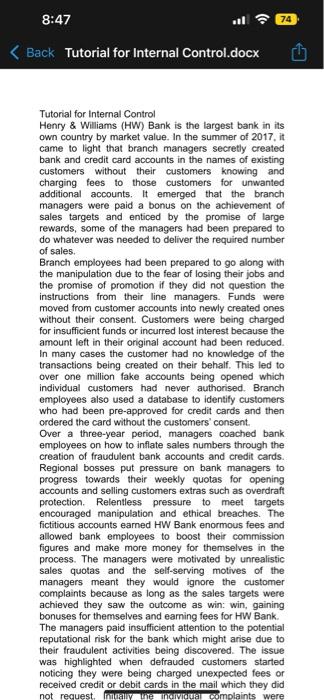
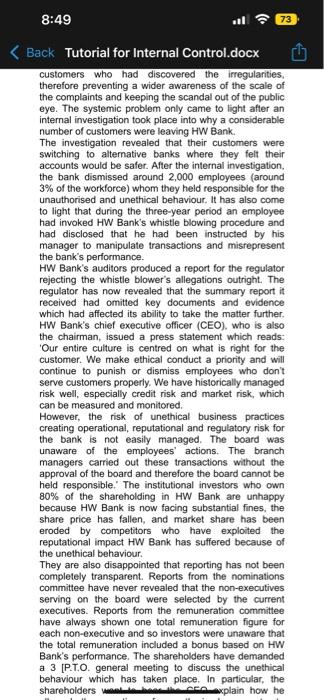
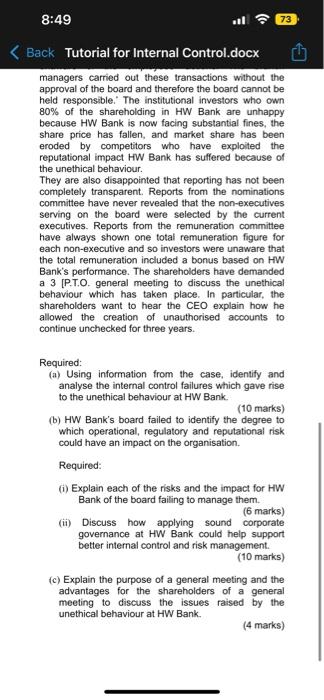
Tutorial for Internal Control Henry \& Williams (HW) Bank is the largest bank in its own country by market value. In the summer of 2017, it came to light that branch managers secretly created bank and credit card accounts in the names of existing customers without their customers knowing and charging fees to those customers for unwanted additional accounts. It emerged that the branch managers were paid a bonus on the achievement of sales targets and enticed by the promise of large rewards, some of the managers had been prepared to do whatever was needed to deliver the required number of sales. Branch employees had been prepared to go along with the manipulation due to the fear of losing their jobs and the promise of promotion if they did not question the instructions from their line managers. Funds were moved from customer accounts into newly created ones without their consent. Customers were being charged for insufficient funds or incurred lost interest because the amount left in their original account had been reduced. In many cases the customer had no knowledge of the transactions being created on their behalf. This led to over one million fake accounts being opened which individual customers had never authorised. Branch employees also used a database to identify customers who had been pre-approved for credit cards and then ordered the card without the customers' consent. Over a three-year period, managers coached bank employees on how to inflate sales numbers through the creation of fraudulent bank accounts and credit cards. Regional bosses put pressure on bank managers to progress towards their weekly quotas for opening accounts and selling customers extras such as overdraft protection. Relentless pressure to meet targets encouraged manipulation and ethical breaches. The fictitious accounts eamed HW Bank enormous fees and allowed bank employees to boost their commission figures and make more money for themselves in the process. The managers were motivated by unrealistic sales quotas and the self-serving motives of the managers meant they would ignore the customer complaints because as long as the sales targets were achieved they saw the outcome as win: win, gaining bonuses for themselves and eaming fees for HW Bank. The managers paid insufficient attention to the potential reputational risk for the bank which might arise due to their fraudulent activities being discovered. The issue was highlighted when defrauded customers started noticing they were being charged unexpected fees or received credit or debit cards in the mail which they did customers who had discovered the irregularities, therefore preventing a wider awareness of the scale of the complaints and keeping the scandal out of the public eye. The systemic problem only came to light after an internal investigation took place into why a considerable number of customers were leaving HW Bank. The investigation revealed that their customers were switching to altemative banks where they felt their accounts would be safer. After the internal investigation, the bank dismissed around 2,000 employees (around 3% of the workforce) whom they held responsible for the unauthorised and unethical behaviour. It has also come to light that during the three-year period an employee had invoked HW Bank's whistle blowing procedure and had disclosed that he had been instructed by his manager to manipulate transactions and misrepresent the bank's performance. HW Bank's auditors produced a report for the regulator rejecting the whistle blower's allegations outright. The regulator has now revealed that the summary report it received had omitted key documents and evidence which had affected its ability to take the matter further. HW Bank's chief executive officer (CEO). Who is also the chairman, issued a press statement which reads: 'Our entire culture is centred on what is right for the customer. We make ethical conduct a priority and will continue to punish or dismiss employees who don't serve customers properly. We have historically managed risk well, especially credit risk and market risk, which can be measured and monitored. However, the risk of unethical business practices creating operational, reputational and regulatory risk for the bank is not easily managed. The board was unaware of the employees' actions. The branch managers carried out these transactions without the approval of the board and therefore the board cannot be heid responsible. "The institutional investors who own 80% of the shareholding in HW Bank are unhappy because HW Bank is now facing substantial fines, the share price has fallen, and market share has been reputational impact HW Bank has suffered because of the unethical behaviour. They are also disappointed that reporting has not been completely transparent. Reports from the nominations committee have never revealed that the non-executives serving on the board were selected by the current executives. Reports from the remuneration committee have always shown one total remuneration figure for each non-executive and so investors were unaware that the total remuneration included a bonus based on HW Bank's performance. The shareholders have demanded a 3 [P.T.O. general meeting to discuss the unethical behaviour which has taken place, In particular, the shareholders a how he approval of the board and therefore the board cannot be heid responsible." The institutional investors who own 80% of the shareholding in HW Bank are unhappy because HW Bank is now facing substantial fines, the share price has fallen, and market share has been eroded by competitors who have exploited the reputational impact HW Bank has suffered because of the unethical behaviour. They are also disappointed that reporting has not been completely transparent. Reports from the nominations committee have never revealed that the non-executives serving on the board were selected by the current executives. Reports from the remuneration committee have always shown one total remuneration figure for each non-executive and so investors were unaware that the total remuneration included a bonus based on HW Bank's performance. The shareholders have demanded a 3 [P.T.O. general meeting to discuss the unethical behaviour which has taken place. In particular, the shareholders want to hear the CEO explain how he allowed the creation of unauthorised accounts to continue unchecked for three years. Required: (a) Using information from the case, identify and analyse the internal control failures which gave rise to the unethical behaviour at HW Bank. (10 marks) (b) HW Bank's board failed to identify the degree to which operational, regulatory and reputational risk could have an impact on the organisation. Required: (i) Explain each of the risks and the impact for HW Bank of the board failing to manage them. (6 marks) (ii) Discuss how applying sound corporate governance at HW Bank could help support better internal control and risk management. (10 marks) (c) Explain the purpose of a general meeting and the advantages for the shareholders of a general meeting to discuss the issues raised by the unethical behaviour at HW Bank. (4 marks) Step by Step Solution
There are 3 Steps involved in it
1 Expert Approved Answer
Step: 1 Unlock

Question Has Been Solved by an Expert!
Get step-by-step solutions from verified subject matter experts
Step: 2 Unlock
Step: 3 Unlock
 Study Help