



Question: pls solve in steps 9. If I have a particle that does not experience any sort of potential energy (all energy is kinetic), then the
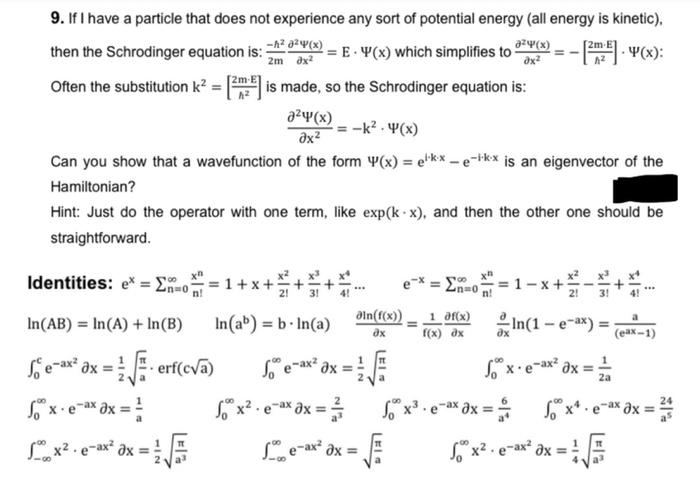
9. If I have a particle that does not experience any sort of potential energy (all energy is kinetic), then the Schrodinger equation is: 2mh2x22(x)=E(x) which simplifies to x22(x)=[22mE](x) : Often the substitution k2=[h22mE] is made, so the Schrodinger equation is: x22(x)=k2(x) Can you show that a wavefunction of the form (x)=eikxeikx is an eigenvector of the Hamiltonian? Hint: Just do the operator with one term, like exp(kx), and then the other one should be straightforward. Identities: ex=n=0n!xn=1+x+2!x2+3!x3+4!x4ex=n=0n!xn=1x+2!x23!x3+4!x4 ln(AB)=ln(A)+ln(B)ln(ab)=bln(a)xln(f(x))=f(x)1xf(x)xln(1eax)=(eax1)a 0ceax2x=21aerf(ca)0eax2x=21a0xeax2x=2a1 0xeaxx=a10x2eaxx=a320x3eaxx=a460x4eaxx=a524 x2eax2x=21a3eax2x=a0x2eax2x=41a3
Step by Step Solution
There are 3 Steps involved in it

Get step-by-step solutions from verified subject matter experts