



Question: plwase explain and show work why answer is A for number 15 13) When a lender refuses to make a loan, although borrowers are willing
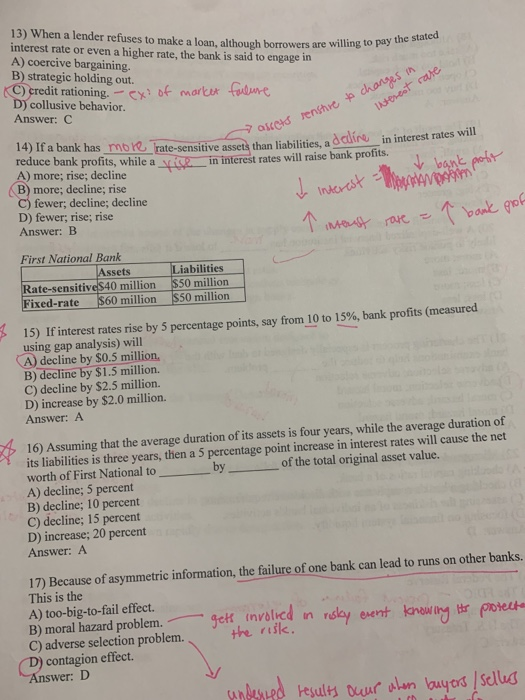
13) When a lender refuses to make a loan, although borrowers are willing to pay interest rate or even a higher rate, the bank is said to engage in A) coercive bargaining. B) strategic holding out. predit rationing.yi of mortur fedune collusive behavior Answer: C 14) If a bank has moe rate-sensitive assets than liabilities, a nk nofits itive assets than liabilties, a d cdire in interest rates will reduce bank profits, while a A) more; rise; decline B more; decline; rise yin interest rates will raise bank profits. fewer; decline; decline D) fewer; rise; rise Answer: B First National Bank iabilities $50 million $50 million ssets Rate-sensitiveS40 million Fixed-rate $60 million 15) If interest rates rise by 5 percentage points, say from 10 to 15%, bank profits (measured using gap analysis) wil A) decline by $0.5 million B) decline by $1.5 million. C) decline by $2.5 million. D) increase by $2.0 million. Answer: A 16) Assuming that the average duration of its assets is four years, while the average duration of its liabilities is three years, then a 5 percentage point increase in interest rates will cause the net worth of First National to_byof the total original asset value. A) decline; 5 percent B) decline; 10 percent C) decline; 15 percent D) increase; 20 percent Answer: A 17) Because of asymmetric information, the failure of one bank can lead to runs on other banks. This is the A) too-big-to-fail effect. B) moral hazard problem.jeh invalicd n rdly eent lonwing tr potet the rik C) adverse selection problem. D) contagion effect. : D
Step by Step Solution
There are 3 Steps involved in it

Get step-by-step solutions from verified subject matter experts